
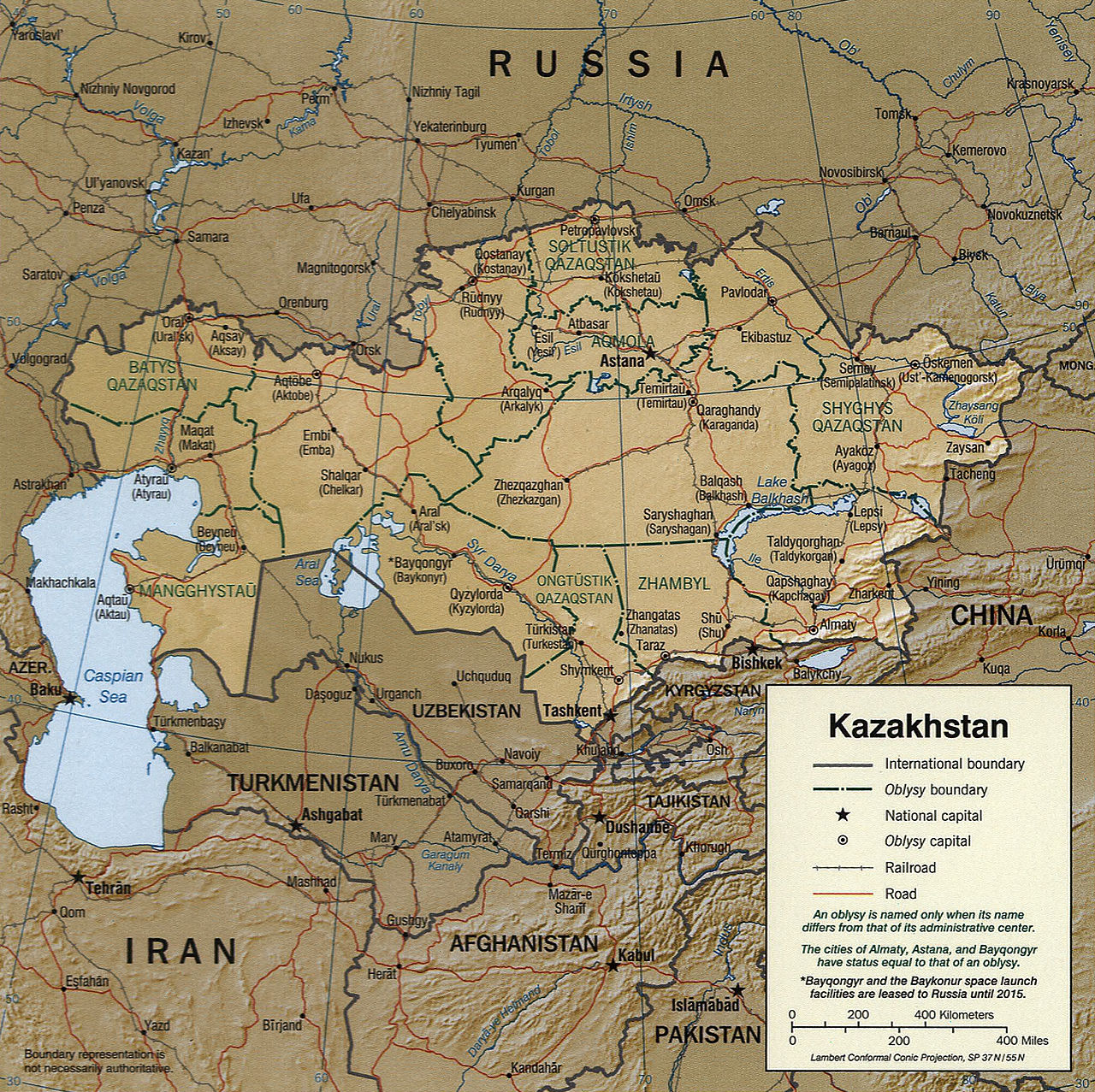
The major natural resources of Kazakhstan include oil, uranium, chromium, copper, and wheat. Kazakhstan is the world's largest uranium producer, accounting for roughly 43% of global output, and a major oil producer thanks to the giant Kashagan and Tengiz fields. With more than 5,000 mineral deposits valued at an estimated $46 trillion, it ranks among the most mineral-diverse nations on Earth.
Introduction
Stretching across 2.7 million square kilometres of steppe, desert, and mountain, Kazakhstan is the largest country in Central Asia and the ninth-largest in the world. Beneath that immense landmass lies a geological inheritance of extraordinary richness: more than 90 distinct minerals have been identified within its borders, ranging from energy fuels such as oil, gas, and coal to strategic metals like uranium, chromium, and copper.
This resource wealth has shaped Kazakhstan's economy, foreign policy, and environment alike. From the Soviet-era Virgin Lands grain campaign to the modern uranium boom led by state company Kazatomprom, the story of Kazakhstan is in many ways the story of how a nation extracts, exports, and manages the raw materials that the rest of the world depends upon. For a wider picture of the nation, see our Kazakhstan country guide.

Major Mineral Resources
If any single resource defines Kazakhstan on the global stage, it is uranium. The country dominates world production through its state-owned company Kazatomprom, which operates a network of mines concentrated in the south and relies heavily on in-situ leaching, a lower-cost extraction method that dissolves the ore underground. In 2023 Kazakhstan produced more than 21,000 tonnes of uranium, nearly double the output of second-place Canada, and supplied roughly 43% of the global total. That single statistic makes Kazakhstan indispensable to the nuclear power industry worldwide.
Beyond uranium, the country's metallic endowment is remarkable in both depth and variety:
- Uranium: World's largest producer, around 43% of global output.
- Chromium: Second-largest reserves on Earth, centred on the Donskoy chromite deposit in the Aktobe region.
- Copper: Major producer, with the historic Zhezkazgan and Kounrad mines.
- Zinc: A significant global producer alongside lead.
- Manganese and bauxite: Substantial reserves supporting steel and aluminium industries.
Taken together, Kazakhstan holds over 5,000 individual mineral deposits with a combined estimated value exceeding $46 trillion. Many of these deposits were so prized during the Soviet period that their precise locations and reserves were classified as state secrets for decades, a testament to how central the region's underground wealth was to the wider Soviet economy.
Energy Resources
Kazakhstan is the largest oil producer in Central Asia, pumping more than 1.8 million barrels per day and sitting on roughly 30 billion barrels of proven reserves. The crown jewel is the Kashagan field beneath the shallow waters of the Caspian Sea, one of the largest oil discoveries of recent decades, with estimated reserves of around 13 billion barrels. Onshore, the Tengiz field, operated by Chevron, has been producing since 1993 and remains a backbone of national output.
- Oil: About 30 billion barrels of proven reserves, led by the offshore Kashagan field.
- Natural gas: Major reserves at Karachaganak and Tengiz.
- Coal: Vast deposits in the Karaganda and Ekibastuz basins.
- Hydropower: Generated along the Irtysh and Ili river systems.
- Renewables: Ambitious wind and solar targets across the open steppe.
Coal has underpinned the economy for generations, with the Ekibastuz and Karaganda basins ranking among the country's largest producers and fuelling much of its domestic electricity. Looking ahead, Kazakhstan is steadily diversifying its energy mix, targeting 15% of electricity generation from renewable sources by 2030. Its endless, wind-swept grasslands and high levels of solar irradiation make the steppe an ideal canvas for large-scale wind farms and solar arrays.
Agricultural Resources
While minerals and hydrocarbons dominate the headlines, Kazakhstan is also a serious agricultural power. The northern steppe forms a continuous grain belt that places the country among the world's top ten wheat exporters, with annual production typically ranging from 15 to 20 million tonnes. These vast grasslands were first ploughed for large-scale cultivation during the Soviet Virgin Lands Campaign of the 1950s, an ambitious and environmentally fraught project that transformed the landscape.
- Wheat: The flagship crop of the northern steppe grain belt and a major export.
- Cotton: Grown in the southern regions near the Uzbekistan border.
- Cattle and sheep: Raised across extensive steppe grazing lands.
- Horse meat: A traditional product of enduring cultural and economic importance.
- Wool: A major output from the country's large sheep flocks.
In the warmer south, farmers cultivate cotton, grow rice along the Syr Darya river, and tend fruit orchards. Across the open plains, extensive grazing supports large herds of cattle, sheep, and horses. Kazakhstan's deep-rooted horse-meat culture means equine products remain both a culinary staple and a meaningful contributor to rural livelihoods.
Water and Forest Resources
Water is at once a vital asset and Kazakhstan's most acute environmental vulnerability. The Caspian Sea, the world's largest enclosed body of water, forms the western border and hosts the country's offshore oil industry. Inland, the Irtysh River in the northeast and the Ili River feeding Lake Balkhash are the most important freshwater systems, while the Syr Darya sustains agriculture in the south.
- Caspian Sea: The world's largest enclosed body of water, along the western border.
- Freshwater rivers: The Irtysh, Ili, and Syr Darya.
- Aral Sea: A former inland sea now largely dry, the site of an ecological disaster.
- Forests: Roughly 13 million hectares, mostly in the mountains.
The shrinking of the Aral Sea stands as one of the planet's worst human-made environmental catastrophes. Once the world's fourth-largest lake, it has lost more than 90% of its volume after decades of Soviet-era irrigation diversions, though restoration efforts have partially revived its northern section. Forests cover about 5% of national territory, concentrated in the Altai and Tien Shan ranges, while the dramatic Charyn Canyon shelters relict ash-tree forests that survived the last Ice Age and date back some five million years.
How Kazakhstan Compares to Similar Nations
Kazakhstan's resource profile blends features of several different kinds of commodity economies. As an oil exporter it invites comparison with Russia, its northern neighbour, though Russia's reserves and production dwarf Kazakhstan's; the two also share legacy Soviet infrastructure and pipeline routes. As a uranium giant, Kazakhstan stands in a league of its own, comfortably out-producing Canada, the world's traditional second-place miner, and Australia, which holds the largest reserves but extracts far less.
Within Central Asia, Kazakhstan is the clear resource heavyweight: it produces more oil than neighbouring Uzbekistan or Turkmenistan, the latter of which leans far more heavily on natural gas. What distinguishes Kazakhstan from petro-states such as Saudi Arabia or gas-dependent Turkmenistan is the sheer breadth of its endowment. Few countries can simultaneously rank as a top-tier producer of uranium, oil, chromium, and wheat, giving Kazakhstan a more diversified and resilient foundation than economies tied to a single commodity.
Key Facts
- Uranium: Kazakhstan produces about 43% of the world's uranium, more than any other country.
- Kashagan field: One of the largest oil discoveries in decades, at roughly 13 billion barrels.
- Mineral wealth: Over 5,000 deposits worth an estimated $46 trillion.
- Wheat exports: Typically among the world's top ten exporters, producing 15-20 million tonnes annually.
- Oil output: More than 1.8 million barrels per day, the most in Central Asia.
- Aral Sea: Has shrunk by over 90%, among the world's worst environmental disasters.
- Land area: 2.7 million square kilometres, the largest country in Central Asia.
Frequently Asked Questions
What is Kazakhstan's most important natural resource?
Uranium and oil are the two most significant. Kazakhstan is the world's largest uranium producer, supplying around 43% of global output, while its oil reserves of roughly 30 billion barrels and production of over 1.8 million barrels per day make it Central Asia's leading petroleum exporter.
How much uranium does Kazakhstan produce?
Kazakhstan produced more than 21,000 tonnes of uranium in 2023, nearly twice the output of second-place Canada. Most of it is extracted by the state-owned company Kazatomprom using lower-cost in-situ leaching techniques in the south of the country.
Why is the Aral Sea considered an environmental disaster?
The Aral Sea was once the world's fourth-largest lake, but decades of Soviet-era irrigation diversions for cotton and rice cut off its inflow. It has since shrunk by more than 90%, devastating fisheries and local communities, though restoration projects have partly revived the northern section.
Is Kazakhstan a major agricultural producer?
Yes. The northern steppe grain belt makes Kazakhstan one of the world's top ten wheat exporters, producing 15-20 million tonnes a year. The country also raises large herds of cattle, sheep, and horses, with horse meat remaining a culturally important product.