
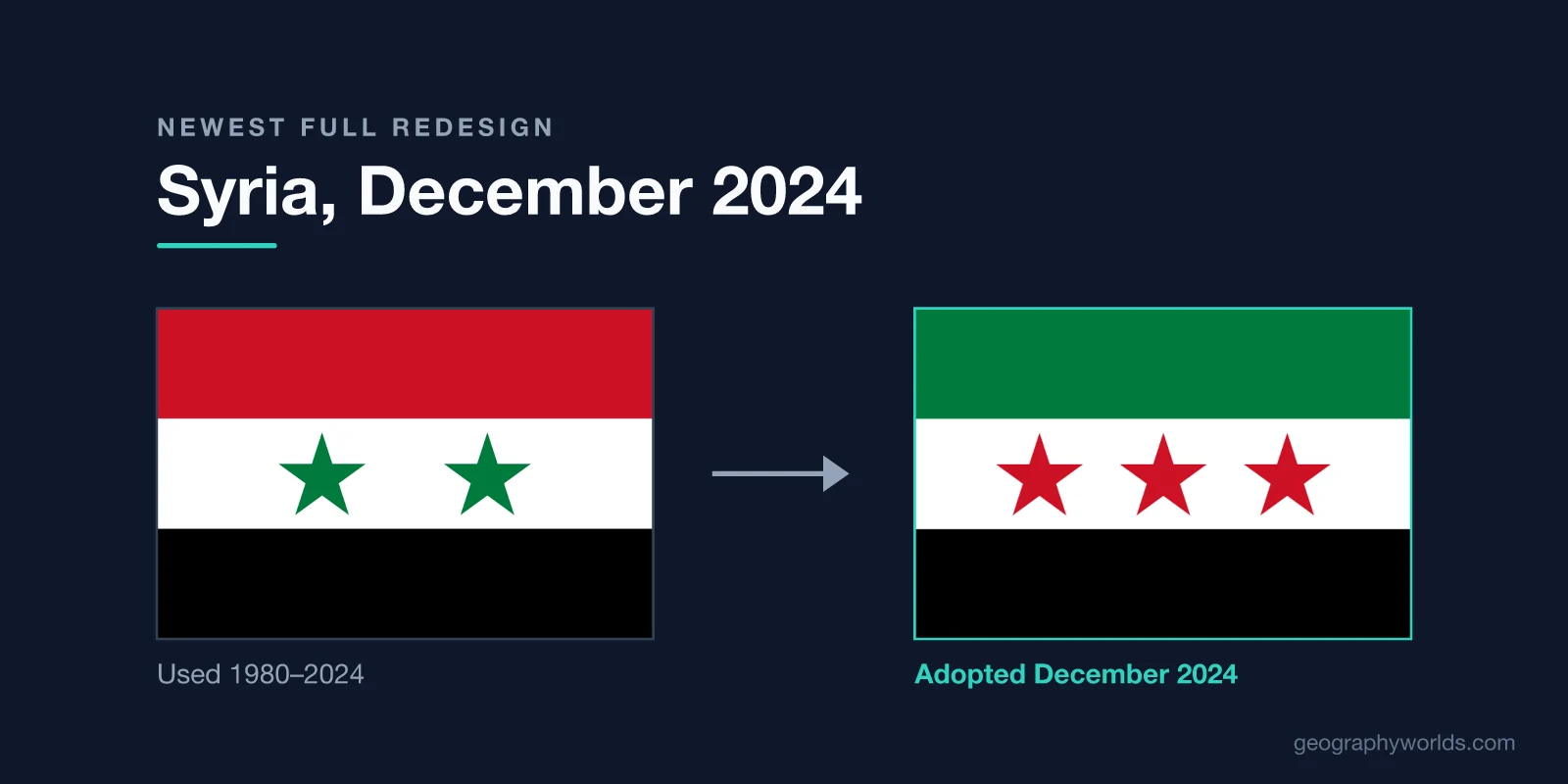
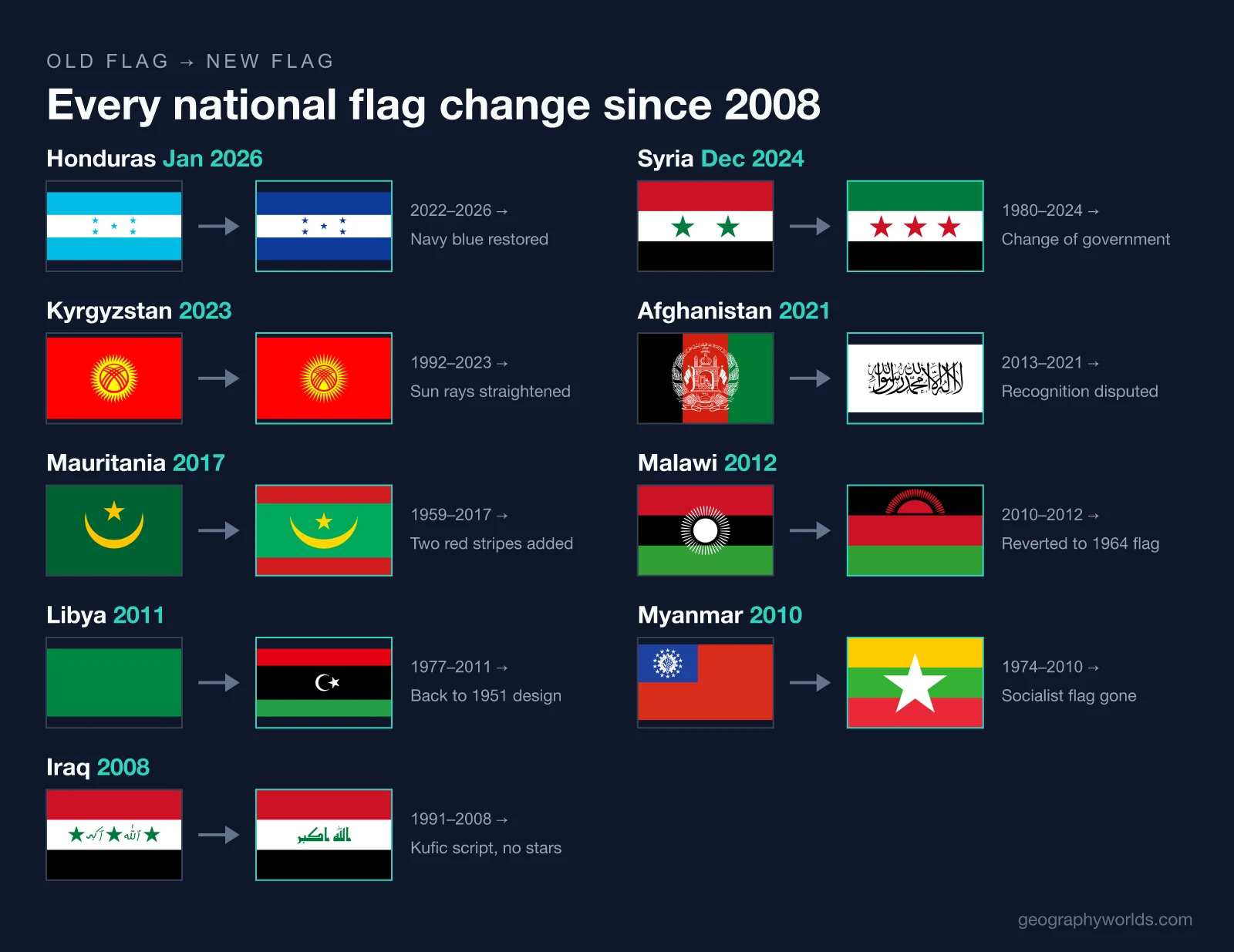
The most recent national flag change in the world is Honduras's: on 27 January 2026 the country restored the navy blue of its stripes, abandoning the turquoise flown since 2022. The newest flag design, as opposed to a change of shade, remains Syria's green, white and black tricolour with three red stars, raised in December 2024. Which one counts as "newest" depends on whether a colour change counts as a new flag — a question with no settled answer. Either way the field is small: eleven countries have changed their national flag since 2008.
Honduras Changed a Colour, Not a Design
Honduras made the most recent change of all, and it is the narrowest on this list: the blue of its two outer stripes went from turquoise back to navy on 27 January 2026, timed to the start of the new legislative period and the inauguration of President Nasry Asfura. Nothing else moved — same three stripes, same five blue stars in the centre for the five states of the former Federal Republic of Central America.
The argument behind it is older than either administration. Legislative Decree No. 29 of January 1949, still the governing text for the national symbols, describes the outer stripes as turquesa — turquoise. In practice Honduras flew a much darker navy for the next seven decades, until President Xiomara Castro's inauguration in January 2022 brought the flag into line with the letter of the decree. Four years later it went back. So the country now flies a shade the 1949 law does not literally specify, which is exactly what it did for most of the twentieth century.
Whether that is a flag change at all is a fair question, and it is why the answer to "what is the newest flag" splits in two. If any officially adopted alteration counts, Honduras is the most recent. If you mean a genuinely new design, Syria still holds it.
Syria's Tricolour Was Already Sixty Years Old
The design Syria adopted in December 2024 was not new. Three red stars on a green-white-black tricolour was the flag of the Syrian Republic at independence in 1932, flown until the country merged with Egypt to form the United Arab Republic in 1958. What replaced it then is the flag most of the world came to recognise: red, white and black with two green stars, one for each member of the union. Egypt left in 1961, but Syria kept returning to that design, readopting it permanently in 1980.
When the uprising began in 2011, opposition groups deliberately revived the 1932 flag, and for thirteen years the two designs functioned as rival claims to the same country — the two-star flag over government buildings, the three-star flag at protests and in exile. The Assad government fell on 8 December 2024, and within days the three-star flag was flying over Syrian embassies abroad. The stars are usually read as the three historic districts of Aleppo, Damascus and Deir ez-Zor.
The two flags were never merely decorative. Syrian embassies that defected to the opposition raised the three-star version as a declaration of allegiance, and for years the design a Syrian household flew was a statement about which authority it recognised. That is why the December 2024 handover was completed in days rather than legislated over months: there was no design competition to run, because the replacement had been flying somewhere in the country continuously since 2011. Our flag of Syria guide traces the full sequence.
Kyrgyzstan Argued About a Sunflower
Kyrgyzstan's 2023 change is the subtlest on this list, and the only one driven by aesthetics rather than politics. The flag keeps everything that identifies it: the red field, the golden sun with forty rays for the forty tribes united by the epic hero Manas, and at the centre the tunduk, the crossed wooden crown at the peak of a traditional yurt.
What changed was the rays. The original 1992 design gave them a wavy, curling profile, and legislators complained that from a distance the emblem read less as a sun than as a sunflower — a plant with no place in the national iconography and, some argued, a faintly comic one. Parliament passed the amendment in December 2023 and the president signed it, straightening the rays into clean triangular points. It was also the first alteration to the flag since Kyrgyzstan adopted it at independence in 1992, and it passed comfortably despite public grumbling that a parliament had found time for the shape of sunbeams. Set side by side the difference is obvious; seen alone, most people would not notice.
Afghanistan Has Two Flags, Depending on Who You Ask
The Taliban entered Kabul on 15 August 2021, and the white banner of the Islamic Emirate — a plain white field bearing the shahada, the Islamic declaration of faith, in black script — displaced the black, red and green tricolour the Islamic Republic had flown with its white national emblem centred on the red band. A decree followed requiring the white flag in all official settings and outlawing the tricolour.
Whether that counts as a national flag change depends on whose list you are reading, and the disagreement is the interesting part. The Islamic Emirate is not widely recognised, so the tricolour still represents Afghanistan's seat at the United Nations, still flies for its athletes at the Olympics, and is still what most flag databases return — ask a standard flag CDN for Afghanistan today and you get the tricolour, not the banner actually flying over Kabul. Inside the country the old flag has become a protest symbol. Two designs, two claims, and no settled answer, which is a situation none of the other changes here share.
Mauritania Voted on It
Mauritania is the only country here whose flag was changed by a direct popular vote. In August 2017 a referendum put two questions to voters at once: abolish the Senate, and redesign the flag. Both passed. Two red horizontal stripes were added, one along the top edge and one along the bottom, framing the green field with its gold crescent and star.
The official explanation is that the red represents the blood shed by those who resisted French colonial rule — a symbolism the previous flag, unchanged since 1959, carried nowhere on it. The crescent and star, and the green they sit on, were left exactly as they were. It is an addition rather than a replacement, which is why the flag remains instantly recognisable as Mauritania's.
Three Flags Fell in Eighteen Months
Between October 2010 and July 2011 three countries raised new flags, for three different reasons.
Myanmar went first, on 21 October 2010, retiring its socialist-era flag — red with a blue canton containing a cogwheel and rice ears — days before a general election, as part of the constitutional settlement drafted in 2008. The replacement is a yellow, green and red horizontal tricolour with a large white star across the centre.
Libya followed in 2011. Under Gaddafi the country had flown a plain green rectangle since 1977 — no emblem, no second colour, the only single-colour national flag in the world. When the government fell, Libya readopted the flag of the 1951 kingdom: red, black and green bands with a white crescent and star, the black band twice the depth of the others. It is one of the few cases where a revolution restored an older flag rather than commissioning a new one, and our flag of Libya guide covers why that design carried such weight.
South Sudan is the outlier, because it did not replace anything. On 9 July 2011 it became a sovereign state and raised a flag the Sudan People's Liberation Movement had used for decades: black, red and green bands divided by thin white stripes, with a blue triangle at the hoist carrying a gold star. It remains the most recent flag raised by a genuinely new country — Kosovo had done the same on 17 February 2008, adopting a blue field with a gold map of its territory beneath six white stars, deliberately free of the symbolism of any one ethnic group. Both are a different milestone from the most recent redesign — see the newest countries in the world for how rarely that now happens.
Malawi Changed Its Flag, Then Changed It Back
Malawi is the only country here to have done it twice. In July 2010 parliament replaced the independence flag of 1964 — black, red and green bands with a red rising sun on the black — with a rearranged design that put red on top and swapped the rising sun for a full white sun of forty-five rays, presented as a claim that the country had moved past the dawn of independence into full development.
It was never popular. Critics called it Bingu's flag, after President Bingu wa Mutharika, and objected that it had been pushed through without real consultation. When he died in office in April 2012 the argument ended quickly: on 28 May 2012 parliament voted to restore the 1964 design, and Malawi has flown it since. The interim flag lasted under two years — the shortest life of any national flag in this period.
Iraq Has Been Editing the Same Flag for Sixty Years
Iraq's 2008 change is best understood as one edit in a long sequence. The red-white-black tricolour with three green stars dates from 1963. In January 1991, days before the air campaign of the Gulf War began, Saddam Hussein added the takbir — Allahu Akbar, "God is greatest" — in green between the stars, reportedly in his own handwriting.
After 2003 that handwriting became the problem. A wholesale redesign proposed in 2004 was abandoned after a hostile public reaction to its pale blue and white palette, which many thought resembled Israel's. The 2004 proposal had come from a Kurdish-Iraqi artist and dropped the pan-Arab colours entirely, which was precisely the objection: a flag meant to unify was read as erasing one identity in favour of another. The compromise finally reached in 2008 kept the tricolour and kept the takbir, but removed the three stars and rewrote the inscription in Kufic script, severing the link to the former president without discarding the flag itself.
What Actually Prompts a Redesign
Set the changes beside one another and the causes sort into a few groups. Five followed a change of government or regime: Syria in 2024, Afghanistan in 2021, Libya in 2011, Myanmar in 2010, Iraq in 2008. Two accompanied independence: Kosovo in 2008 and South Sudan in 2011. Two were domestic political quarrels that ended roughly where they started, Malawi's and Honduras's. Two were refinements of an existing design rather than replacements: Kyrgyzstan in 2023 and Mauritania in 2017. Myanmar shows how tightly the first group ties to the politics: the flag was swapped at 3pm on a date chosen by astrologers, with existing flags ordered to be burned, six weeks before an election the new constitution had scheduled.
What the list does not contain is a single flag changed because a country simply fancied something more modern. That is not for want of trying. New Zealand ran the most serious such attempt in living memory, spending roughly NZ$26 million on a two-stage process: a first referendum in 2015 chose a silver fern design from more than 10,000 public submissions, and a second in March 2016 put it against the existing flag. Voters kept the old one, 56.6% to 43.2%. Fiji announced a change in 2015 and quietly abandoned it in 2016. Australia has debated the question for decades without putting it to a vote.
The pattern is consistent: flags change when the state changes, and almost never otherwise. A flag that has outlived its government tends to outlive the campaign to replace it too — which is also why so many designs on today's map are older than the countries flying them. If you would rather test yourself than read on, the flag quiz runs through the current set.
Common Questions
What is the newest national flag in the world?
It depends what counts. The most recent change was Honduras restoring the navy blue of its stripes on 27 January 2026. The most recent new design is Syria's green, white and black tricolour with three red stars, raised in December 2024 after the fall of the Assad government.
Why did Syria change its flag?
The Assad government fell on 8 December 2024, and the incoming authorities adopted the flag the opposition had flown since 2011 — itself the country's independence-era flag from 1932. The change was confirmed in the interim constitution in March 2025.
Which flag was newest before Syria's?
Kyrgyzstan's, changed in December 2023 when parliament voted to straighten the rays of the sun so the emblem would stop resembling a sunflower. Before that, Mauritania's 2017 addition of two red stripes.
How often do countries change their flags?
Rarely. Eleven countries have changed their national flag since 2008 — roughly one every eighteen months across nearly 200 countries, and that figure counts Malawi and Honduras twice each, since both changed and then reverted. Most follow a change of government or independence rather than a design decision.
Which country has the newest flag by independence?
South Sudan, which raised its flag on 9 July 2011 as it became the world's youngest sovereign state. Its design predates statehood, having been used by the independence movement for years beforehand.