
Introduction
Nigeria 🇳🇬 and Brazil 🇧🇷 sit on opposite shores of the Atlantic, yet they invite comparison: both are populous, tropical heavyweights that anchor their respective continents. One is a densely packed West African nation; the other is a continental giant covering nearly half of South America. This comparison lines them up across size, population, capitals, language and natural features.
Whether you are studying geography, planning travel, or simply curious how two of the world's largest tropical nations differ, the figures below lay out the essentials.
Size & Geography
| Feature | Nigeria 🇳🇬 | Brazil 🇧🇷 |
|---|---|---|
| Area | 923,768 km² | 8,515,767 km² |
| Continent | Africa | South America |
| Region | West Africa | South America |
| Land Borders | Benin, Niger, Chad, Cameroon | All South American countries except Chile and Ecuador |
| Landscape | tropical forests, savannas, and the Niger Delta | Amazon basin, highlands, coastal mountains, wetlands |
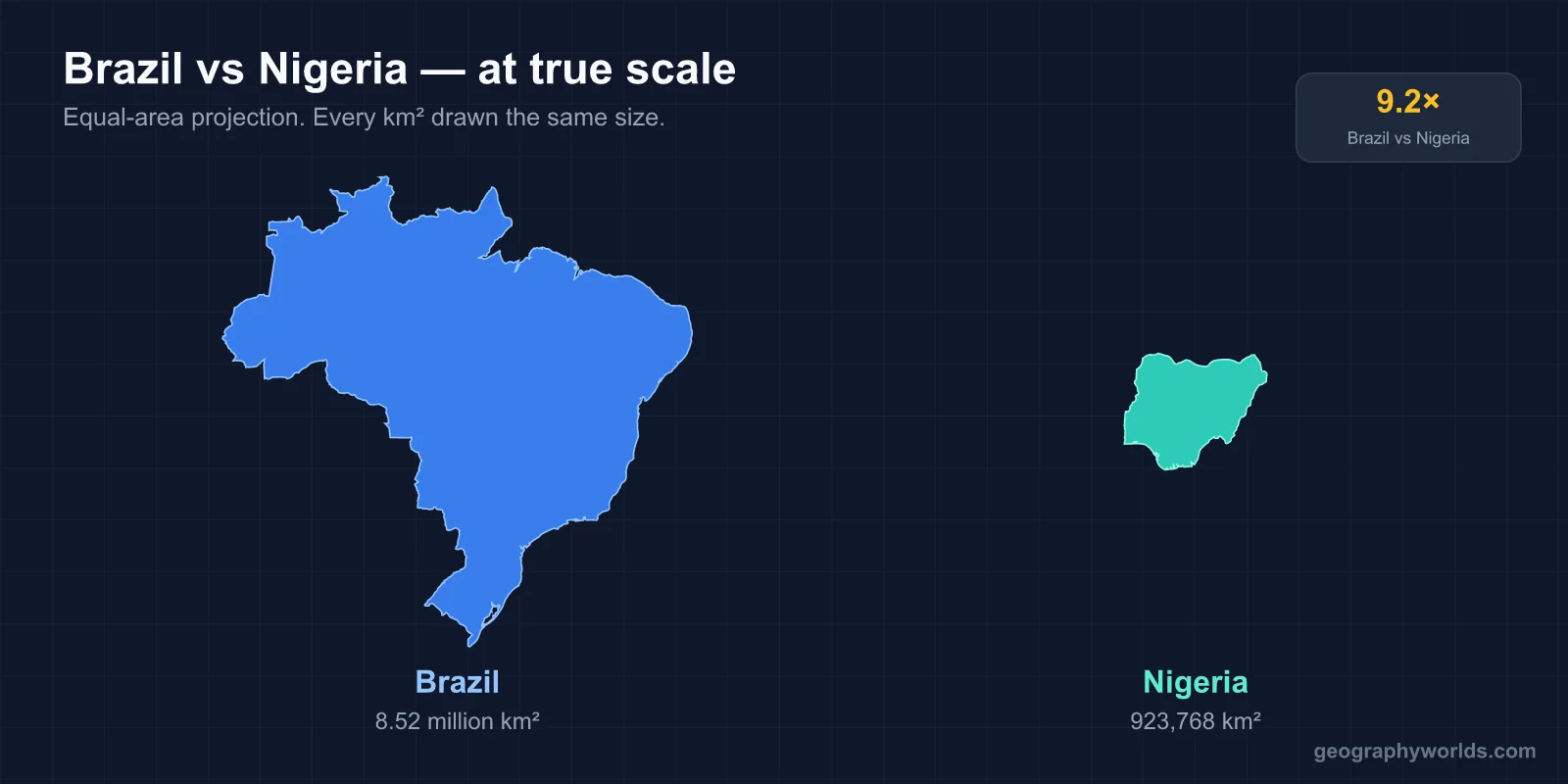
The difference in scale is enormous. Brazil's 8,515,767 km² are roughly 9.2 times Nigeria's 923,768 km², and that reach shows in their borders: Brazil touches every country in South America except Chile and Ecuador, while Nigeria abuts just four neighbors in Benin, Niger, Chad and Cameroon. Nigeria's terrain runs from tropical forests through savannas to the oil-rich Niger Delta, whereas Brazil spans the Amazon basin, interior highlands, coastal mountains and vast wetlands.
Population & Demographics
| Metric | Nigeria 🇳🇬 | Brazil 🇧🇷 |
|---|---|---|
| Population | 242.4 million | 213.6 million |
| Population Density | 262.4 per km² | 25.1 per km² |
This is where the comparison turns. Even though Brazil dwarfs Nigeria in land, Nigeria holds more people — 242.4 million to Brazil's 213.6 million, about 1.1 times as many. Squeezed into a far smaller country, Nigerians live at a density of 262.4 per km², more than ten times Brazil's sparse 25.1 — a gap of around 237.4 people per km². Brazil's huge but thinly inhabited Amazon interior pulls its average down dramatically.
Capital Cities
Both countries deliberately built inland capitals to balance their geography. Nigeria governs from Abuja, a planned city in the country's center, while Brazil's capital is Brasília, a modernist city carved out of the interior plateau and inaugurated in 1960. Abuja sits in Africa and Brasília in South America, but the impulse behind each — a central, custom-built seat of government — is much the same.
Language, Currency & Culture
| Aspect | Nigeria 🇳🇬 | Brazil 🇧🇷 |
|---|---|---|
| Languages | English (official), Hausa, Yoruba, Igbo | Portuguese (official) |
| Currency | Nigerian Naira (NGN) | Brazilian Real (BRL) |
The two reflect very different colonial legacies. Nigeria uses English as its official language alongside major indigenous tongues such as Hausa, Yoruba and Igbo, while Brazil is overwhelmingly Portuguese-speaking — the largest Portuguese-speaking nation on Earth. Their currencies are distinct as well: the Nigerian Naira (NGN) and the Brazilian Real (BRL).
Climate & Natural Features
| Aspect | Nigeria 🇳🇬 | Brazil 🇧🇷 |
|---|---|---|
| Climate | tropical in the south, arid in the north | mostly tropical; temperate in south |
| Key Features | Niger River, Jos Plateau, tropical rainforests | Amazon Rainforest, Pantanal wetlands, Iguazu Falls, Sugarloaf |
| Economy | oil, agriculture, tech startup hub | agriculture (soy, coffee), mining, aerospace, oil |
Both straddle the tropics. Nigeria is tropical in the south and arid toward the north, with the Niger River, the Jos Plateau and tropical rainforests among its defining features. Brazil is mostly tropical but turns temperate in the south, and its natural showpieces include the Amazon Rainforest, the Pantanal wetlands, Iguazu Falls and Rio's Sugarloaf. Economically, Nigeria pairs oil and agriculture with a fast-rising tech startup scene, while Brazil runs a broader engine of agriculture (notably soy and coffee), mining, aerospace and oil.
What Makes Each Country Unique
Nigeria is known worldwide for its Nollywood film industry, for the much-loved dish jollof rice, and for its vibrant cultural festivals. It is also one of the most linguistically diverse nations on Earth, with over 500 living languages spoken within its borders.
Brazil is famous for Carnival, the Amazon Rainforest, samba and bossa nova, its footballing passion, and the statue of Christ the Redeemer overlooking Rio. The country contains about 60% of the Amazon Rainforest, which is often said to produce roughly 20% of the world's oxygen.
Key Differences at a Glance
- Area: Nigeria (923,768 km²) vs Brazil (8,515,767 km²) — Brazil is 9.2x larger
- Population: Nigeria (242.4 million) vs Brazil (213.6 million) — Nigeria is 1.1x more populous
- Capitals: Abuja vs Brasília
- Currency: Nigerian Naira (NGN) vs Brazilian Real (BRL)
- Continents: Africa vs South America
- Density: Nigeria is more densely populated (difference of ~237.4 people per km²)
- Languages: English (official) vs Portuguese (official)
Verdict
Nigeria and Brazil make a fascinating mismatch. Brazil towers over Nigeria in land, with 9.2 times the territory, yet Nigeria still edges it on population — about 1.1 times the people — which means Nigerians live more than ten times as densely as Brazilians. It is a textbook case of how a far smaller country can carry a larger crowd when its land is intensively settled and a continental giant leaves much of its interior nearly empty.
In character, Nigeria is defined by its tropical-to-arid climate and the Niger River heartland, with an economy moving from oil toward technology, while Brazil is shaped by its mostly tropical climate and natural icons led by the Amazon Rainforest, supported by a diversified base of farming, mining and industry.
Together they show how two tropical Atlantic powers, born of different continents and colonial histories, can rise to comparable global weight by very different means. Whether you are planning a visit, studying world geography, or simply satisfying your curiosity, comparing them enriches the bigger picture.
Test Your Knowledge!
Think you know your countries? Try our interactive geography quiz!
Play Geography Games →