
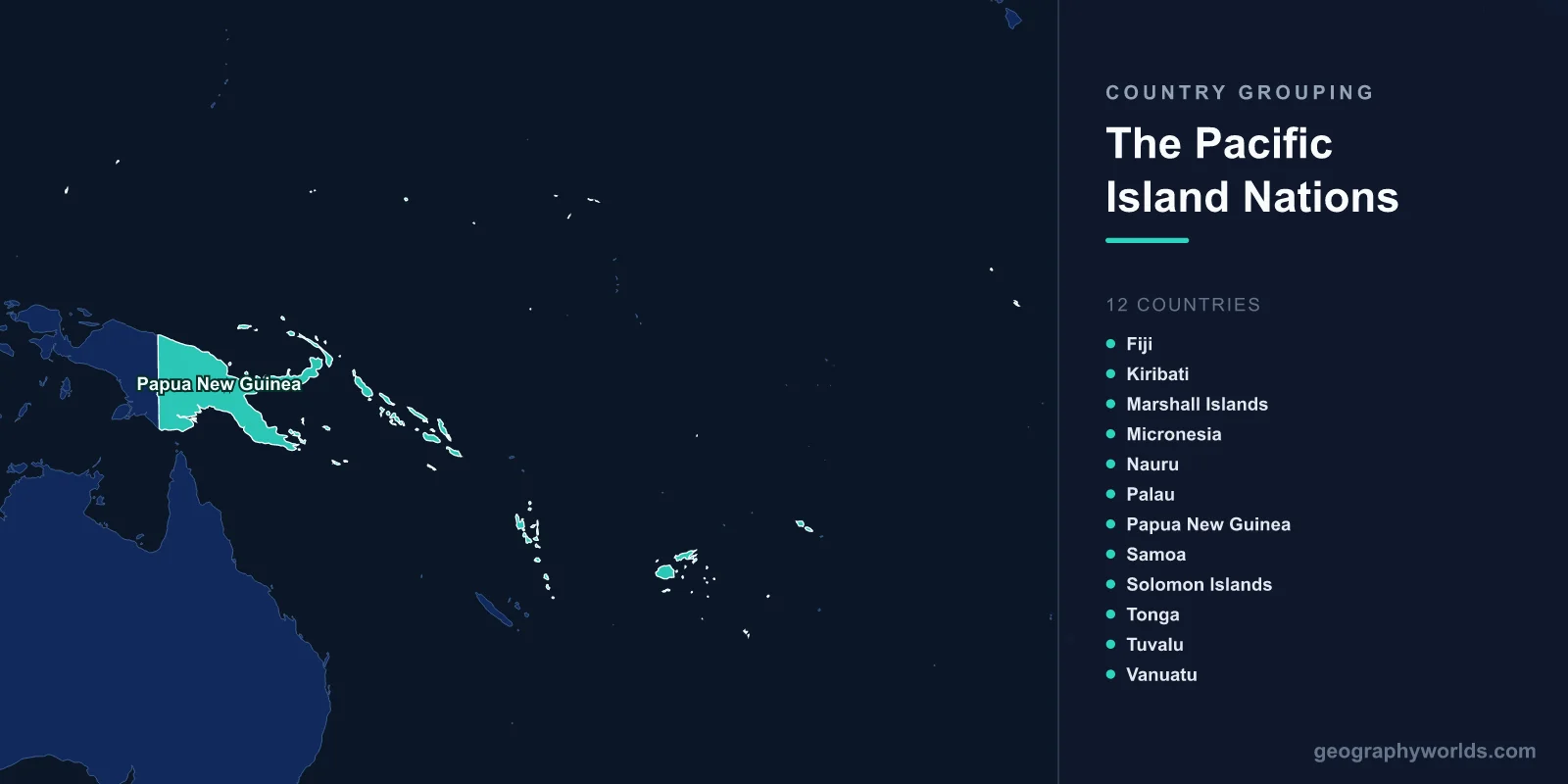
There are 12 independent Pacific Island nations: Fiji, Kiribati, the Marshall Islands, the Federated States of Micronesia, Nauru, Palau, Papua New Guinea, Samoa, the Solomon Islands, Tonga, Tuvalu, and Vanuatu. Together they hold about 12 million people and control over 30 million km² of ocean — an area larger than Africa — on a combined land area smaller than Denmark.

The 12 Nations and Their Three Regions
The Pacific's island states are conventionally grouped into three cultural-geographic regions, a division proposed by European geographers in the 19th century that Pacific Islanders themselves now widely use.
Melanesia
- Papua New Guinea — By far the largest, with roughly 10 million people and about 463,000 km² of land. Mountainous, heavily forested, and the most linguistically diverse country on Earth.
- Fiji — Around 900,000 people across some 330 islands, roughly a third of them inhabited. The region's transport, education, and diplomatic hub.
- Solomon Islands — Roughly 700,000 people on a double chain of volcanic islands; the site of the Guadalcanal campaign in 1942–43.
- Vanuatu — About 320,000 people on some 80 islands, with several active volcanoes and consistently ranked among the world's most disaster-exposed countries.
Micronesia
- Kiribati — 33 atolls and reef islands scattered across 3.5 million km² of ocean, with just 811 km² of land. The only country spanning all four hemispheres.
- Marshall Islands — 29 atolls and 5 islands, averaging barely two metres above sea level. Site of US nuclear testing at Bikini and Enewetak between 1946 and 1958.
- Federated States of Micronesia — Four states (Yap, Chuuk, Pohnpei, Kosrae) spread across more than 600 islands.
- Palau — About 18,000 people; created the world's first national shark sanctuary in 2009.
- Nauru — The world's smallest republic at 21 km², and the third-smallest country of any kind.
Polynesia
- Samoa — Roughly 220,000 people on two main volcanic islands rising above 1,800 m.
- Tonga — The only Pacific nation never formally colonised, retaining its indigenous monarchy throughout.
- Tuvalu — About 11,000 people on nine atolls totalling 26 km², with a maximum elevation near 4.5 m.
Many other Pacific territories — French Polynesia, New Caledonia, Guam, American Samoa, the Cook Islands, Niue — are not independent states and so fall outside this list, though several are self-governing in free association or as overseas territories. For the full regional count, see how many countries are in Oceania.
High Islands and Low Islands
Almost every question about Pacific geography, economy, and vulnerability comes back to a single distinction: whether an island is high or low.
High islands are volcanic. They have elevation, interior mountains, weathered volcanic soils that hold nutrients, and — critically — enough topography to force rain out of passing air and to sustain streams and groundwater. Papua New Guinea, with glaciated peaks above 4,500 m, sits at one extreme; Samoa, Vanuatu, and the larger Fijian islands are more typical. High islands can support agriculture, larger populations, and forestry or mining.
Low islands are coral atolls: rings of reef and sand built atop subsided volcanoes, rarely more than a few metres above the sea. They have thin, alkaline, nutrient-poor soils, no rivers, and fresh water only in the form of a delicate lens of rainwater floating on denser seawater beneath the island. That lens is easily contaminated by storm overwash. Kiribati, Tuvalu, and the Marshall Islands are almost entirely low islands. Our guide to what an atoll is explains how the formation process works.
Many of these islands sit along the Pacific Ring of Fire, and Vanuatu, Papua New Guinea, Tonga, and the Solomons all experience frequent earthquakes and eruptions. The 2022 Hunga Tonga–Hunga Haʻapai eruption was among the most powerful recorded anywhere in the modern instrumental era.
The Greatest Voyage in Human History
The settlement of the Pacific is one of the most remarkable achievements in the human record. Migration into New Guinea and the Solomon Islands began roughly 50,000 years ago, when lower sea levels made shorter crossings possible. The far harder phase came much later: the Austronesian expansion, which pushed east into open ocean where no land is visible from any other land.
Lapita pottery marks the trail of these voyagers into Fiji, Tonga, and Samoa around 3,000 years ago. From there, after a long pause, navigators reached the remotest corners of Polynesia — Hawaii, Rapa Nui, and Aotearoa New Zealand — with the last major settlements around 1,000–1,300 CE.
They did it without instruments. Traditional wayfinding read star paths at the horizon, the interference patterns of ocean swells refracting around unseen islands, cloud formations that stack over land, and the flight lines of birds at dawn and dusk. The knowledge was nearly lost in the colonial period and has been deliberately revived since the 1970s, most famously by the voyaging canoe Hōkūleʻa and the Micronesian navigator Mau Piailug.
Ocean Economies
Pacific economies are shaped by three unavoidable facts: tiny domestic markets, extreme remoteness from trading partners, and exposure to natural disasters. Within those constraints, several distinctive economic models have emerged.
- Fisheries. The Western and Central Pacific holds the world's largest and most valuable tuna fishery. Under the Nauru Agreement, eight countries jointly sell fishing days to distant-water fleets rather than competing against each other — a rare and genuinely effective example of small states pooling bargaining power.
- Tourism. Central to Fiji, Palau, Vanuatu, Samoa, and the Cook Islands; negligible for the remote atoll states, which lack the air links to support it.
- Remittances. Money sent home from diaspora communities in Australia, New Zealand, and the United States is a leading source of national income for Tonga and Samoa.
- Resources. Papua New Guinea is the outlier, with substantial gold, copper, and liquefied natural gas exports. Nauru's phosphate deposits made it briefly one of the richest countries per capita before near-total exhaustion by the 1990s — a cautionary tale in resource dependence.
- Sovereignty as an asset. Tuvalu earns a meaningful share of national revenue from licensing its ".tv" internet domain; several states earn fees from shipping registries and licensing arrangements.
Pacific Islands vs Caribbean Islands: A Comparison
Both regions are archipelagic groups of small states, and they are often lumped together as "small island developing states." Comparing them clarifies what is genuinely distinctive about the Pacific.
- Scale and isolation. The Caribbean is compact — most of its islands lie within a day's sail of a neighbour and within a few hours' flight of North America. The Pacific states are spread across a third of the planet's surface. Kiribati alone spans more longitude than the continental United States.
- Market access. Caribbean nations sit next to the world's largest consumer market, which sustains mass tourism, cruise traffic, and offshore finance. Most Pacific nations are thousands of kilometres from any large economy, making the same tourism model impossible for all but a handful.
- Ocean-to-land ratio. Pacific states control vastly more ocean per person. This makes fisheries and seabed resources central to Pacific economics and diplomacy in a way they are not in the Caribbean.
- Elevation and existential risk. Most Caribbean islands are volcanic or limestone with real elevation; their principal hazard is hurricanes, which are devastating but survivable. Pacific atoll nations face something categorically different — sea-level rise threatens not damage but the permanent loss of national territory.
- Cultural continuity. Caribbean populations are overwhelmingly descended from people brought through the transatlantic slave trade and later indentured migration, with indigenous populations largely destroyed. Pacific Island populations are overwhelmingly indigenous, with continuous occupation and languages stretching back millennia. Tonga was never colonised at all.
The last two points explain why Pacific diplomacy sounds different from Caribbean diplomacy. Pacific leaders frame climate change not as an economic risk to be managed but as a question of national survival and international justice.
The Front Line of Sea-Level Rise
For the atoll nations, climate change is not a future scenario. Saltwater intrusion is already contaminating freshwater lenses and killing taro pits, the traditional staple crop. King tides now routinely flood areas that were previously dry. Warming and acidifying water bleaches the reefs that both generate the sand islands are made of and buffer them from wave energy — meaning reef damage attacks the land itself, not just the ecosystem.
Responses have been strikingly creative. Kiribati purchased land in Fiji as a contingency. Tuvalu has begun building a digital replica of its territory and, in a 2023 treaty with Australia, secured a migration pathway for its citizens alongside commitments on its continuing statehood. Several Pacific states have led the legal push to establish that maritime boundaries remain fixed even if baselines are submerged — a technical-sounding point on which their entire ocean economies depend. For context on comparable exposure elsewhere, see our guide to cities below sea level.
Meanwhile the region has become an arena of strategic competition between China, the United States, and Australia, giving these small states more diplomatic leverage than at any point since independence — leverage they have used primarily to press for climate action.
Final Thoughts
The Pacific Island nations are easy to underestimate from a standard world map, where they appear as scattered dots in empty blue. That map is misleading. These 12 countries steward a share of the planet's ocean surface out of all proportion to their land area, sustain some of the oldest continuous cultures on Earth, and hold the world's most valuable tuna fishery. They also face, in the low-lying atoll states, a threat no other group of nations confronts: the prospect of a country outliving its own territory.