
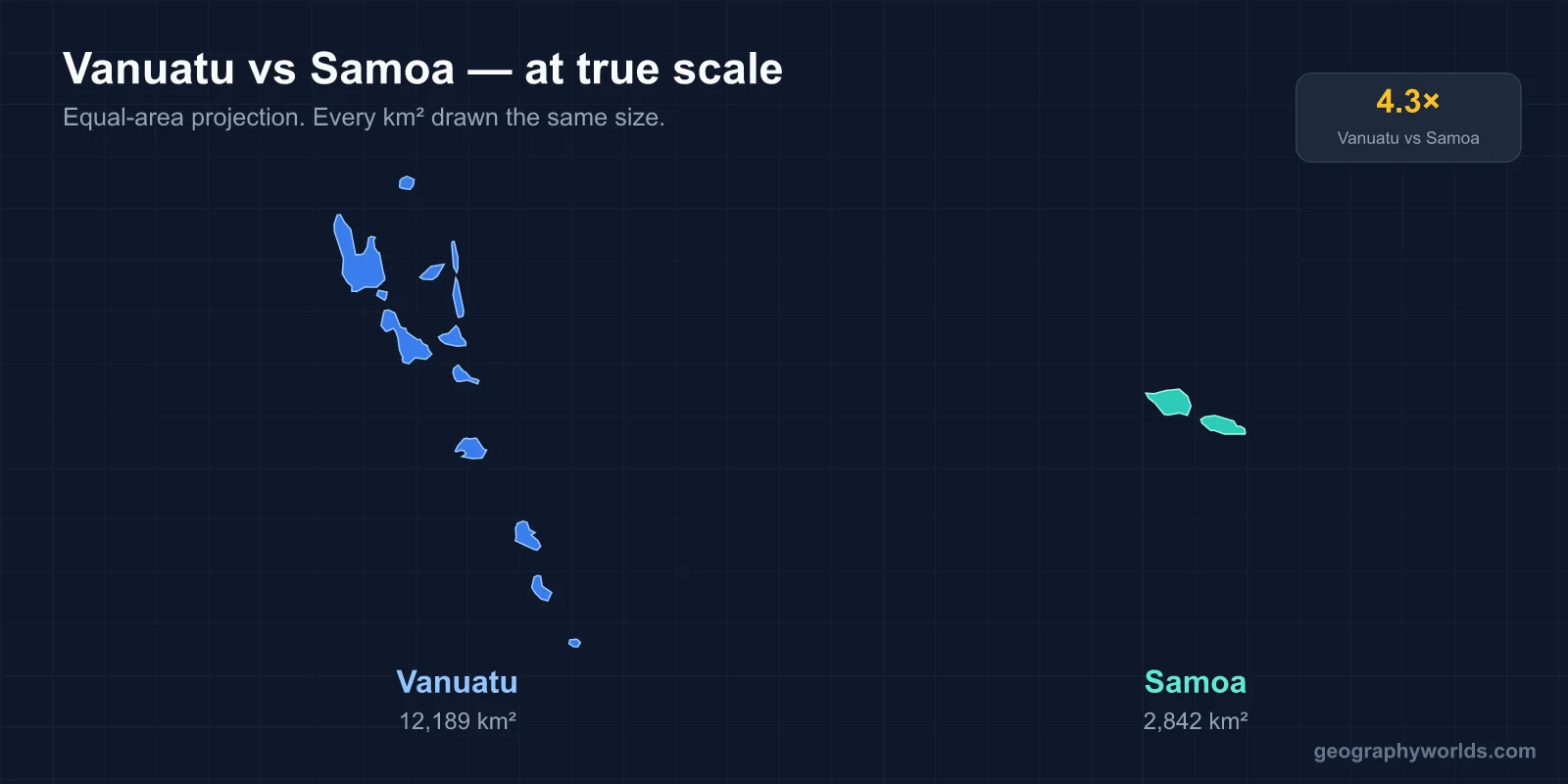
Vanuatu is the bigger of the two by a wide margin: about 12,190 km² of land against Samoa’s roughly 2,840 km², so it is more than four times the size. It also has more people, 300,019 at its 2020 census compared with 205,557 in Samoa’s 2021 census. Samoa is the richer country per person, with a nominal GDP per capita of about US$4,420 (IMF, 2024) against Vanuatu’s US$3,188 (IMF, 2023). Samoa’s capital is Apia, on the island of Upolu, and its official languages are Samoan and English; Vanuatu’s capital is Port Vila, on Efate, and it has three official languages, Bislama, English and French. Samoa is Polynesian and Vanuatu Melanesian, with Fiji lying between them in the South Pacific.
| Figure | Samoa | Vanuatu |
|---|---|---|
| Land area | about 2,840 km² | about 12,190 km² |
| Islands | 2 main islands (Upolu, Savai’i) and 8 islets | about 83 islands, 65 inhabited |
| Population (latest census) | 205,557 (2021) | 300,019 (2020) |
| Capital and its population | Apia, 35,974 (2021) | Port Vila, 49,034 (2020) |
| Highest point | Mount Silisili, 1,858 m | Mount Tabwemasana, 1,879 m |
| Official languages | Samoan, English | Bislama, English, French |
| Independence | 1 January 1962, from New Zealand | 30 July 1980, from Britain and France |
| GDP per capita (nominal) | US$4,420 (2024) | US$3,188 (2023) |
| Human Development Index (2023) | 0.708 (122nd) | 0.621 (146th) |
| Time zone and driving side | UTC+13, drives on the left | UTC+11, drives on the right |
Some of those rows are close. The two highest summits differ by just 21 metres, and both countries are small island states of a few hundred thousand people. The interesting part is the rows where they pull far apart, and each of those gaps has a specific cause.
Four Times the Land: Vanuatu’s Y-Shaped Chain Against Samoa’s Two Islands
Samoa is compact. Upolu and Savai’i hold 99% of its land, and the eight islets that make up the rest include Manono and Apolima in the strait between them and the four Aleipata Islands off Upolu’s eastern tip. Upolu is 75 km long and 1,125 km² in area, and nearly three-quarters of Samoans live on it. Savai’i is larger but far emptier, with 43,958 residents at the 2016 census, one township at Salelologa and a single sealed highway connecting most of its villages.
Vanuatu is spread out. Its roughly 83 islands form a Y-shaped chain about 1,300 km from the northernmost to the southernmost, between latitudes 13°S and 21°S. Fourteen of them are larger than 100 km², led by Espiritu Santo at about 3,956 km², which on its own is bigger than the whole of Samoa. Malakula, Efate, Erromango, Ambrym and Tanna follow. Two further specks, Matthew and Hunter islands, are claimed by Vanuatu but controlled by France as part of New Caledonia.
The spread shapes daily life. From Upolu, a Samoan crosses to Savai’i by ferry from Mulifanua Wharf to Salelologa, a trip of 60 to 90 minutes. In Vanuatu, reaching the Banks Islands in the north or Aneityum in the far south from Port Vila means a domestic flight or a long sea passage,. The capitals hold similar shares of their populations: Port Vila held 16.3% of Vanuatu’s people in 2020, and Apia about 17.5% of Samoa’s a year later. But nearly three-quarters of Samoans live on Upolu with their capital, while ni-Vanuatu are scattered across 65 inhabited islands.

113 Languages in Vanuatu, One Samoan Tongue
This is the biggest cultural gap of all. Samoa is close to monolingual: the population is about 96% Samoan, and Samoan, a Polynesian language, has more speakers in Samoa than English even when second-language users are counted. The same language is spoken in American Samoa next door, and with the diaspora there were an estimated 510,000 speakers worldwide in 2015. Among Polynesian languages it has the most native speakers.
Vanuatu has 113 indigenous languages, all Oceanic languages of the Austronesian family, and the highest density of languages per person of any country, averaging only about 2,000 speakers each. To talk across that patchwork, ni-Vanuatu use Bislama, an English-based creole in which more than 95% of the words are of English origin. It is the first language of many people in Port Vila and Luganville and a second language for most others, and the national anthem, “Yumi, Yumi, Yumi”, is written in it. Between 1999 and 2009, the share of people using an indigenous language at home fell from 73.1% to 63.2% as Bislama spread.
English and French are also official in Vanuatu, and the country belongs to both the Commonwealth and la Francophonie. That dual inheritance is the legacy of the next gap.
The New Hebrides Condominium Versus the New Zealand Mandate
Both countries were settled by Lapita people roughly 3,000 years ago. Europeans reached Vanuatu first, when Pedro Fernandes de Queirós landed on Espiritu Santo in 1606; Jacob Roggeveen sighted Samoa in 1722, and Bougainville passed both groups in 1768. After that their colonial stories run in very different directions.
Samoa was fought over by Germany, Britain and the United States. A hurricane on 15 March 1889 wrecked the rival warships crowded into Apia harbour, and after further civil war the Tripartite Convention of 1899 split the islands: the eastern group became American Samoa, while the western islands became German Samoa in 1900. New Zealand troops occupied the colony without a fight on 30 August 1914, ran it as a League of Nations mandate from 1920 and as a UN trust territory from 1946, and Western Samoa became independent on 1 January 1962, the first small-island country in the Pacific to become independent. It dropped “Western” from its name on 4 July 1997.
Vanuatu, then the New Hebrides, was named by James Cook in 1774 after the islands off Scotland. Britain and France both had settlers there, and instead of one power taking over, they agreed in 1906 to rule jointly as an Anglo-French condominium. Almost everything came in pairs: two health services, two education systems, two police forces, two currencies and two prison systems. The one shared institution was a Joint Court of three judges: one British, one French and a third nominated by the King of Spain. Independence came late, on 30 July 1980 under Prime Minister Walter Lini, and it was contested: Jimmy Stevens’s Nagriamel movement declared the independent Republic of Vemarana on Espiritu Santo, and Papua New Guinean troops had to end the brief Coconut War before Stevens surrendered on 1 September 1980. The English–French divide carried straight into politics: Lini ran an Anglophone-dominated government until a no-confidence vote removed him in 1991.
Mount Yasur’s Glow Against Savai’i’s Silent Lava Fields
Both countries are volcanic, but they sit on different kinds of volcano. Samoa grew over the Samoa hotspot, which is probably driven by a mantle plume beneath the Pacific plate. Only Savai’i is still considered active, and its most recent eruptions were at Mount Matavanu between 1905 and 1911. Those flows left the Saleaula lava fields on the central north coast, about 50 km² of solidified lava.
Vanuatu lies on a subduction zone, where the Indo-Australian plate is being subducted under the Pacific plate, and that makes it far more restless. Mount Yasur on Tanna, only 361 m high, has been erupting almost continuously for several hundred years, often several times an hour, and its glow is thought to be what drew Cook ashore in 1774. Lopevi and Ambrym are also active, and a huge Ambrym eruption around 200 CE likely forced further population movements. Cyclones add to the hazard: Cyclone Pam, a Category 5 storm in March 2015, damaged or destroyed thousands of homes, schools and other buildings and is regarded as one of the worst natural disasters in Vanuatu’s history.

Samoa’s great natural shock in recent memory came from the sea instead: the magnitude 8.1 earthquake of 29 September 2009 beside the Tonga–Kermadec subduction zone sent a tsunami onto Samoa, American Samoa and Tonga.
Auckland’s 213,069 Samoans and the Income Gap
Samoa earns about US$1,200 more per person than Vanuatu in nominal terms, and ranks 24 places higher on the UN’s Human Development Index. A large part of the explanation is outside Samoa itself. Because New Zealand ran the country for almost half a century, migration there began in earnest in the 1950s, and at New Zealand’s 2023 census 213,069 people identified as ethnically Samoan. That is more than the population of Samoa. Money sent home by these families, alongside development aid, is one of the pillars of the Samoan economy, which the UN has classed as developing since 2014 and in which services made up about 66% of GDP in 2017.
Vanuatu has no diaspora of that scale, and its growth has leaned on tourism, beef exports, copra and kava, and remittances from workers abroad. Its growth figures have at times been respectable, averaging 5.9% a year between 2003 and 2007 according to the Asian Development Bank, but unstable coalitions and frequent changes of prime minister since 1991, along with repeated cyclone damage, have weighed on it. Two small everyday differences also trace to the neighbours each country leans on: Samoa switched to driving on the left on 7 September 2009, in common with Australia and New Zealand, home to large numbers of Samoans, and at the end of 29 December 2011 it skipped Friday 30 December altogether, shifting from UTC−11 to UTC+13 to do business on the same days as Australia and New Zealand. Vanuatu has kept right-hand driving and UTC+11.
Lapita Pottery and Village Custom: Where the Two Line Up
For all those gaps, the two countries share a deep base. The Lapita potters who reached Samoa and Vanuatu around 3,000 years ago are the common ancestors of much of the Pacific, and the Lapita sites were Vanuatu’s first UNESCO World Heritage listing in 2008, while the oldest Samoan remains come from a Lapita site at Mulifanua. Both societies still run on custom alongside state law. In Samoa it runs through the matai system of chiefly titles: there are more than 25,000 matai, and only matai may stand for 49 of the 51 seats in the Fono, the national parliament. In Vanuatu it is kastom, which carries rituals such as land diving on southern Pentecost, where men jump from wooden towers 20 to 30 metres high with vines tied to their ankles.
Both are members of the Commonwealth and the Pacific Islands Forum, and both are exposed to the same cyclones and rising seas. For a visitor, the choice comes down to texture: Samoa offers one language, one dominant culture and a short drive between beaches, while Vanuatu offers active volcanoes, dozens of cultures and long hops between islands. Our guide to Apia and our guide to Port Vila look at the two capitals in more detail, and Samoa’s closest Polynesian rival gets the same treatment in our comparison of Fiji and Samoa.