
Introduction
Separated by little more than 20 miles of water at the narrowest point of the English Channel, the United Kingdom 🇬🇧 and France 🇫🇷 have spent the better part of a thousand years as neighbours, rivals, and trading partners. The two countries sit close enough to share weather systems, yet they have grown into strikingly different places. This comparison sets their geography side by side, from land area and population to climate, capitals, and the features that define each one.
If you are revising for an exam, mapping out a trip, or just settling a friendly argument about which country is bigger, the tables and notes below give you the essentials at a glance.
Size & Geography
| Feature | United Kingdom 🇬🇧 | France 🇫🇷 |
|---|---|---|
| Area | 243,610 km² | 643,801 km² |
| Continent | Europe | Europe |
| Region | Western Europe | Western Europe |
| Land Borders | Ireland | Belgium, Luxembourg, Germany, Switzerland, Italy, Spain, Andorra, Monaco |
| Landscape | varied topography; highlands in north, lowlands in south and east | mostly flat plains; hills and mountains along borders |
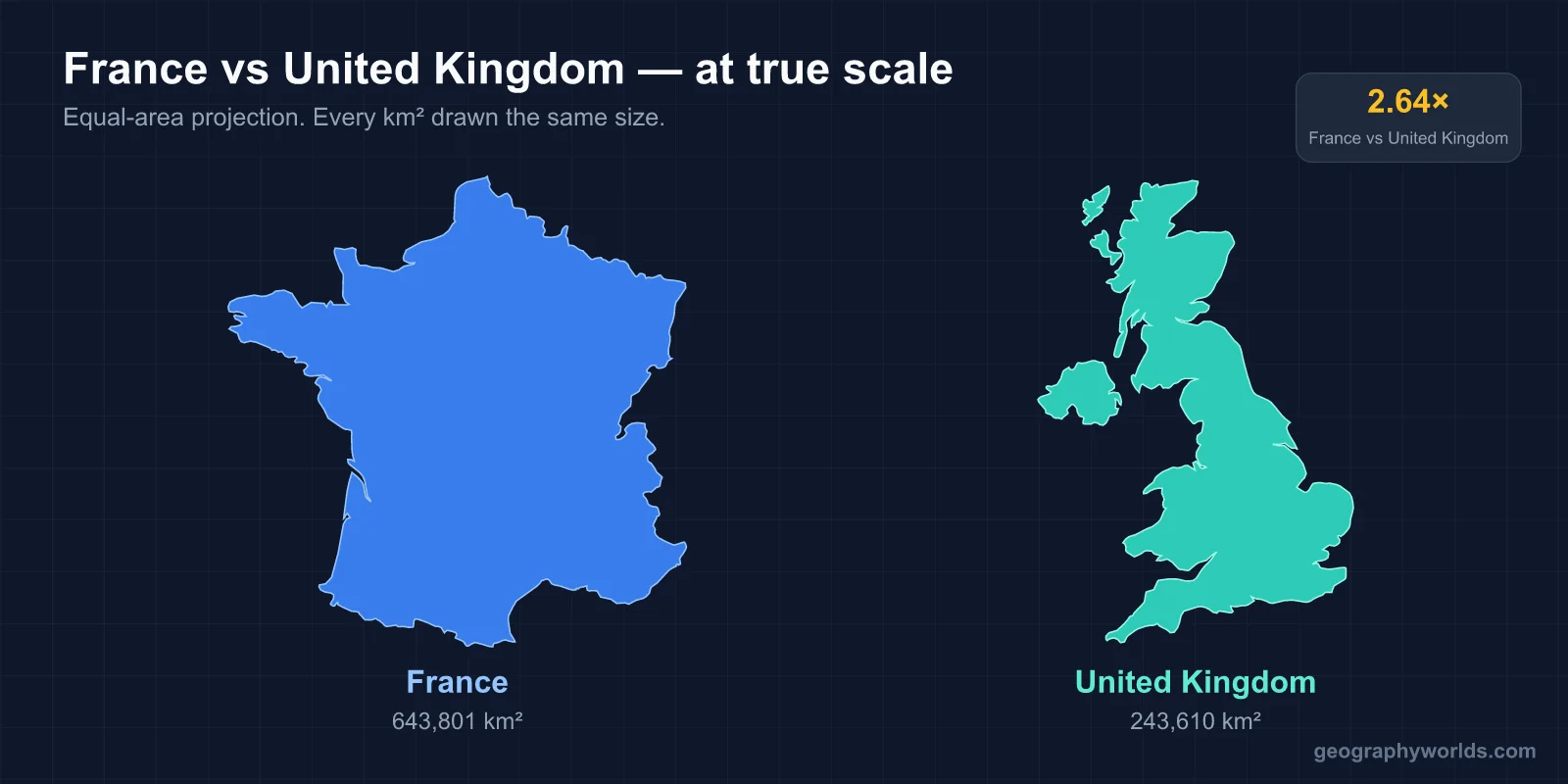
The difference in scale is the first thing that stands out. At 643,801 km², France covers roughly 2.6 times the area of the United Kingdom's 243,610 km², making it the largest country in Western Europe by some margin. That gap is also reflected in how each connects to its neighbours: France touches eight other countries by land, from Belgium in the north to Spain, Andorra, and Monaco in the south, while the UK shares a single land border, with Ireland. The rest of Britain's frontier is coastline. The terrain reads differently too. The UK rises and falls between highlands in the north and lowlands across the south and east, whereas France is dominated by broad, flat plains, with the hills and mountains saved mostly for its outer edges.
Population & Demographics
| Metric | United Kingdom 🇬🇧 | France 🇫🇷 |
|---|---|---|
| Population | 69.9 million | 66.7 million |
| Population Density | 287.1 per km² | 103.7 per km² |
Here the larger country is not the more crowded one. France has more land but slightly fewer people, 66.7 million against the UK's 69.9 million. Because those Britons are packed into a country less than half the size, the contrast in density is dramatic: 287.1 people per km² in the UK versus 103.7 in France, a difference of about 183.4 people per km². In practice that means Britain's space fills up far faster, while France keeps large stretches of countryside thinly settled even close to its major cities.
Capital Cities
London anchors the United Kingdom and Paris anchors France, and the two capitals are among the most influential cities anywhere. Both sit in Western Europe, roughly a couple of hours apart by high-speed rail under the Channel, which has long made them a natural pairing for business and weekend travel alike.
Language, Currency & Culture
| Aspect | United Kingdom 🇬🇧 | France 🇫🇷 |
|---|---|---|
| Languages | English (official), Welsh, Scottish Gaelic, Irish | French (official) |
| Currency | British Pound Sterling (GBP) | Euro (EUR) |
Language is where the UK's internal patchwork shows. English is the official language throughout, but Welsh, Scottish Gaelic, and Irish remain part of the national fabric, a reminder that the United Kingdom is a union of distinct nations. France, by contrast, lists French alone as its official language. The currencies underline a more recent divergence: France uses the Euro as a member of the eurozone, while the UK kept the British Pound Sterling and never adopted the single currency.
Climate & Natural Features
| Aspect | United Kingdom 🇬🇧 | France 🇫🇷 |
|---|---|---|
| Climate | temperate maritime; mild, wet year-round | Mediterranean in south, oceanic in west, continental in east |
| Key Features | Scottish Highlands, Lake District, White Cliffs of Dover, Thames River | Alps, Pyrenees, Loire Valley, French Riviera, Mont Blanc |
| Economy | finance, services, pharmaceuticals, aerospace, creative industries | aerospace, tourism, agriculture, luxury goods, nuclear energy |
The UK's weather is famously consistent in its inconsistency: a temperate maritime climate that stays mild and wet for most of the year, with few extremes in either direction. France is large enough to hold several climates at once, Mediterranean warmth in the south, an oceanic feel along the western coast, and a more continental swing of hot summers and cold winters in the east. Their landscapes follow suit. Britain's signatures are the Scottish Highlands, the Lake District, the White Cliffs of Dover, and the Thames, while France lays claim to the Alps and the Pyrenees, the chateaux of the Loire Valley, the French Riviera, and Mont Blanc, the highest peak in Western Europe. Economically the two play to different strengths: the UK leans on finance, services, pharmaceuticals, aerospace, and creative industries, whereas France blends aerospace, tourism, agriculture, luxury goods, and a power grid built heavily on nuclear energy.
What Makes Each Country Unique
The United Kingdom is recognised the world over for the Royal Family, Big Ben, Shakespeare, the Premier League, and the Beatles. Its global footprint runs deeper still: the British Empire was the largest empire in history, covering about 25% of the world's land area at its peak, which is a large part of why English is so widely spoken today.
France trades on a different kind of fame, built around the Eiffel Tower, its cuisine and wine, the fashion houses of Paris, and world-class art museums. That cultural pull translates into raw numbers too: France is the most visited country in the world, attracting over 89 million international tourists annually.
Key Differences at a Glance
- Area: United Kingdom (243,610 km²) vs France (643,801 km²) — France is 2.6x larger
- Population: United Kingdom (69.9 million) vs France (66.7 million) — the UK has the larger population
- Capitals: London vs Paris
- Currency: British Pound Sterling (GBP) vs Euro (EUR)
- Continents: Europe vs Europe
- Density: United Kingdom is far more densely populated (difference of ~183.4 people per km²)
- Languages: English (official) vs French (official)
Verdict
The neat thing about comparing these two cross-Channel rivals is how cleanly the headline figures trade places. France wins on land, with 2.6 times the area, while the UK edges ahead on people, despite being far smaller. It is a textbook case of size and population not moving together, and it explains why one country feels open and rural while the other feels packed.
The same split runs through their geography and economies. Britain offers a single, steady temperate maritime climate and landmarks such as the Scottish Highlands, with an economy tilted toward finance. France stretches across Mediterranean, oceanic, and continental zones, crowns itself with the Alps, and balances aerospace against tourism, farming, and luxury goods.
Neither country comes out clearly ahead, and that is rather the point. Whether you are planning a trip, studying world geography, or just feeding your curiosity, holding the UK and France up against each other is one of the most rewarding ways to see how two close neighbours can turn out so distinctly.
Test Your Knowledge!
Think you know your countries? Try our interactive geography quiz!
Play Geography Games →