
Introduction
Ecuador 🇪🇨 and Peru 🇵🇪 share a long Pacific-facing border and a common Andean spine, yet one is among South America's smallest mainland republics and the other among its largest. This comparison walks through how the two neighbors line up on size, population, capitals, climate, and the landmarks that define them.
If you are studying for a geography class, mapping out a trip through the Andes, or just curious how two countries that look similar on a map actually differ, the side-by-side figures below lay out the essentials.
Size & Geography
| Feature | Ecuador 🇪🇨 | Peru 🇵🇪 |
|---|---|---|
| Area | 283,561 km² | 1,285,216 km² |
| Continent | South America | South America |
| Region | South America | South America |
| Land Borders | Colombia, Peru | Ecuador, Colombia, Brazil, Bolivia, Chile |
| Landscape | Andes mountains, coastal plain, Amazon jungle, Galapagos | Andes mountains, Amazon basin, coastal desert |
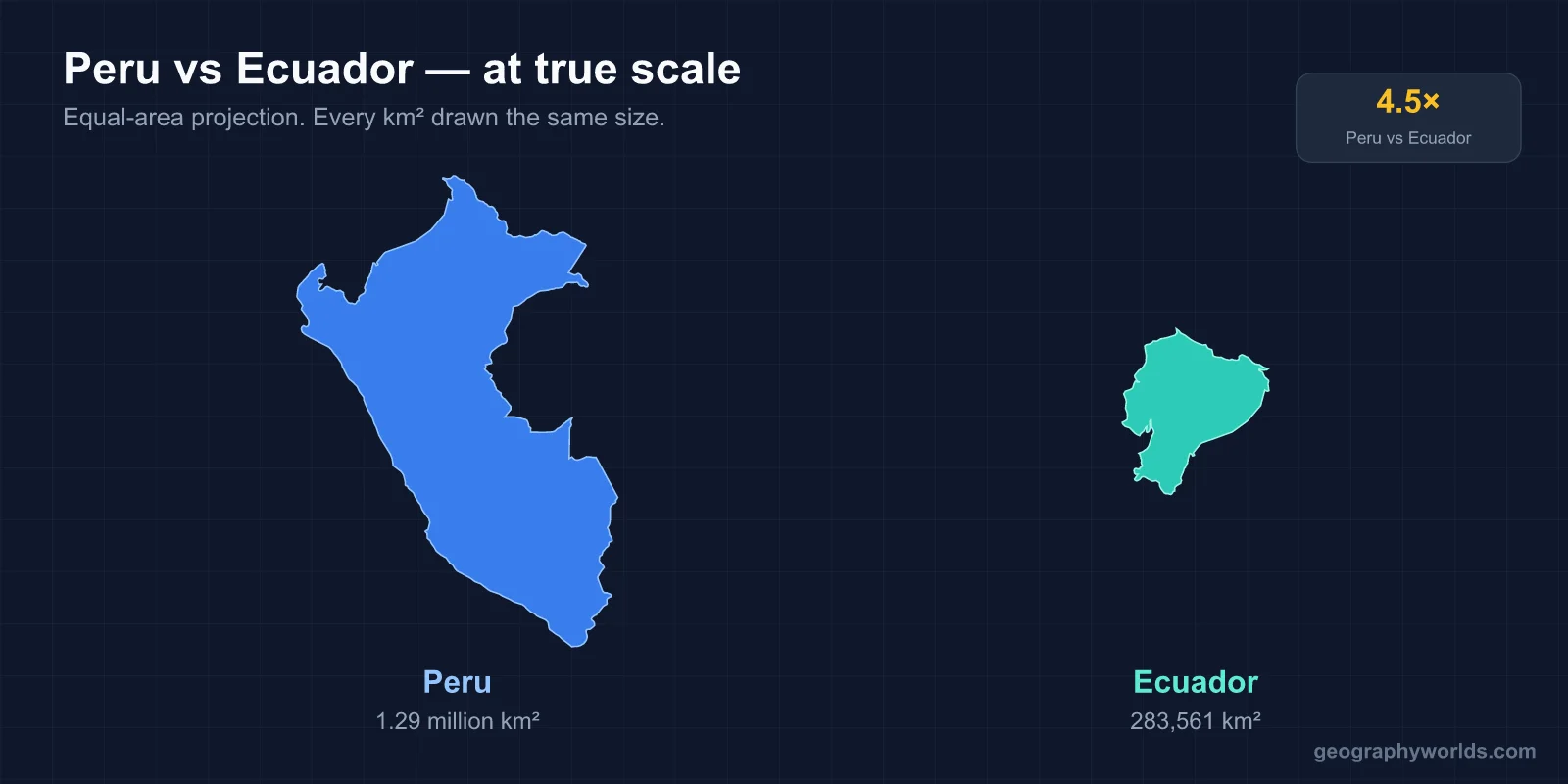
The gap in size is the first thing that stands out: at 1,285,216 km², Peru is about 4.5 times the area of Ecuador's 283,561 km². Both countries are built on the same three-part template, a Pacific coastal strip, the high Andes, and Amazon lowlands to the east, but Peru's borders touch five neighbors (Ecuador, Colombia, Brazil, Bolivia, and Chile) while Ecuador's reach only Colombia and Peru. Ecuador's geography also adds something Peru's does not: the Galapagos, an oceanic archipelago roughly a thousand kilometers offshore.
Population & Demographics
| Metric | Ecuador 🇪🇨 | Peru 🇵🇪 |
|---|---|---|
| Population | 18.4 million | 34.9 million |
| Population Density | 65.0 per km² | 27.2 per km² |
Peru's 34.9 million residents nearly double Ecuador's 18.4 million. But notice how the density figures flip the story: because Ecuador packs a comparable-order population into far less land, it averages 65.0 people per km² against Peru's 27.2, a difference of about 37.9 people per km². In short, Peru has more people overall, while Ecuador's people live more closely together.
Capital Cities
Quito is the capital of Ecuador and Lima the capital of Peru. Both sit within South America, but they could hardly be more different in setting: Quito is a high-altitude Andean capital, while Lima sprawls along the desert coast facing the Pacific. Lima is also by far the larger metropolis of the two.
Language, Currency & Culture
| Aspect | Ecuador 🇪🇨 | Peru 🇵🇪 |
|---|---|---|
| Languages | Spanish (official), Kichwa and Shuar | Spanish (official), Quechua, Aymara |
| Currency | United States Dollar (USD) | Peruvian Sol (PEN) |
Spanish is the official language in both countries, a shared legacy of the colonial era, and both also recognize Indigenous Andean and Amazonian languages, Kichwa and Shuar in Ecuador, Quechua and Aymara in Peru. The sharpest contrast is in money: Ecuador adopted the United States Dollar (USD) as its currency, while Peru keeps its own Peruvian Sol (PEN).
Climate & Natural Features
| Aspect | Ecuador 🇪🇨 | Peru 🇵🇪 |
|---|---|---|
| Climate | tropical along coast and jungle; cooler inland at elevation | varies from tropical in east to dry desert in west |
| Key Features | Galápagos Islands, Andes, Amazon basin, equator line | Machu Picchu, Andes, Amazon, Lake Titicaca, Nazca Lines |
| Economy | oil, agriculture (bananas, shrimp, flowers), tourism | mining (copper, gold), agriculture, fishing, textiles |
In both countries, altitude does most of the work that latitude usually does elsewhere. Ecuador runs tropical along its coast and jungle but turns cool in the highlands, while Peru shifts from tropical in the east to dry desert in the west. Ecuador's signature attractions, the Galápagos Islands, the Andes, the Amazon basin, and the equator line itself, lean toward nature, while Peru's, Machu Picchu, the Andes, the Amazon, Lake Titicaca, and the Nazca Lines, blend natural wonders with ancient human achievement. Their economies diverge too: Ecuador leans on oil, agriculture such as bananas, shrimp, and flowers, and tourism, whereas Peru is anchored by mining of copper and gold alongside agriculture, fishing, and textiles.
What Makes Each Country Unique
Ecuador is famous for the Galápagos Islands, for sitting astride the equator, and for packing extraordinary biodiversity into a compact territory. The country takes its name from the equator, which crosses it directly, so visitors can stand with one foot in each hemisphere.
Peru is synonymous with Machu Picchu and the Inca Empire, with the dish ceviche, and with Lake Titicaca, the world's highest navigable lake. Machu Picchu stayed hidden from the wider world for centuries and was only brought to international attention in 1911.
Key Differences at a Glance
- Area: Ecuador (283,561 km²) vs Peru (1,285,216 km²) — Peru is 4.5x larger
- Population: Ecuador (18.4 million) vs Peru (34.9 million) — Peru is 1.9x more populous
- Capitals: Quito vs Lima
- Currency: United States Dollar (USD) vs Peruvian Sol (PEN)
- Continents: South America vs South America
- Density: Ecuador is more densely populated (difference of ~37.9 people per km²)
- Languages: Spanish (official) vs Spanish (official)
Verdict
These two Pacific Andean neighbors are cut from the same geographic cloth and yet sit at opposite ends of the size scale. Peru is the heavyweight, 4.5 times larger by area and 1.9 times more populous, but Ecuador answers with denser settlement and a far smaller footprint that still manages to span coast, mountains, jungle, and the unique Galápagos.
Ecuador's identity rests on its equatorial position, its biodiversity, and landmarks like the Galápagos Islands, set against a climate that is tropical near the coast and cooler at elevation. Peru's draws on Machu Picchu and a landscape that ranges from eastern rainforest to western desert. The economic split is just as telling, Ecuador on oil and agriculture, Peru on mining.
Whichever you find more compelling, comparing them side by side shows how two countries sharing a border, a continent, and a colonial language can still feel like very different places. Reading the numbers next to each other is one of the best ways to understand why.
Test Your Knowledge!
Think you know your countries? Try our interactive geography quiz!
Play Geography Games →