
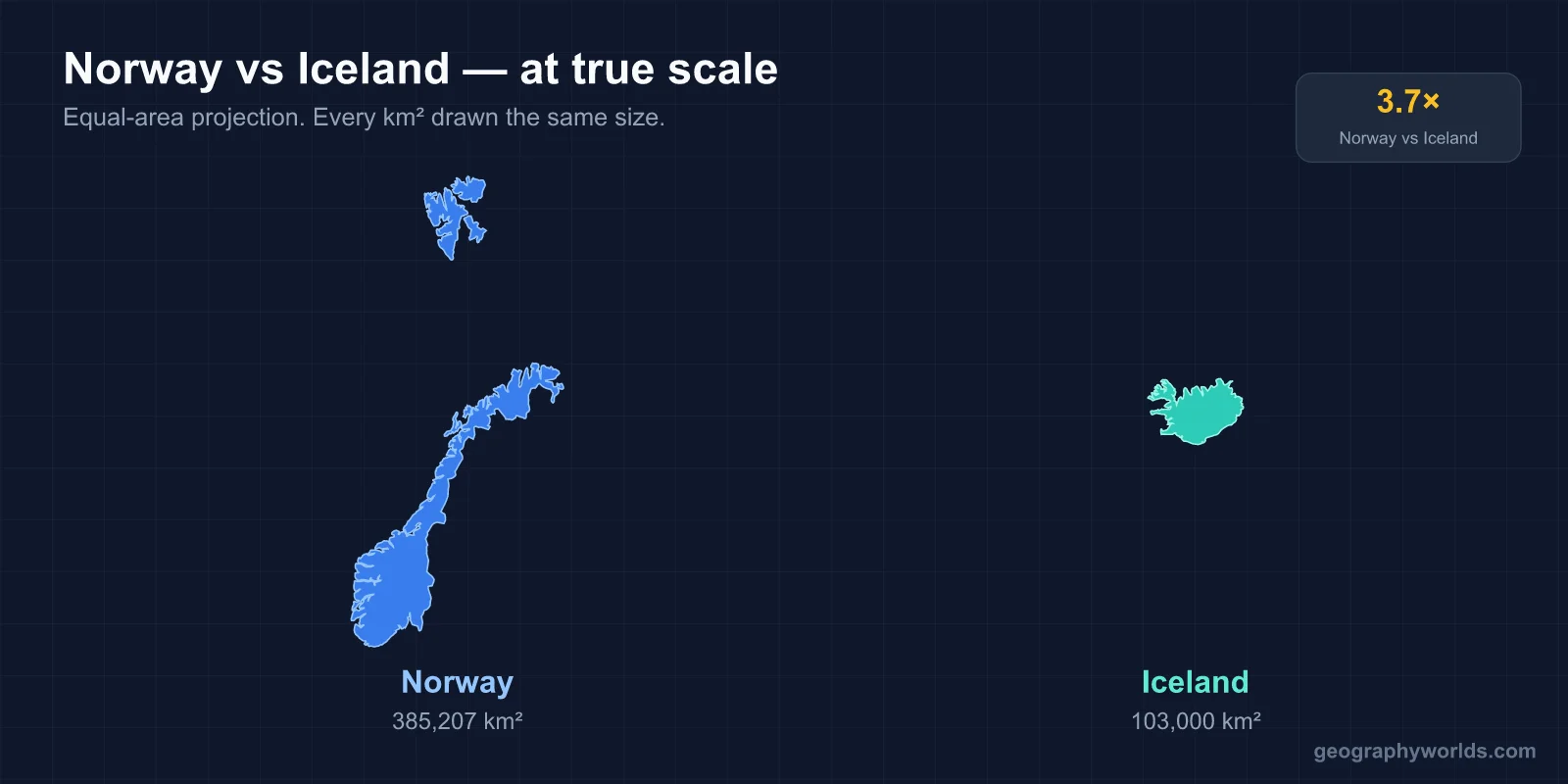
Norway is the larger, more populous and richer of the two. It covers about 385,207 km², nearly four times Iceland’s 103,125 km², and had about 5.63 million people in 2026 against Iceland’s 394,324, some 14 times as many. IMF estimates put Norway’s GDP per person at about US$105,877 for 2026 and Iceland’s at about US$90,280 for 2025, so both rank among the world’s ten richest countries by that measure. Norway is a constitutional monarchy governed from Oslo, with Norwegian (written as Bokmål and Nynorsk) and Sámi as official languages; Iceland has been a republic since 1944, governed from Reykjavík, and speaks Icelandic. Iceland was settled from Norway in the 870s, so the two are something like parent and child. The table below sets the main numbers side by side, and the sections after it explain the widest gaps.
| Measure | Norway | Iceland |
|---|---|---|
| Area | 385,207 km² | 103,125 km² |
| Population | about 5.63 million (2026) | 394,324 (1 January 2026) |
| Capital (population) | Oslo, 724,290 (2025) | Reykjavík, about 140,000 (2026) |
| GDP per person, nominal (IMF) | US$105,877 (2026) | US$90,280 (2025) |
| Human Development Index 2023 | 0.970, 2nd | 0.972, 1st |
| Highest point | Galdhøpiggen, 2,469 m | Hvannadalshnúkur, 2,109.6 m |
| Largest glacier (Norway: mainland) | Jostedalsbreen, 487 km² | Vatnajökull, about 7,700 km² |
| Coastline | 25,148 km mainland; 83,281 km with islands | about 4,970 km |
| Main electricity source | hydropower, about 98–99% | hydropower and geothermal, almost 100% |
| Government | constitutional monarchy | parliamentary republic since 17 June 1944 |
Fourteen Norwegians for Every Icelander
The population gap is the largest in the table, and it shapes everything else. Norway’s 5.6 million people are spread along a long coast and a few southern valleys, with Oslo at the head of the Oslofjord as the clear centre: 724,290 people in the municipality in 2025, about 1.1 million in the urban area and some 1.5 million in the wider metropolitan region. Bergen, once the base of the Hanseatic League’s trade in Norway, and Trondheim, founded by Olav Tryggvason in 997 and Norway’s capital until 1217, are the main regional centres outside the capital.
Iceland has no second city of any size. Reykjavík, at 64°08′ N the northernmost capital of a sovereign state, has about 140,000 residents, and its Capital Region about 252,000, or roughly 64% of the country. More than 70% of Icelanders live in the southwest corner, which covers less than 2% of the island. Iceland is the smallest NATO member by population and the only one without a standing army, relying on a lightly armed coast guard. Norway, a NATO founder in 1949 like Iceland, maintains full armed forces and shares a 196 km border with Russia in the far north.
Galdhøpiggen’s Glacier-Carved Fjords Against a Rift Island Still Being Built
Both countries are mountainous and cold-edged, but their mountains have different origins. Norway’s were shaped mainly by ice. During the last glacial period an ice sheet covered almost the whole country, and its movement gouged out deep valleys that the sea later flooded: the Sognefjord is the world’s second-deepest fjord, and Hornindalsvatnet the deepest lake in Europe. Galdhøpiggen, in the Jotunheimen range in Innlandet county, is at 2,469 m the highest mountain in Norway, Scandinavia and Northern Europe. The coast is shielded by a chain of skerries, and Norway’s official mapping agency counts 320,249 islands and islets along it, which is why the coastline stretches from 25,148 km on the mainland to 83,281 km once islands are included.

Iceland was made by fire. It sits on the Mid-Atlantic Ridge, where the Eurasian and North American plates pull apart, and it grew from eruptions along that seam. Its interior Highlands are an uninhabitable mix of sand, lava fields and mountains; 62.7% of the island is tundra and only 23% carries vegetation. Its highest point, Hvannadalshnúkur, is a peak on the crater rim of the Öræfajökull volcano, measured at 2,109.6 m in August 2005, about 360 m lower than Galdhøpiggen. Iceland has no land border at all, while Norway’s 2,515 km of land frontier runs 1,619 km with Sweden, 729 km with Finland and 196 km with Russia. At sea the balance tips back towards Norway again: counting the zone around Jan Mayen and the one Norway has claimed around Svalbard since 1977, its exclusive economic zone covers about 2,385,178 km², one of the largest in Europe and more than six times its own land area. Many fjords also cut into Iceland’s shore, but its 4,970 km coastline is less than a fifth of mainland Norway’s.
Vatnajökull, Sixteen Times the Size of Jostedalsbreen
On the mainland the contest is lopsided. Jostedalsbreen in Vestland, the largest glacier in continental Europe, covers about 487 km², and its arms such as Nigardsbreen and Bøyabreen reach down into the valleys. Vatnajökull in southeast Iceland covers about 7,700 km², close to 16 times as much, and holds about 3,000 km³ of ice with an average thickness of 380 m and a maximum of 950 m. It is the largest ice cap in Iceland and, after the Severny Island ice cap on Russia’s Novaya Zemlya, the second largest in Europe. Only in Norway’s Arctic archipelago of Svalbard is there a rival: the Austfonna ice cap on Nordaustlandet covers about 7,800 km².
A US$2.2 Trillion Oil Fund Against Fish, Aluminium and Visitors
Norway’s wealth rests on the North Sea. Oil was found at the Ekofisk field in 1969, and the petroleum industry now accounts for around a quarter of GDP; per person, Norway is the largest producer of oil and gas outside the Middle East. Rather than spend the revenue at once, the state created the Government Pension Fund Global in 1990 to invest it abroad. By July 2026 it held over US$2.2 trillion, equal to about 1.5% of the value of the world’s listed companies and more than US$390,000 per Norwegian. Norway is also the world’s largest salmon producer, and fish is its second-largest export after oil and gas.
Iceland has no oil. It lived for centuries on fishing and farming, and industrial fisheries plus Marshall Plan aid, at US$209 per person the highest in Europe, made it rich after 1945. Its economy is narrower and more volatile: in 2017 tourism made up 42% of exports, seafood 17% and aluminium 16%. The collapse of its banks in 2008 hit far harder than any shock Norway has faced, and the recovery was driven largely by a tourism boom from 2010, which by 2017 accounted for more than 10% of GDP.
Mountain Rivers in Norway, Underground Heat in Iceland
Both run almost entirely on renewable electricity, but from different sources. Hydroelectric plants generate roughly 98–99% of Norway’s power, a higher share than in any other country, from rivers fed by the same mountains and glaciers that carved the fjords. The state holds large stakes in the sector through Statkraft, and Norsk Hydro turns part of that power into aluminium.
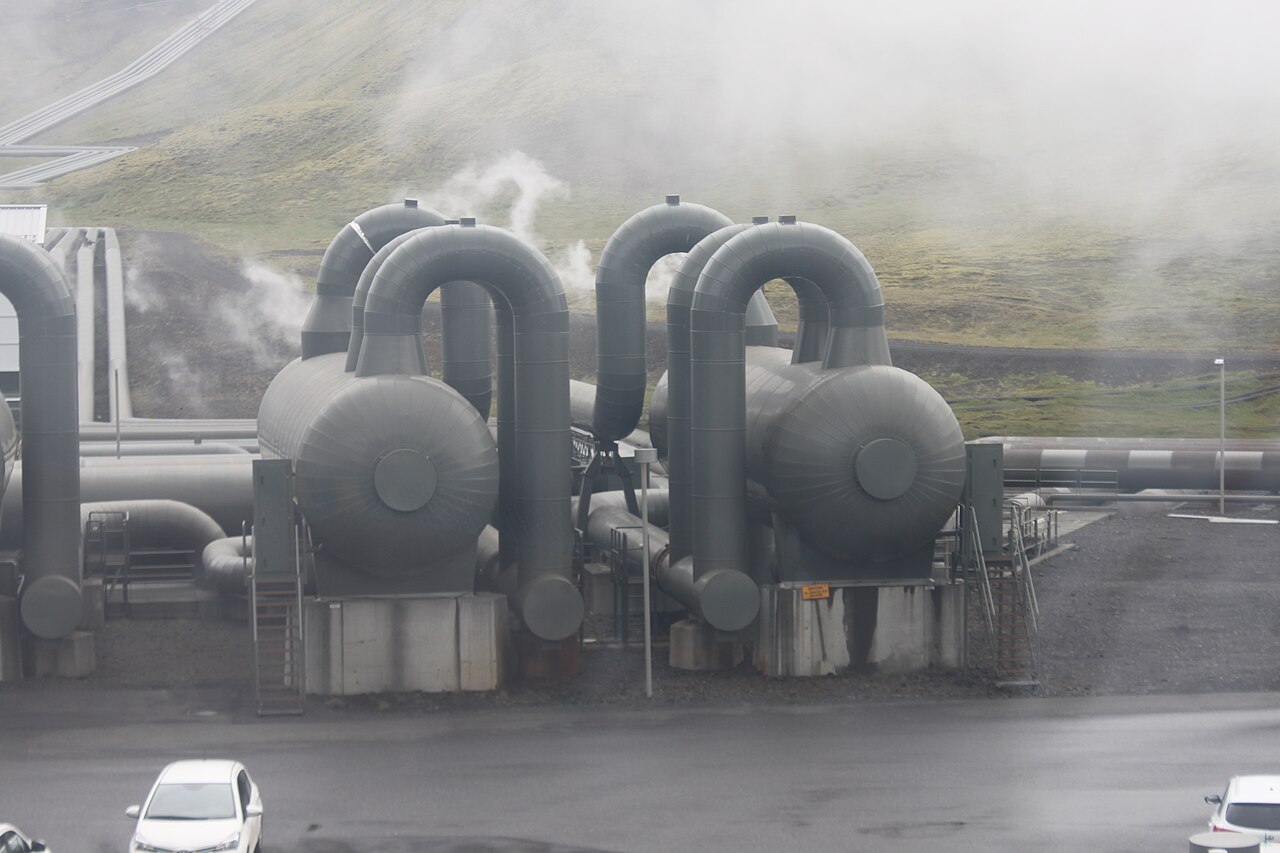
Iceland mixes hydropower with heat from the ground. Geothermal stations such as Hellisheiði and Nesjavellir near Reykjavík, and hydroelectric plants such as Kárahnjúkar in the east, supply effectively all of its electricity and about 85% of its total primary energy, with imported oil used mainly for transport. Abundant hydro and geothermal power make Iceland the world’s largest electricity producer per person, and most homes enjoy cheap geothermal heating and hot water. That cheap power is why aluminium smelters, which need huge amounts of electricity, have become one of Iceland’s three main export earners.
The Kingdom of 872 and the Republic of 1944
The political difference goes back to the start of Iceland itself. By tradition Harald Fairhair united Norway after the Battle of Hafrsfjord near Stavanger in 872, and according to the sagas many Norwegians left for Iceland, the Faroes and Greenland rather than live under him. Ingólfr Arnarson settled at Reykjavík in 874; by about 930 most of the island had been claimed, and Iceland governed itself through the Althing, founded that year, until it accepted Norwegian rule in 1262–1264. Much of what is known of Norway’s early kings comes from an Icelander, Snorri Sturluson.
From there the paths diverged. Norway spent 1537 to 1814 in Denmark–Norway, then a union with Sweden that it dissolved peacefully on 7 June 1905; a referendum later that year confirmed a monarchy over a republic. Iceland, left with Denmark by the Treaty of Kiel in 1814, won sovereignty under the Danish king in 1918 and voted to become a republic in 1944 while Denmark was under German occupation. Neither has joined the European Union: Norwegians voted no in 1972 and 1994, Iceland set aside its 2009 application in 2015, and on 29 August 2026 Icelanders voted 52.8% against reopening the talks. Both belong to EFTA and reach the EU single market through the European Economic Area.
Whaling and a €500 Million Loan: Oslo and Reykjavík Today
The two remain close partners in the Nordic Council, NATO and EFTA, and on some issues they stand together against most of the world. Both still hunt whales commercially and have often sided with Japan against calls to end the trade: in 1992 they jointly announced a return to commercial whaling on certain species, and when Iceland authorised commercial whaling again in 2006 it became only the second country after Norway to do so. When Iceland’s banks failed, Norway stepped in, lending €500 million over five years in November 2008 to steady the króna.
For more on how Norway turned rock, water and oil into wealth, see our guide to Norway’s natural resources; the full sweep of its mountains and coast is in our Norway geography guide, and the settlers’ story behind a name that confuses visitors is told in why Iceland is called Iceland.