
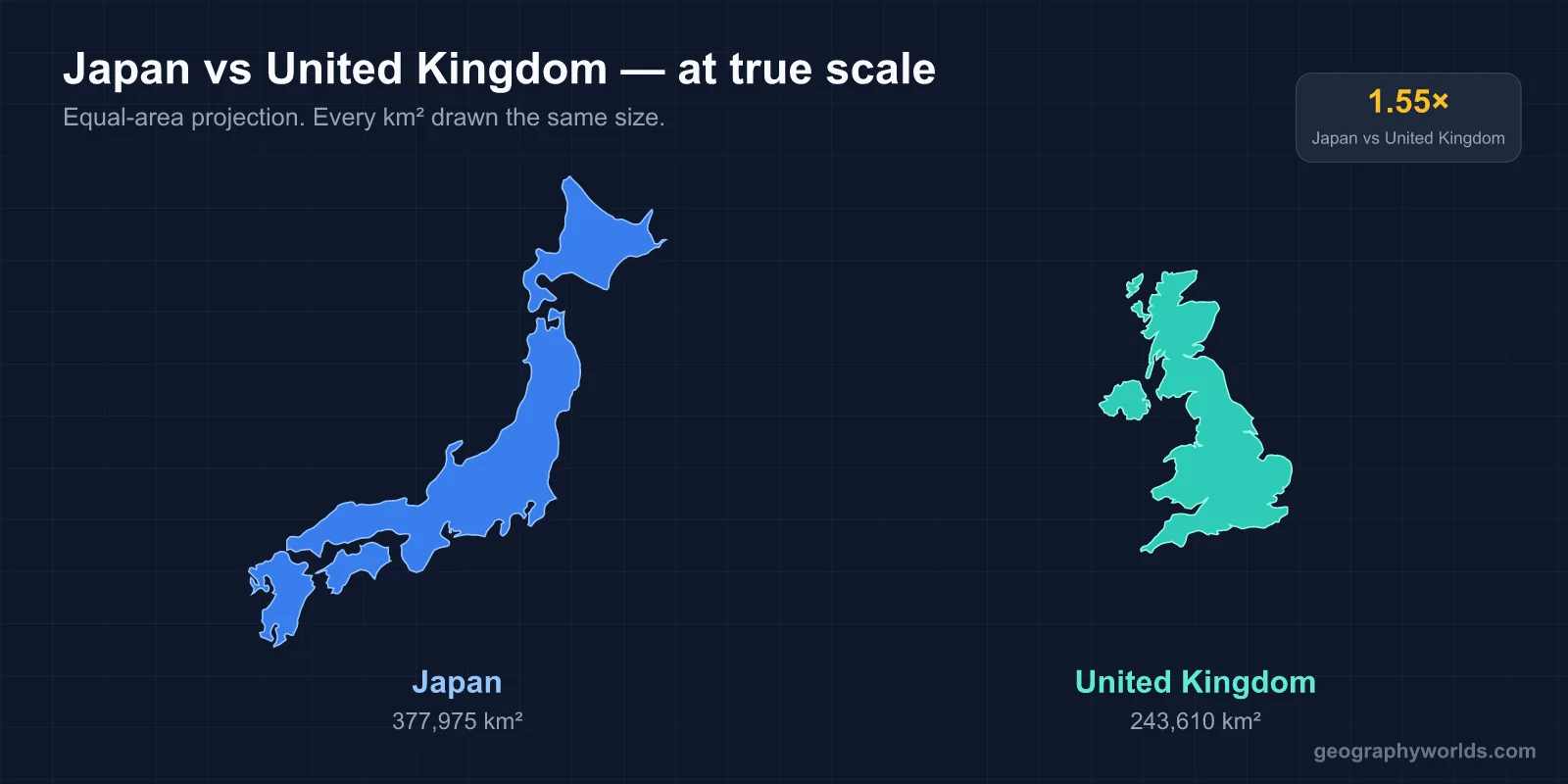
The United Kingdom and Japan are both archipelagos lying off the edge of a continental landmass, and both are densely populated, but Japan is substantially larger and far more mountainous. Japan covers about 378,000 km² to the UK's 244,000, and holds around 123 million people against roughly 68 million — yet only about a quarter of Japan's land is habitable, which puts far more pressure on its usable ground.
The same position, different distance
Both countries sit across a narrow sea from a much larger continent, and both have spent their histories managing what crosses it.
The Strait of Dover is about 33 km wide at its narrowest, which is close enough that England has been invaded repeatedly and, since 1994, is physically joined to France by the Channel Tunnel. The Korea Strait separating Japan from the Asian mainland is roughly 200 km — six times wider — and Japan has never been successfully invaded across it. The two Mongol attempts in 1274 and 1281 were broken up by storms, remembered as the kamikaze or divine wind.
That difference in distance shows up in the histories. Britain absorbed Romans, Anglo-Saxons, Vikings and Normans, and its language and law carry all of them. Japan borrowed heavily from China and Korea — writing, Buddhism, administrative models — but did so by choice and at arm's length, and was never occupied until 1945.
Flat against vertical
Physically the two are not much alike. The UK is a low country: its highest point, Ben Nevis, reaches 1,345 metres, and the great majority of England is gently rolling lowland. Most of the island is usable for farming or building.
Japan is roughly three-quarters mountainous. Its spine is a chain of volcanic ranges, Mount Fuji reaching 3,776 metres, and the flat land is confined to narrow coastal plains — of which the Kanto plain around Tokyo is by far the largest. That is why Japanese cities are so dense and why the Tokyo–Osaka corridor holds such an enormous share of the national population.
Japan also sits on the Pacific Ring of Fire, at the junction of several tectonic plates, and experiences a substantial share of the world's larger earthquakes along with roughly a tenth of its active volcanoes. The UK sits in the middle of a stable plate and has essentially no seismic hazard at all — a difference that runs right through building codes, insurance and public preparedness.
Driving on the left, and other shared oddities
Both drive on the left, which puts them in a minority of roughly a third of the world's population and is one of the more visible things they have in common. Japan's convention predates the car — it is generally traced to sword-wearing samurai keeping their scabbards clear — while Britain's was formalised by law in the eighteenth century and exported across its empire.
Both are also nations of tea drinkers with entirely different rituals attached, and both drive an outsized share of the world's whisky market — Japan's distilleries were founded in explicit imitation of Scotland's, and Japanese single malts now compete with Scotch at the top of international judging.
Both also use non-metric units in stubborn pockets despite official metrication: pints and miles in Britain, and in Japan the tsubo for floor area and traditional units in food and construction.
Two islands, two currents, two climates
Both countries are warmed by ocean currents, and both are milder than their latitudes suggest.
The UK sits between roughly 50 and 59 degrees north — the latitude of Labrador and Moscow — and is habitable at that range because of the North Atlantic Drift. Its climate is maritime and remarkably even: cool summers, mild winters, rain distributed through the year, and very little extremity in either direction.
Japan spans a far wider range, from around 24 degrees north in Okinawa to 45 in Hokkaido, which gives it subtropical islands at one end and heavy snow at the other. The Sea of Japan side of Honshu receives some of the heaviest snowfall recorded anywhere, as cold Siberian air picks up moisture crossing the sea and dumps it against the mountains. Japan also has a rainy season and a typhoon season; the UK has neither.
Constitutional monarchies with very different monarchies
Both are constitutional monarchies with a ceremonial head of state and a parliamentary government, and both have unusually long dynastic continuities.
The Japanese imperial house claims the longest unbroken hereditary succession of any monarchy in the world, and the emperor's role since 1947 has been defined constitutionally as a symbol of the state with no political powers whatsoever.
The British monarch retains formal prerogative powers exercised on ministerial advice, and the UK has no codified constitution at all — a rarity among developed democracies. Its parliament is sovereign in a way Japan's, operating under a written 1947 constitution, is not.
Both are shrinking, one faster
Japan's demographic position is the more extreme case of a problem both share. Its population peaked around 2010 and has been declining since, with one of the world's oldest median ages, very low fertility and historically restrictive immigration — although that last point has been quietly loosening.
The UK's fertility rate is also below replacement, but its population has continued to grow because of immigration, which has been a central and contested feature of its politics for two decades and a major factor in the 2016 vote to leave the European Union.
So the two islands face the same arithmetic and have answered it differently: Japan has absorbed the decline, and Britain has offset it.
Rail, and what each built instead of roads
Both invested early and heavily in railways, and both remain rail-dependent in a way the United States is not.
Britain invented the intercity railway — the Liverpool and Manchester line opened in 1830 — and exported the technology worldwide. Japan built the first high-speed line, the Tōkaidō Shinkansen, for the 1964 Tokyo Olympics, and its network is the benchmark for punctuality and safety, with no passenger fatalities from derailment or collision in its operating history.
The comparison is unflattering to Britain in the modern era. Japan's network carries an extraordinary share of intercity travel at high speed; Britain's, privatised in the 1990s and heavily used, has struggled with capacity and cost, and its own high-speed programme has been repeatedly cut back.
Fish, and two ways of eating it
Both are fishing nations shaped by surrounding seas, and both have exported that appetite.
Japan has among the highest per-capita seafood consumption of any large country, and Tokyo's wholesale market — Tsukiji until 2018, now Toyosu — is the reference point for global tuna pricing. Japanese demand is a major driver of bluefin fisheries worldwide, and the country's continued whaling, including its 2019 withdrawal from the International Whaling Commission, remains internationally contentious.
Britain's fishing industry is far smaller than its cultural weight suggests, and much of what it lands is exported while much of what it eats is imported. Fishing rights nonetheless became a symbolically enormous issue in the Brexit negotiations — out of all proportion to the sector's share of the economy, which is a fraction of one per cent.
What each sells the world now
Japan's export profile is machinery: vehicles above all, along with industrial robots, machine tools, semiconductors and precision components. Toyota has been among the largest carmakers in the world for years, and Japanese firms dominate several component categories that other countries' manufacturing depends on.
The UK's is services. Financial services, insurance, legal work, higher education, consultancy and creative industries make up the bulk of its exports, and the City of London remains one of the two dominant global financial centres. Its manufacturing is smaller as a share of output than Japan's by a wide margin, though it retains strengths in aerospace, pharmaceuticals and high-value automotive.
Both are also unusually dependent on imported energy and food, a vulnerability islands share. Japan imports the overwhelming majority of its fuel and around 60 per cent of its calories; the UK imports roughly half its food.
The comparison is between an economy that makes things and one that arranges them — and the two have very different exposures as a result.
Empire, and the endings
Both built maritime empires and both lost them in the middle of the twentieth century, but the endings could hardly have been more different.
Britain's empire was the largest in history by area and unwound over roughly three decades of mostly negotiated independence, leaving the Commonwealth, the English language and a set of legal systems behind it.
Japan's imperial expansion across Korea, Taiwan, Manchuria and South-East Asia ended in 1945 in total military defeat, occupation and a constitution renouncing war — Article 9 of which still constrains Japanese defence policy and remains politically contested.
What the two have in common now is a similar strategic posture: middle-sized island powers, allied to the United States, with economies far larger than their populations would suggest, working out how much to rely on a nearby continent they cannot move away from. Our Japan and United Kingdom guides cover each in its own right.