
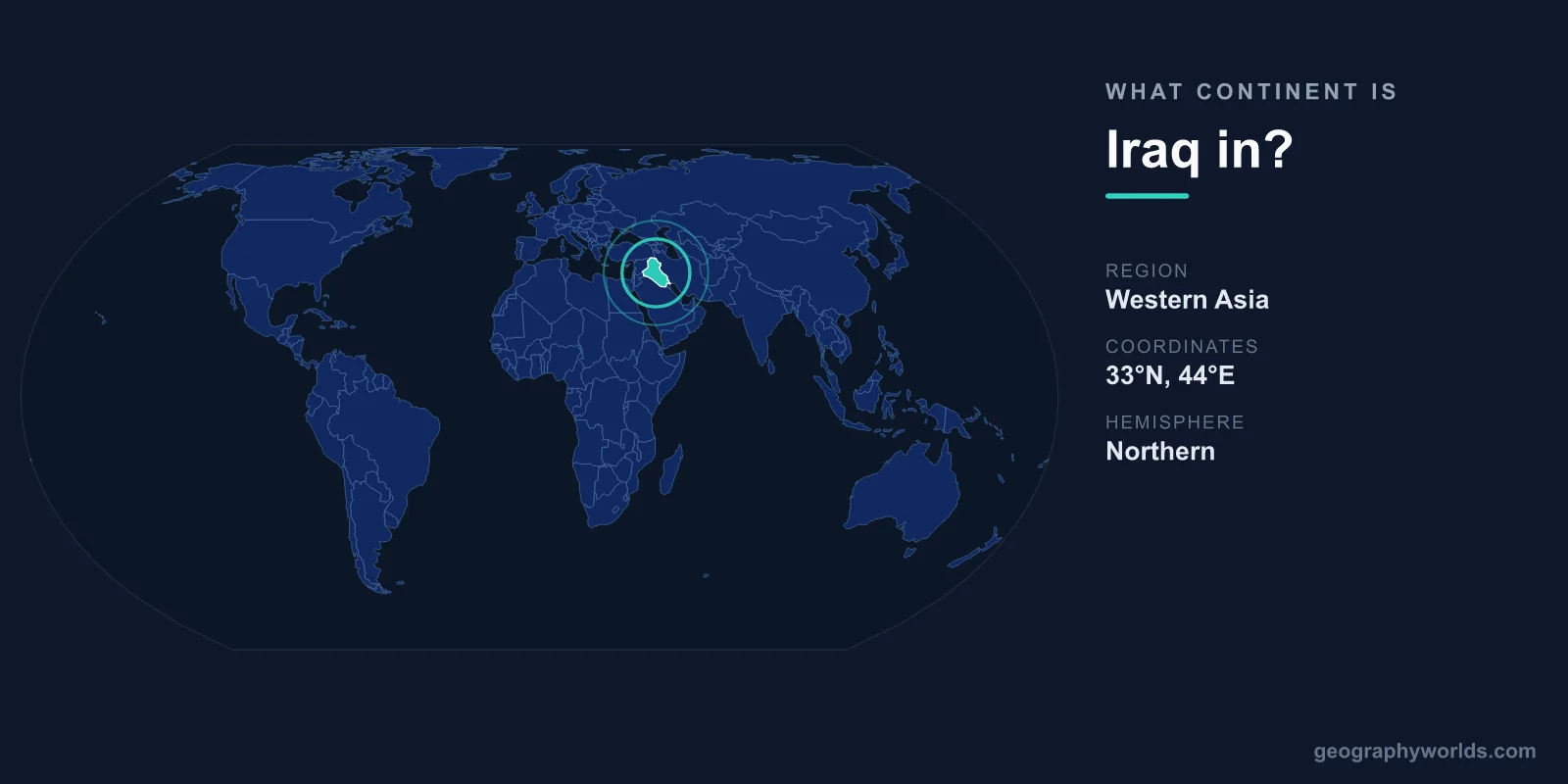
Iraq is located in Asia, specifically in the southwestern part of the continent in a region known as Western Asia, which is more commonly called the Middle East. It is not in Europe, Africa, or any other continent, though its position at the junction of three continents has made it a historic crossroads of trade, culture, and empire for thousands of years.
Why Iraq Is in Asia
Geographers divide the world into continents based on large, continuous landmasses, and Iraq sits firmly on the Asian landmass. The United Nations classifies Iraq within the subregion of Western Asia, alongside neighbors such as Iran, Syria, and Saudi Arabia. The broader cultural and political term "Middle East" is used interchangeably to describe this same area, but in terms of continents, the answer is unambiguous: Iraq belongs to Asia.
Iraq covers roughly 438,317 square kilometers, making it slightly larger than the U.S. state of California. Its capital, Baghdad, lies near the center of the country along the Tigris River and is one of the largest and oldest continuously inhabited cities in the Middle East. You can learn more in our iraq country guide.
Iraq's Place in the Middle East
Iraq occupies a central position in the Middle East, bordered by six countries — all of which are also in Asia:
- Turkey to the north (which straddles both Asia and Europe)
- Iran to the east
- Kuwait and Saudi Arabia to the south
- Jordan and Syria to the west
Iraq is almost entirely landlocked, with just a narrow 58-kilometer coastline on the Persian Gulf near the southern port city of Basra. This sliver of coast gives the country crucial access to international shipping routes and the global oil trade, despite being surrounded by land on nearly every side.
The Cradle of Civilization
Iraq's location in Asia is inseparable from its identity as the heart of ancient Mesopotamia — a Greek word meaning "the land between the rivers." Those rivers are the Tigris and the Euphrates, which flow southeast across the country before converging near Basra to form the Shatt al-Arab waterway that empties into the Persian Gulf.
The fertile plains between these two rivers nurtured some of humanity's earliest cities, including Ur, Uruk, and the legendary Babylon. It was here, around 3400 BC, that writing was first developed in the form of cuneiform script. Mesopotamia is widely credited with foundational human achievements such as the wheel, organized agriculture, codified law, and the first urban societies — which is why Iraq is so often called the "Cradle of Civilization." Centuries later, Baghdad became the center of the Islamic Golden Age, a hub of science, mathematics, and learning that flourished for hundreds of years.
Iraq's Varied Geography
Although Iraq is frequently pictured as flat desert, its terrain is surprisingly diverse for a country of its size. The landscape can be divided into several distinct zones:
- The northern mountains: The autonomous Kurdistan region features rugged ranges and green valleys. The country's highest point, Cheekha Dar, rises to about 3,611 meters near the Iranian border.
- The river plains: The fertile alluvial lowlands of central and southern Iraq are watered by the Tigris and Euphrates and support most of the country's agriculture and population.
- The western desert: Flat, arid plains stretch toward Jordan, Syria, and Saudi Arabia, with a hot, dry climate that defines much of the country.
- The southern marshlands: Near the Gulf lie the Mesopotamian Marshes, one of the world's most distinctive wetland ecosystems and home to the Marsh Arabs.
Most of Iraq experiences an arid to semi-arid climate, with extremely hot summers in the south and cooler, wetter conditions in the northern highlands.
A Crossroads of Three Continents
While Iraq is geographically in Asia, its strategic importance comes from sitting close to where Asia, Africa, and Europe meet. Throughout history this position placed it along major trade routes connecting the Mediterranean world to Persia, India, and beyond. Empires from the Akkadians and Babylonians to the Persians, Greeks, and later the Islamic caliphates all sought control of this land precisely because of where it sits on the map. Today that same location keeps Iraq central to the politics, energy markets, and culture of the wider Middle East.
Frequently Asked Questions
Is Iraq in the Middle East or Asia?
Both terms apply. "Asia" refers to the continent Iraq sits on, while "Middle East" is a regional and cultural label for the part of Western Asia (and nearby North Africa) where Iraq is found. There is no contradiction — Iraq is a Middle Eastern country located on the continent of Asia.
Is any part of Iraq in Europe or Africa?
No. Iraq lies entirely within Asia. Unlike neighboring Turkey, which spans both Asia and Europe, Iraq does not cross any continental boundary and has no territory in Europe or Africa.
What is the capital of Iraq and where is it?
The capital is Baghdad, located in the center of the country along the Tigris River. It has been a major city for more than 1,200 years and was once the intellectual capital of the Islamic world during its Golden Age.
Does Iraq have a coastline?
Yes, but only a very short one — about 58 kilometers along the Persian Gulf in the far south, near Basra. The rest of the country is bordered by land, making Iraq almost entirely landlocked.