
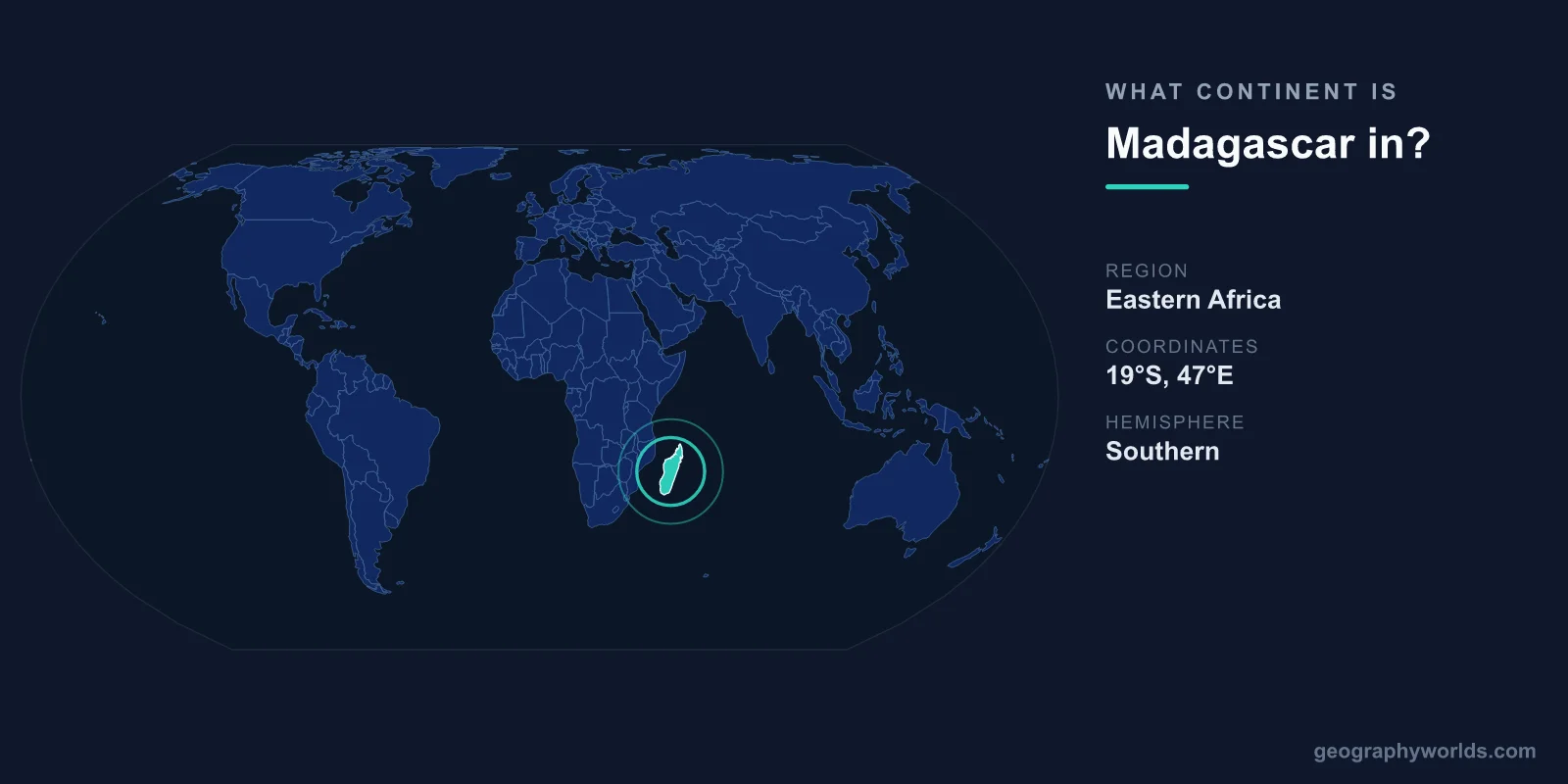
Madagascar is located in Africa. It sits in the western Indian Ocean off the continent's southeastern coast, separated from mainland Africa by the Mozambique Channel. Although it is the world's fourth-largest island and lies hundreds of kilometres out at sea, Madagascar is firmly classified as an African nation by both the United Nations and the African Union.
Why Madagascar Is Part of Africa
Madagascar's African identity rests on geography, politics, and history. The United Nations places it in the Eastern Africa subregion, alongside countries such as Kenya, Tanzania, and Mozambique. Politically, Madagascar is a founding-era member of the African Union and participates in regional African organisations rather than Asian or Oceanian ones.
Geographically, the island lies just about 400 kilometres east of Mozambique across the Mozambique Channel. That channel is the only thing dividing it from the African mainland, and no other continent is anywhere near as close. Geologically, too, the rocks of Madagascar were once joined to Africa as part of the ancient supercontinent Gondwana, reinforcing the connection that continues today.
An Island in the Indian Ocean
Madagascar covers roughly 587,041 km², making it the fourth-largest island on Earth after Greenland, New Guinea, and Borneo. It stretches about 1,580 kilometres from north to south and has a coastline of around 4,828 kilometres, giving it more land area than France or mainland Spain.
Its position in the western Indian Ocean places it among a cluster of African island nations and territories:
- Comoros and Mayotte lie to the northwest, near the top of the Mozambique Channel.
- Mauritius and the French island of Réunion sit to the east.
- The Seychelles lie far to the northeast.
The capital, Antananarivo, sits inland on the central highland plateau at around 1,280 metres above sea level, well away from the tropical coasts.
How Madagascar Became So Isolated
Madagascar's geography tells a long story of separation. The island broke away from the African mainland roughly 160 million years ago, and later split from the Indian subcontinent about 88 million years ago. Since then it has drifted in isolation, with no land bridge connecting it to any continent.
This deep isolation turned the island into a kind of natural laboratory for evolution. Around 90% of Madagascar's wildlife is found nowhere else on Earth. Lemurs — primates that exist in the wild only here — number roughly 100 species, from the tiny mouse lemur to the indri. The island is also home to the fossa, a cat-like predator, and a remarkable variety of chameleons, frogs, and orchids. Its iconic baobab trees, some more than 1,000 years old, can store enormous quantities of water in their swollen trunks.
The Landscape From Coast to Coast
Despite being a single island, Madagascar packs in dramatically varied terrain. A central highland plateau runs down the spine of the country and reaches its highest point at Maromokotro, a peak of 2,876 metres in the Tsaratanana Massif in the north.
The climate and vegetation shift sharply across the island:
- Eastern coast: humid and rainy, cloaked in tropical rainforest.
- Central highlands: cooler and temperate, with rolling hills and terraced rice paddies.
- Western lowlands: dry deciduous forest and savanna.
- Southwest: semi-arid scrub and spiny desert, home to unusual drought-adapted plants.
This range of environments, all within one country, is part of what makes Madagascar one of the most biologically diverse places in Africa. To explore the country's people, culture, and travel highlights in more depth, see our madagascar country guide.
Frequently Asked Questions
Is Madagascar in Africa or Asia?
Madagascar is in Africa. While it lies in the Indian Ocean, it is far closer to the African mainland than to Asia and is classified as part of Eastern Africa by the United Nations and the African Union.
Is Madagascar a country or just an island?
It is both. Madagascar is a sovereign country and is also the world's fourth-largest island. The nation occupies the entire main island plus several smaller surrounding islets.
How far is Madagascar from mainland Africa?
At its closest, Madagascar lies about 400 kilometres east of Mozambique, separated by the Mozambique Channel.
What is the capital of Madagascar?
The capital is Antananarivo, located in the central highlands of the island and home to the country's government and largest population centre.