
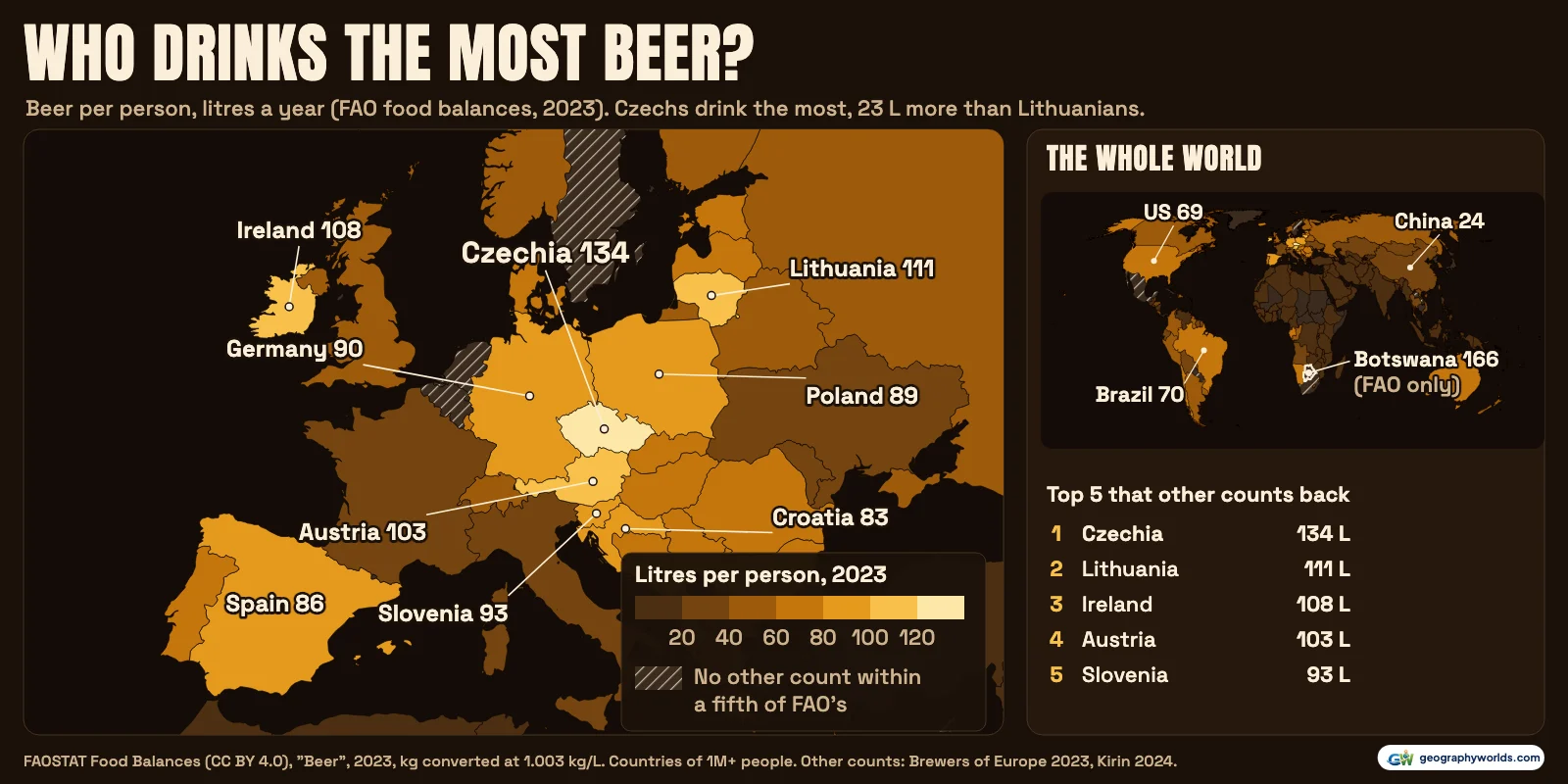
Czechia drinks the most beer per person: about 134 litres a year in FAO's food balance sheets for 2023, and 133.2 litres in the Czech Statistical Office's own count. Lithuania (111 litres), Ireland (108) and Austria (103) come next. FAO's table actually puts Botswana first, at 166 litres, but no second source we checked supports it: Kirin's top 35, which ends at 55.2 litres, leaves Botswana out. In total volume, China drinks the most beer, 33.6 billion litres in 2023, ahead of the United States (23.7 billion).
Those figures come from the FAO's food balance sheets, which measure supply, not drinking. For each country FAO takes beer production, adds imports, subtracts exports and stock changes, and divides what is left by the resident population. Its handbook says the result reflects "only the quantities reaching the consumer" and that the amount actually consumed may be lower. FAO also reports beer by weight. USDA's food database weighs a 12-fluid-ounce can of regular beer at 356 g, or 1.003 kg per litre, so kilograms and litres differ by only 0.3%; every litre figure here is FAO's kilograms divided by that factor. To test the table we set it beside three counts that do not come from FAO: the Czech Statistical Office, the Brewers of Europe's figures for 2023, and the brewer Kirin's global report for 2024.
Per person and in total are two different leaderboards
China's 33.6 billion litres is 19% of all the beer in FAO's world balance, and Kirin's report, built from brewers' associations, puts China higher still, at 42.1 billion litres for 2023 and first in the world for the 22nd year running in 2024. The United States is second in both ledgers: 23.7 billion litres in FAO's figures, 22.5 billion in Kirin's. Brazil (14.8 billion), Russia (8.6 billion) and Mexico (8.3 billion) follow, with Germany (7.6 billion) the largest European market.
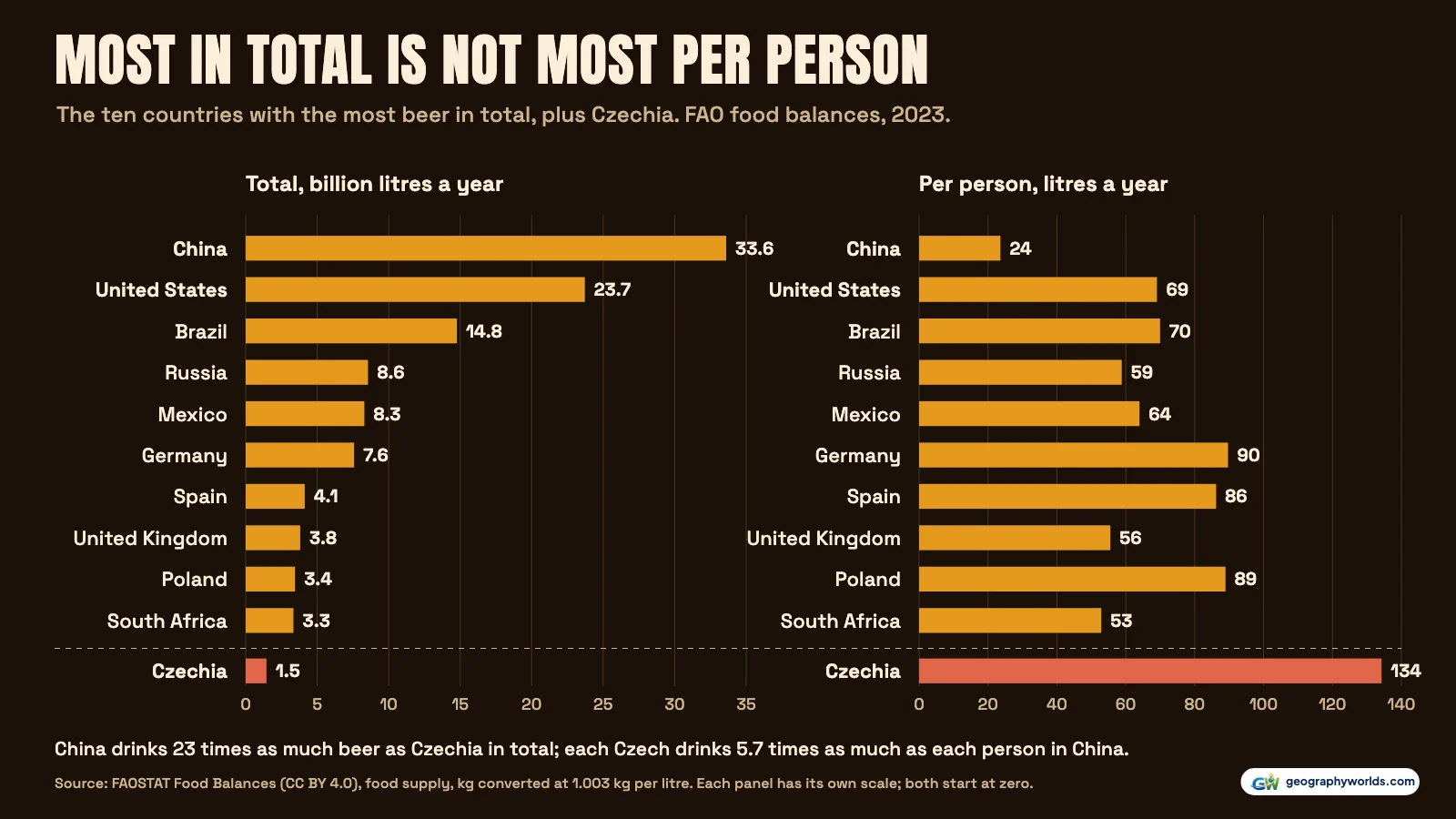
Spread over 1.4 billion people, China's total comes to just 24 litres each, 64th of the 130 ranked countries of 1 million people or more. Czechia is the mirror image. Its 1.45 billion litres rank only 25th in total, yet each Czech drinks 5.7 times as much as each person in China, while China drinks 23 times as much as Czechia overall. The United States sits in between: big in total, 18th per person at 69 litres.
| Rank (FAO) | Country | FAO 2023 (billion L) | Kirin 2023 (billion L) | Litres per person (FAO 2023) |
|---|---|---|---|---|
| 1 | China | 33.60 | 42.09 | 24 |
| 2 | United States | 23.72 | 22.46 | 69 |
| 3 | Brazil | 14.77 | 15.14 | 70 |
| 4 | Russia | 8.56 | 8.73 | 59 |
| 5 | Mexico | 8.30 | 10.23 | 64 |
| 6 | Germany | 7.58 | 7.40 | 90 |
| 7 | Spain | 4.13 | 4.42 | 86 |
| 8 | United Kingdom | 3.81 | 4.43 | 56 |
| 9 | Poland | 3.45 | 3.40 | 89 |
| 10 | South Africa | 3.34 | 4.39 | 53 |
| 25 | Czechia | 1.45 | 1.58 | 134 |
FAO's China figure has also shrunk. It peaked at 47.5 billion litres in 2013, about two-fifths above the 2023 figure. Kirin's China total fell 3.7% in 2024 alone.
The per-person table, and the figures nobody else backs
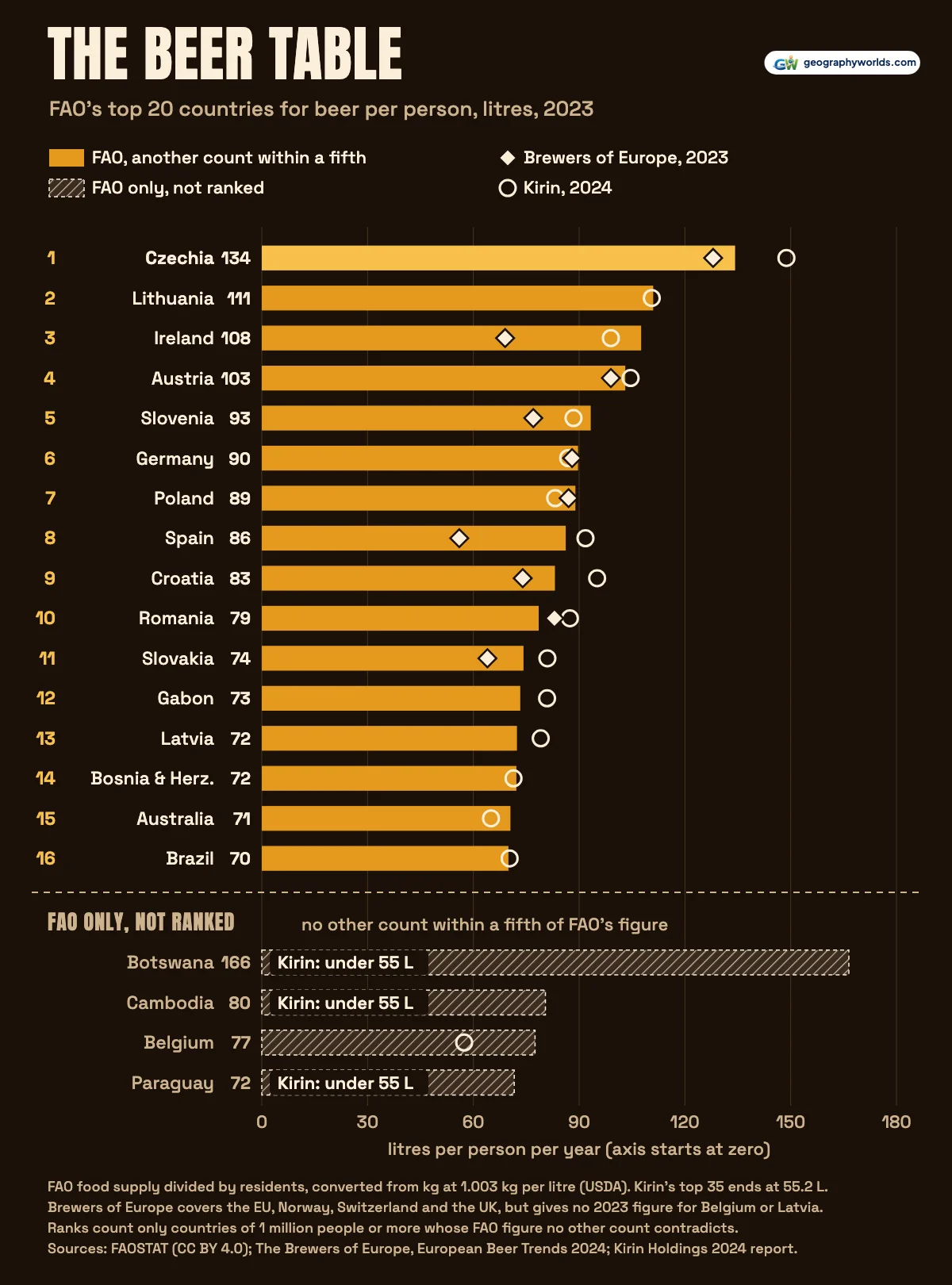
We kept a country's FAO figure as checked when the Brewers of Europe or Kirin lands within a fifth of it. Brewers of Europe covers the EU, Norway, Switzerland and the United Kingdom; Kirin publishes only its 35 highest per-person countries, ending with Laos at 55.2 litres. Of FAO's top 20, 16 pass that test and 4 do not. Across all 141 countries of 1 million people or more, 11 get no rank number because another count sits more than a fifth from FAO's figure or Kirin's list rules it out: Botswana, Cambodia, Belgium, Paraguay, Panama, Mexico, South Africa, Sweden, Netherlands, Cyprus and Laos; their FAO values stay in the table and the CSV.
| Rank | Country | FAO 2023 (L/person) | Brewers of Europe 2023 (L) | Kirin 2024 (L) | Another source within 20%? |
|---|---|---|---|---|---|
| not ranked | Botswana | 166 | not covered | not in top 35 (under 55.2) | no |
| 1 | Czechia | 134 | 128 | 148.8 | yes |
| 2 | Lithuania | 111 | n/a | 110.6 | yes |
| 3 | Ireland | 108 | 69 | 99.0 | yes |
| 4 | Austria | 103 | 99 | 104.6 | yes |
| 5 | Slovenia | 93 | 77 | 88.4 | yes |
| 6 | Germany | 90 | 88 | 86.9 | yes |
| 7 | Poland | 89 | 87 | 83.2 | yes |
| 8 | Spain | 86 | 56 | 91.8 | yes |
| 9 | Croatia | 83 | 74 | 95.1 | yes |
| not ranked | Cambodia | 80 | not covered | not in top 35 (under 55.2) | no |
| 10 | Romania | 79 | 83 | 87.4 | yes |
| not ranked | Belgium | 77 | n/a | 57.4 | no |
| 11 | Slovakia | 74 | 64 | 81.0 | yes |
| 12 | Gabon | 73 | not covered | 80.9 | yes |
| 13 | Latvia | 72 | n/a | 79.1 | yes |
| 14 | Bosnia and Herzegovina | 72 | not covered | 71.4 | yes |
| not ranked | Paraguay | 72 | not covered | not in top 35 (under 55.2) | no |
| 15 | Australia | 71 | not covered | 65.0 | yes |
| 16 | Brazil | 70 | not covered | 70.3 | yes |
Botswana is the biggest problem. FAO's figure for the country of 2.5 million people rose from 36 litres in 2010 to 166 in 2023, above Czechia's in 2021, 2022 and 2023. Both sides of its ledger jumped: production from 38,000 to 200,000 tonnes, and imports from 37,000 tonnes in 2016 to 139,000 in 2017 and 215,000 by 2023. Kirin's list does not include Botswana at all, so if Kirin covers it, its reading is under 55.2 litres, a third of FAO's or less. We report FAO's number but do not rank it.
Cambodia and Paraguay look similar. Cambodia's figure leapt from 45 to 74 litres between 2018 and 2019, when FAO's production estimate went from 700,000 to 1,200,000 tonnes; Paraguay's has nearly doubled since 2010, from 37 litres. Neither appears in Kirin's top 35. Belgium is a re-exporter: FAO records 1,498,000 tonnes of exports against 2,300,000 tonnes brewed, and Kirin's 57.4 litres sits well below FAO's 77. The errors run the other way too. FAO gives the Netherlands 41 litres where Brewers of Europe has 65, and Laos 8 where Kirin has 55.2.
Ireland and Spain split the sources. Kirin backs FAO, with 99.0 litres for Ireland and 91.8 for Spain, while Brewers of Europe reports just 69 and 56. The brewers' report notes that its Spanish figure comes from the Ministry of Agriculture. FAO divides by residents only, so beer drunk by holidaymakers lands in the per-resident figure, and so does any export that customs records miss. We cannot say which source is right, so both stay in the table.
Why Czechia stays out in front
None of this touches the top. Czechia is first in Kirin's table and the brewers' European table, and first among the countries ranked here; its 134 litres put it 23 litres, or 21%, ahead of Lithuania. With Botswana set aside, Czechia led FAO's table in twelve of the fourteen years from 2010 to 2023, every year since 2014; Ireland led in 2011 and 2013, reaching 150 litres in 2013 against Czechia's 142. Kirin says the Czech Republic has topped its per-person ranking every year since 1993, 32 years running.
Almost all of that beer is brewed at home. FAO records 2.0 million tonnes of Czech production in 2023, with 533,000 tonnes exported (27%) and only 38,000 tonnes imported. The Brewers of Europe's count agrees: 20.0 million hectolitres brewed and 5.06 million exported. It also shows where Czechs drink. Only 30% of the volume went through pubs and restaurants in 2023, and 70% was bought in shops, so most Czech beer is bought to take home. What Czechs eat with it is covered in our guide to the traditional food of the Czech Republic.

The pilsner style was born here. Germany's patent office notes that the first brew made by the method now known worldwide as Pilsner took place in Plzeň on 5 October 1842, under the Bavarian brewer Joseph Groll. Next door, Austria drinks 103 litres a head; our Czech Republic and Austria comparison sets the two neighbours side by side on everything else.
Even for Czechia, the counts do not agree on the size of the lead. The Czech Statistical Office puts beer at 133.2 litres per person in 2023, within 1% of FAO. Brewers of Europe says 128. Kirin says 152.1 litres for 2023. Part of that gap is the divisor: Kirin's own total and per-person figures for 2024 imply a population of about 10.5 million, while FAO counts 10.81 million residents. Kirin's 2023 total of 1,576 million litres, shared among FAO's residents, comes to 146 litres. None of these counts removes beer drunk by Prague's visitors. FAO's file has a line for tourist consumption, but for Czechia it reads zero for 2010 to 2013 and is blank after that.
Less beer, even in the pilsner's homeland
The leader is drinking less. FAO's Czech figure peaked at 152.4 litres in 2019 and fell to 134.2 in 2023, the lowest since its series begins in 2010. The statistics office tells the same story with a sharper last step: 147.0 litres in 2014, 146.0 in 2019, 142.9 in 2022 and 133.2 in 2023, the lowest in its ten-year table. Brewers of Europe's Czech figure fell from 138 litres in 2017 to 128.
Germany shows the same drift: 100 litres per person in FAO's 2010 figure, 90 in 2023, while Brewers of Europe has it falling from 98 litres in 2017 to 88. Across the world, FAO's figure slipped from 25.3 litres a head in 2010 to 22.0 in 2023. Total volume is roughly flat, because growth in places with rising populations offsets the decline: Kirin counts 194.1 billion litres in 2024, 0.5% more than in 2023.
The fastest risers in FAO's top 20 since 2010 are Botswana, Cambodia and Paraguay, the same three that no other count supports. Rapid growth in a balance sheet is as likely to mean a new production estimate as new drinkers, which is why a second source matters most where the numbers move fastest.
How the figures were built
FAO figures are from the Food Balances (2010–) bulk file, item "Beer", element "Food supply quantity (kg/capita/yr)", which runs to 2023. Regional totals are removed, Hong Kong and Macao are treated as territories, and the ranking covers countries of 1 million people or more. Kilograms become litres at 1.0031 kg per litre, from USDA's 356 g for a 354.9 ml can. Second readings are the Brewers of Europe's 2023 per-person table in European Beer Trends (2024 edition) and Kirin's 2024 per-person table; a figure counts as backed when either lands within 20% of FAO's. The two second sources cover different years and are not adjusted. The Czech Statistical Office series is used for Czechia only.
You can download the data as a CSV: all 175 countries and territories, FAO's per-person figure for every year since 2010, 2023 production and trade, and the Brewers of Europe and Kirin readings beside each.
- FAO, FAOSTAT Food Balances (2010–), item "Beer": food supply (kg per person per year), food, production, imports, exports and population, 2010–2023; bulk file of October 2025; CC BY 4.0 (FAO database terms of use)
- Czech Statistical Office, Spotřeba potravin 2023, table 2 (alcoholic beverages per person): beer, total, litres per person a year, 2014–2023
- The Brewers of Europe, European Beer Trends, 2024 edition: beer consumption per person 2017–2023 (litres), production, exports and on-trade share for Czechia; quoted
- Kirin Holdings, Global Beer Consumption by Country in 2024 (22 December 2025): total consumption 2023 and 2024 (thousand kl) and per-person consumption 2024 (litres) for the top 35 countries; quoted
- Kirin Holdings, Global Beer Consumption by Country in 2023 (19 December 2024): Czech per-person figure for 2023 (152.1 L), quoted from the release text
- USDA FoodData Central, Alcoholic beverage, beer, regular, all (FDC 168746): portion weights used for the kg-to-litre conversion; public domain
- FAO, Food Balance Sheets: A Handbook (2001), chapter 2
- Natural Earth country outlines (via world-atlas): public domain
Coffee tells a similar story about balance sheets, and our ranking of the countries that drink the most coffee runs the same kind of second-source test on Finland's famous habit.