
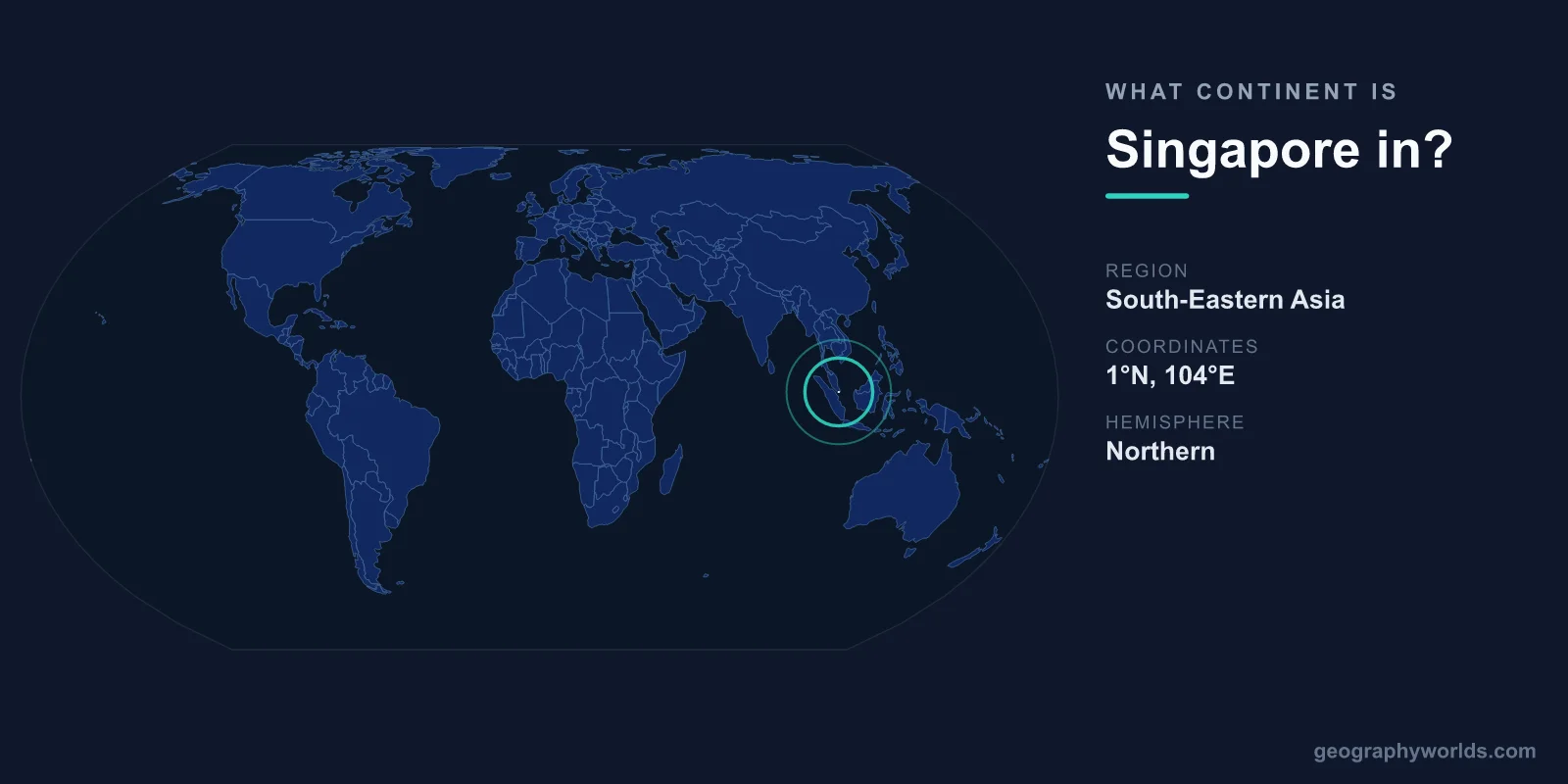
Singapore is in Asia, more precisely in the region of Southeast Asia. It is a sovereign island city-state perched at the southern tip of the Malay Peninsula, just one degree of latitude north of the equator. Although it ranks among the smallest nations on Earth at roughly 733 square kilometers, Singapore is one of Asia's wealthiest, most connected, and most strategically located countries.
Asia and the Southeast Asian Region
When people ask which continent Singapore belongs to, the answer is unambiguous: Asia. Within that vast continent, Singapore sits in the southeastern subregion alongside neighbors such as Malaysia, Indonesia, Thailand, the Philippines, and Vietnam. The United Nations geoscheme, the World Bank, and ASEAN all classify Singapore as part of Southeast Asia.
Southeast Asia is generally divided into a mainland portion (Indochina) and a maritime portion (the islands and archipelagos). Singapore belongs firmly to maritime Southeast Asia, sitting almost exactly where the two halves meet. This pivotal position, where the Asian mainland gives way to the great island chains of Indonesia, has shaped Singapore's identity as a meeting point of cultures, trade routes, and peoples for centuries. It is worth noting that Asia is the largest continent on Earth, home to more than half of humanity, so saying a country is "in Asia" still leaves enormous variety. Singapore's specific corner of Asia is defined by warm seas, dense rainforest origins, and a position astride one of the world's great maritime corridors.
Where Exactly Is Singapore?
Singapore lies at approximately 1.3 degrees north of the equator and 103.8 degrees east longitude. It hangs off the bottom of the Malay Peninsula like a punctuation mark, separated from Malaysia to the north by the narrow Strait of Johor and from Indonesia's Riau Islands to the south by the Strait of Singapore. Two causeways link Singapore to the Malaysian mainland, carrying road and rail traffic across the water.
The country is not a single landmass. It is made up of one main island, often called Pulau Ujong, plus more than 60 smaller islets. The main island accounts for the overwhelming majority of the population and developed area, while smaller islands such as Sentosa, Jurong Island, and Pulau Tekong serve roles in tourism, industry, and defense. To put its location in everyday terms, Singapore sits roughly 350 kilometers north of the equator-crossing islands of Indonesia and around 4,700 kilometers southwest of Tokyo. It shares a time zone with much of East and Southeast Asia but, because of a historical decision to align with Malaysia, its clocks run notably ahead of where its longitude would naturally place them.
A Tropical Land at the Equator
Because Singapore sits so close to the equator, it has a tropical rainforest climate with little seasonal variation. Temperatures hover around 25 to 32 degrees Celsius year-round, humidity is high, and rainfall is abundant in every month. There are no true winters or summers, only slightly wetter and slightly drier stretches tied to the northeast and southwest monsoons. The wettest months typically fall between November and January during the northeast monsoon, while sudden afternoon thunderstorms can occur in any season. This consistent warmth and moisture once cloaked the islands in lush equatorial forest, fragments of which survive in protected reserves and give Singapore its reputation as a "City in a Garden."
The terrain is mostly low and gently undulating. Bukit Timah Hill, the highest natural point, rises just 163 meters, a reminder that Singapore is a city built far more on commerce and ingenuity than on dramatic landscapes. The central catchment area holds reservoirs and remnant rainforest, while much of the rest of the island has been intensively developed or reclaimed from the sea.
Key Facts
- Continent: Asia
- Region: Southeast Asia (maritime)
- Area: Approximately 733 km²
- Highest point: Bukit Timah Hill, about 163 m
- Coastline: Roughly 193 km
- Islands: One main island plus 60+ islets
- Capital: Singapore (the city and country are the same)
Why Singapore's Location Matters
Singapore's spot on the map is no accident of importance. It commands the eastern entrance to the Strait of Malacca, one of the busiest and most strategically vital shipping lanes on the planet. Vessels traveling between the Indian Ocean and the Pacific Ocean, including a huge share of global oil and container traffic, funnel past Singapore. This has made the country one of the world's busiest ports and a leading global financial and logistics hub.
That same crossroads position explains Singapore's remarkable diversity. Its population blends Chinese, Malay, Indian, and other communities, and the nation recognizes four official languages: English, Mandarin, Malay, and Tamil. Trade brought these peoples together, and Singapore's geography keeps it connected to the rest of Asia and the wider world. Singapore is also a founding member of ASEAN, the Association of Southeast Asian Nations, established in 1967, and it serves as a regional headquarters for countless multinational companies precisely because of where it sits.
Remarkably, Singapore has grown physically over time. Through extensive land reclamation since its independence in 1965, the city-state has expanded its total land area by around a quarter, pushing its coastline outward to make room for ports, airports, industry, and housing. Few countries have reshaped their own geography so deliberately, and Singapore plans to keep reclaiming land for decades to come.
A City, a State, and a Country All at Once
Singapore is unusual because it is simultaneously a city, a country, and an island. It is one of only a handful of true city-states left in the world, in company with Monaco and Vatican City. The capital of Singapore is, fittingly, Singapore itself, as the entire nation functions as a single urban entity governed from one center. Unlike most countries, it has no rural provinces, no distant second city, and no internal states to manage, which makes its government, economy, and infrastructure exceptionally compact and tightly coordinated. To explore its history, culture, economy, and travel highlights in more depth, see our singapore country guide.
How Singapore Compares to Its Neighbors
Geographically, Singapore is dwarfed by the nations surrounding it. Indonesia, its southern neighbor, is an archipelago of more than 17,000 islands spanning three time zones, while Malaysia, to the north, is many hundreds of times larger in area. Yet despite its tiny footprint, Singapore punches far above its size in economic and strategic terms. Its position at the meeting point of mainland and maritime Southeast Asia, and at the gateway between two oceans, gives it an influence that has little to do with the number of square kilometers it occupies. In that sense, Singapore is the clearest example of how location, rather than size, can define a country's place in the world.
Frequently Asked Questions
Is Singapore in Asia or Oceania?
Singapore is firmly in Asia, within the Southeast Asian region. It is not part of Oceania. Although it is a tropical island nation, it lies on the edge of the Asian mainland rather than in the Pacific island world that defines Oceania.
Is Singapore part of China?
No. Singapore is a fully independent, sovereign country and is not part of China. While a majority of Singaporeans are of Chinese descent and Mandarin is one of its official languages, Singapore has its own government, currency, and legal system, and gained full independence in 1965.
What countries border Singapore?
Singapore has no land borders in the traditional sense, but its closest neighbors are Malaysia to the north and Indonesia to the south. It is connected to Malaysia by two causeways and is separated from both countries by narrow straits of water.
How close is Singapore to the equator?
Singapore lies only about 137 kilometers, or roughly one degree of latitude, north of the equator. This near-equatorial position is why it experiences hot, humid, and consistently tropical weather throughout the year, with no distinct cold season.