
Taiga, also known as boreal forest, is the world's largest terrestrial biome, forming a vast circumpolar belt of coniferous trees across the northern latitudes of Russia, Canada, Scandinavia, and Alaska.
Introduction
Covering approximately 17 million square kilometers — roughly 11.5 percent of Earth's land surface — the taiga stores more carbon than any other terrestrial biome. It stretches unbroken for thousands of kilometers across Siberia and Canada, representing one of the last great wilderness areas on Earth. Winters are long and brutally cold, with temperatures dropping below minus 40 degrees Celsius, while brief summers bring enough warmth for explosive growth.
Definition & Key Characteristics
- Definition: A biome of dense coniferous forest in subarctic regions, characterized by long, cold winters and short summers
- Area: Approximately 17 million km², the largest terrestrial biome
- Temperature Range: -40°C in winter to +20°C in summer
- Growing Season: Only 80 to 150 frost-free days per year
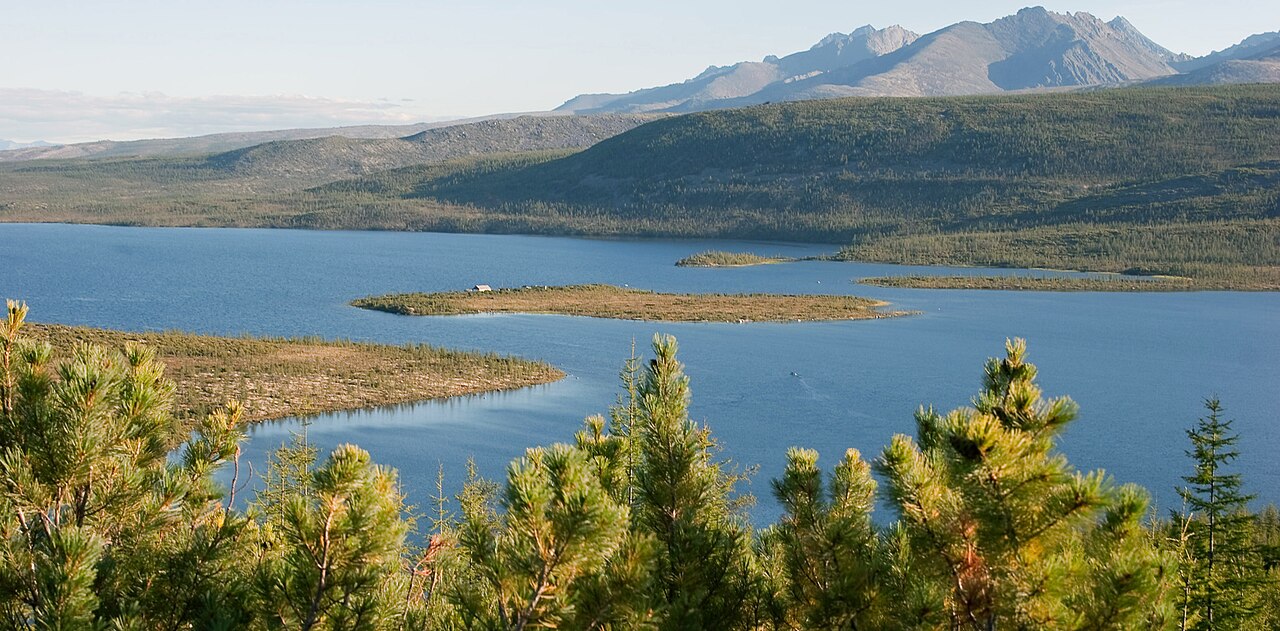
The taiga lies between the tundra to the north and temperate forests or steppes to the south, typically spanning latitudes 50°N to 70°N. It is dominated by cold-tolerant coniferous tree species, primarily spruce, pine, fir, and larch. These trees have evolved needle-shaped leaves with waxy coatings to reduce water loss and conical shapes that shed heavy snow. The forest floor is often carpeted with mosses, lichens, and a thick layer of acidic needles that decompose very slowly in the cold.
Precipitation in the taiga is generally low — 300 to 900 millimeters annually — but because evaporation is also low due to cold temperatures, the soil remains moist or waterlogged for much of the year. Permafrost underlies much of the northern taiga, creating poorly drained, boggy conditions. The combination of cold, acidic soils and short growing seasons makes the taiga a nutrient-poor environment where decomposition is extremely slow.
How the Taiga Forms
- Climate Driver: Continental climates at high latitudes with extreme seasonal temperature swings
- After Ice Ages: Boreal forests recolonized land exposed by retreating glaciers starting about 10,000 years ago
- Fire Cycle: Natural fires on 50-to-200-year cycles regenerate the forest and recycle nutrients
- Succession: After fire, pioneer species like birch and aspen give way to spruce and fir
The taiga exists because of the extreme continentality of high-latitude landmasses. Far from moderating ocean influences, the interiors of Russia and Canada experience massive seasonal temperature swings. Winters are long enough to exclude temperate deciduous trees, which cannot survive months of frozen soil, but summers are just warm enough for cold-adapted conifers to complete their annual growth cycle.
Fire is essential to taiga ecology, much as it is to savannas. Lightning-ignited wildfires sweep through the boreal forest on cycles of 50 to 200 years, consuming dead wood and thick moss layers, releasing locked-up nutrients, and opening the canopy to light. Many taiga species are adapted to fire: jack pine cones open only when heated, and birch and aspen sprout rapidly from stumps. Without fire, organic matter would accumulate indefinitely, locking nutrients away from living trees.
Locations & Extent
- Russia: Contains the largest taiga, stretching over 5,000 km from the Urals to the Pacific
- Canada: Boreal forest covers 270 million hectares, over half the country's land area
- Scandinavia: The taiga extends across Finland, Sweden, and Norway
- Alaska: Interior Alaska supports extensive boreal spruce forests
- Southernmost Extent: Reaches as far south as 50°N in parts of Canada and Russia
Russia's taiga is the largest continuous forest on Earth, spanning eleven time zones from the Ural Mountains to the Sea of Okhotsk. The Siberian taiga alone covers over 9 million square kilometers, an area larger than the entire Amazon basin. It is dominated by Siberian larch in the east — the only conifer that drops its needles in winter — and by spruce and pine in the west.
Canada's boreal forest is the second-largest taiga expanse, stretching from Yukon to Newfoundland. It contains more surface freshwater than any other biome, with millions of lakes, rivers, and wetlands. The Canadian boreal is home to iconic species like moose, wolves, black bears, and woodland caribou. In Scandinavia, the taiga is managed more intensively for timber, but large tracts of old-growth boreal forest survive in Finland and northern Sweden.
Ecological & Global Importance
- Carbon Storage: Stores an estimated 750 billion tonnes of carbon in soil, peat, and biomass
- Oxygen Production: Boreal forests produce a significant fraction of the world's atmospheric oxygen
- Water Filtration: Millions of boreal wetlands filter water and regulate river flows
- Biodiversity: Breeds billions of migratory birds each summer
The taiga's greatest global significance lies in its enormous carbon stocks. Boreal soils and peatlands store roughly twice as much carbon as all tropical forests combined, accumulated over thousands of years in cold, waterlogged conditions that slow decomposition. This makes the taiga a critical buffer against climate change — but also a potential tipping point. As warming thaws permafrost and increases fire frequency, stored carbon is released, potentially creating a feedback loop that accelerates warming.
The boreal forest is also one of the world's most important bird breeding grounds. An estimated three billion birds migrate north into the taiga each spring to take advantage of the summer insect bloom and long daylight hours for raising young. Species like warblers, thrushes, and waterfowl depend on the boreal forest for reproduction, then spread across the Americas, Europe, and Asia during winter.
Related Concepts
- Tundra: The treeless biome immediately north of the taiga, too cold for tree growth
- Permafrost: Permanently frozen ground that underlies much of the northern taiga
- Boreal Peatland: Waterlogged areas within the taiga that accumulate thick layers of partially decomposed organic matter
- Treeline: The ecological boundary between taiga and tundra, controlled by summer temperature
The boundary between taiga and tundra — the treeline — is one of the most studied ecological transitions on Earth. It roughly follows the 10°C July isotherm: where average July temperatures fall below 10°C, trees cannot complete their annual growth cycle and tundra prevails. Climate warming is pushing the treeline northward in many regions, with shrubs and small trees colonizing former tundra.
Permafrost is a defining feature of the northern taiga. Permanently frozen ground restricts root penetration, impedes drainage, and creates the boggy conditions typical of boreal landscapes. As climate change thaws permafrost, the ground becomes unstable, forests tilt and collapse in so-called "drunken forests," and stored methane and carbon dioxide are released. Scientists estimate that permafrost thaw could release hundreds of billions of tonnes of greenhouse gases over the coming centuries.
Key Facts
- Taiga covers approximately 17 million square kilometers, making it Earth's largest terrestrial biome.
- Boreal soils and peatlands store roughly twice as much carbon as all tropical forests combined.
- The taiga supports only 80 to 150 frost-free days per year, limiting the growing season.
- Fire is essential to taiga ecology, recycling nutrients and regenerating the forest on 50-to-200-year cycles.
- The treeline between taiga and tundra roughly follows the 10°C July isotherm.
Fun Facts
- Siberian larch is the only conifer that drops all its needles in winter, an adaptation to extreme cold that can reach minus 60°C.
- Canada's boreal region contains more surface freshwater than any other ecosystem, including millions of lakes.
- An estimated three billion birds migrate into the boreal forest each spring to breed.
- Some taiga peatlands are over 10,000 years old and have accumulated meters of partially decomposed plant material.
Final Thoughts
The taiga is a biome of extremes — punishing winters, explosive summers, and vast unbroken wilderness that spans continents. As Earth's largest terrestrial biome and its greatest terrestrial carbon store, the boreal forest plays an outsized role in regulating the global climate. Protecting this immense but vulnerable ecosystem from accelerating fire, permafrost thaw, and industrial exploitation is one of the most consequential conservation challenges of the 21st century.
Test Your Knowledge!
Think you know your geographic terms? Test your knowledge with our quiz games!
Play Geography Games →