
The Turkish Republic of Northern Cyprus has functioned as a separate state for over four decades. It has a constitution, an elected president and parliament, a flag, a currency (the Turkish lira), an army (heavily integrated with the Turkish armed forces), its own football league, its own university system, its own driving licences, and its own postage stamps. It has none of the other accoutrements of an internationally recognised state. No country in the world other than Turkey recognises it. It cannot participate in the UN. It cannot sign international treaties. Its passports are not generally accepted for international travel. Its football clubs cannot play in FIFA-sanctioned competitions. Its students who go abroad usually do so on Turkish passports. The territory is one of the longest-running examples of a partially recognised state in modern history — older than Eritrea, older than South Sudan, older than the post-Soviet conflicts in the Caucasus. It is also, by most measures, the most successful one, in the sense of having maintained functioning self-government for the longest.
How It Got Here
The Turkish Republic of Northern Cyprus emerged from the 1974 Turkish intervention in Cyprus that followed a Greek-Cypriot-led coup against the Cypriot president. Turkish forces occupied roughly the northern third of the island over two phases of military operations in July and August 1974, displacing approximately 160,000 Greek Cypriots southward and approximately 50,000 Turkish Cypriots northward. The Turkish Cypriot leadership initially declared an autonomous Turkish Federated State of Cyprus in 1975, then in November 1983 upgraded the declaration to the Turkish Republic of Northern Cyprus — a fully independent state from the Turkish Cypriot perspective. UN Security Council Resolution 541 of November 1983 declared the unilateral declaration of independence "legally invalid" and called for its withdrawal. The resolution had no practical effect on the ground.
The Geography
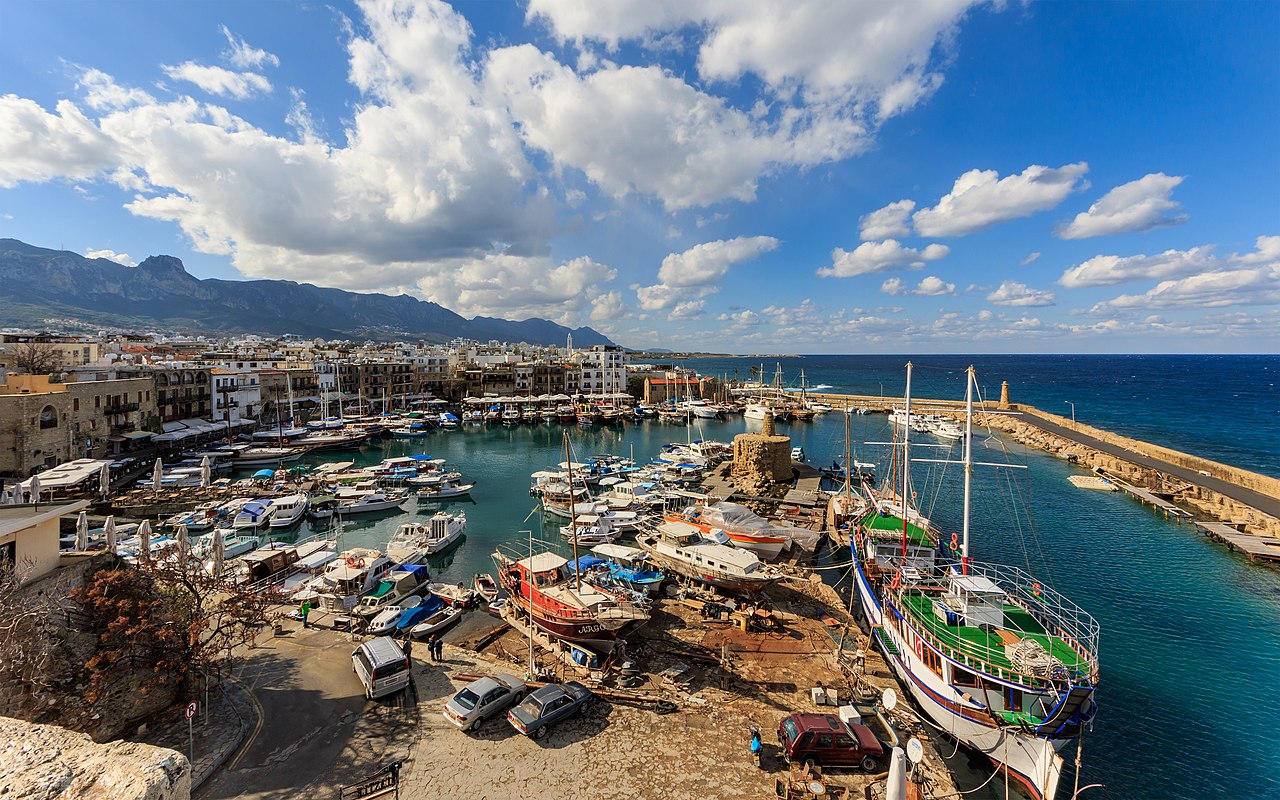
Northern Cyprus covers about 3,300 square kilometres — slightly more than a third of the island's total area. The territory includes the Kyrenia mountain range along the northern coast, the Mesaoria plain in the centre, and the Karpaz peninsula extending eastward into the Mediterranean. The capital is the northern half of Nicosia — the southern half is the capital of the Republic of Cyprus, and the city is the only divided capital in Europe. Other major towns include Kyrenia (Girne in Turkish) on the northern coast, Famagusta (Gazimağusa) on the eastern coast, and Morphou (Güzelyurt) in the western plain. The territory has substantial agricultural land, several major ports, the Ercan international airport (which receives flights from Turkey but not from most other countries), and the abandoned coastal resort of Varosha, which has been sealed off since 1974 and was one of the most popular Mediterranean tourist destinations before the war.
The Population
The population of the TRNC is approximately 360,000, of whom an increasing proportion consists of settlers from mainland Turkey rather than indigenous Turkish Cypriots. The exact balance is contested — Turkish Cypriot critics of the settlement policy estimate that mainland Turkish settlers may now outnumber the original Turkish Cypriots; the TRNC government generally provides smaller numbers. The settlers have arrived in successive waves since 1974, encouraged by Turkish government policy and by the availability of housing and agricultural land vacated by displaced Greek Cypriots. The settlement policy has been one of the central grievances raised by the Republic of Cyprus in international forums and has been condemned in various UN reports and EU resolutions; it is also a politically sensitive subject within the Turkish Cypriot community itself, where the dilution of the indigenous population by mainland settlers is a frequent topic of political debate.
Turkey's Role
The TRNC's effective sovereign is Turkey. Roughly 35,000 Turkish troops are stationed in the territory under the Turkish Cypriot Peace Force Command — a number that is several times the size of the TRNC's own armed forces and represents one of the largest foreign military deployments in any partially recognised state anywhere. Turkey provides the TRNC's currency, telecommunications infrastructure, postal services, and substantial financial support. Turkish presidents are routinely involved in TRNC political decisions, and the Turkish government has effectively vetoed any TRNC political move toward reunification with the south that did not have its own approval. The 2020 election of Ersin Tatar as TRNC president — backed strongly by the Erdoğan government in Ankara and committed to a "two-state solution" rather than reunification — illustrated the depth of Turkish influence.
The Property Question
One of the most intractable issues from the 1974 partition is the property rights of the displaced Greek Cypriots in the north and (to a lesser extent) the Turkish Cypriots in the south. Approximately 160,000 Greek Cypriots fled south leaving homes, land, and businesses in the north; the TRNC subsequently distributed much of this property to Turkish Cypriot displaced persons, to mainland settlers, and to investors who built tourist developments on the northern coast. Most of the original Greek Cypriot owners or their descendants still hold title deeds under the laws of the Republic of Cyprus. The European Court of Human Rights has issued numerous rulings ordering Turkey to pay compensation to Greek Cypriot property owners for the use of their land; Turkey has made some payments but has not solved the underlying problem. The property dispute is one of the major obstacles to any potential reunification settlement.
Varosha
The most visible reminder of the 1974 division is the ghost town of Varosha — a stretch of beachfront resort district on the southern edge of Famagusta that was abandoned by its Greek Cypriot residents during the Turkish advance and has been sealed off by Turkish military authorities ever since. In 1974, Varosha was the most modern resort area on Cyprus, with high-rise hotels, beachfront apartments, restaurants, and shops. None of it has been functionally used in over 50 years. The buildings have decayed in place behind a barbed-wire perimeter. Photography across the perimeter was forbidden until 2020, when the TRNC government partially opened parts of the resort to controlled visitor access — a move that produced sharp Greek Cypriot and EU objection on the grounds that it violated UN resolutions calling for the area to be administered by the UN pending a comprehensive settlement.
The Annan Plan Vote
The 2004 referendum on the Annan reunification plan was a striking inversion of what most outside observers had predicted. The plan had been broadly understood as favoured by the international community and likely to be accepted by the Greek Cypriot majority because the framework gave the Republic of Cyprus the legal continuity of the unified state. The actual vote went the other way: Turkish Cypriots in the north supported the plan by 65 percent; Greek Cypriots in the south rejected it by 76 percent. The plan never came into force. The Republic of Cyprus joined the EU days later as a divided country. The Turkish Cypriot side has used the result for over two decades to argue that it has demonstrated good faith on reunification and that the continued non-recognition of the TRNC is a punishment for the Greek Cypriot rejection rather than any deficiency on the Turkish Cypriot side.
Universities and the Education Economy
One of the genuinely unexpected economic developments in the TRNC since the 1990s has been the rise of higher education as a major industry. The TRNC government licensed a series of private universities — particularly Eastern Mediterranean University in Famagusta and the Near East University in Nicosia — that recruit students from across the Middle East, Africa, and South Asia. The combined student population at these institutions is now over 100,000, many of them from countries that have political or financial difficulties accessing higher education elsewhere. The economic contribution is substantial. The TRNC effectively operates one of the larger international student markets in the eastern Mediterranean, despite (or possibly because of) its unusual diplomatic status — fees are paid in Turkish lira, visa requirements are relaxed, and degrees are accredited in Turkey, which makes them acceptable for further study or professional work in much of the Muslim world.
The Two-State Question
The TRNC's position on reunification has shifted substantially over the past decade. Under earlier presidents — particularly Mehmet Ali Talat (2005-2010) and Mustafa Akıncı (2015-2020) — the TRNC was officially committed to negotiating reunification on a federal model. Under Ersin Tatar, elected in 2020, the official position changed to support for a "two-state solution" in which the TRNC would be formally recognised as a separate sovereign state. The change reflected substantial frustration in the Turkish Cypriot community with what it sees as Greek Cypriot bad faith in successive negotiations, including the 2017 Crans-Montana talks that produced no agreement despite substantial international effort. The 2025 TRNC presidential election will test whether the two-state position holds or whether a renewed reunification track returns to the agenda. Either way, the TRNC will likely continue its current 50-year-plus existence as the world's most established unrecognised state for some time to come.