
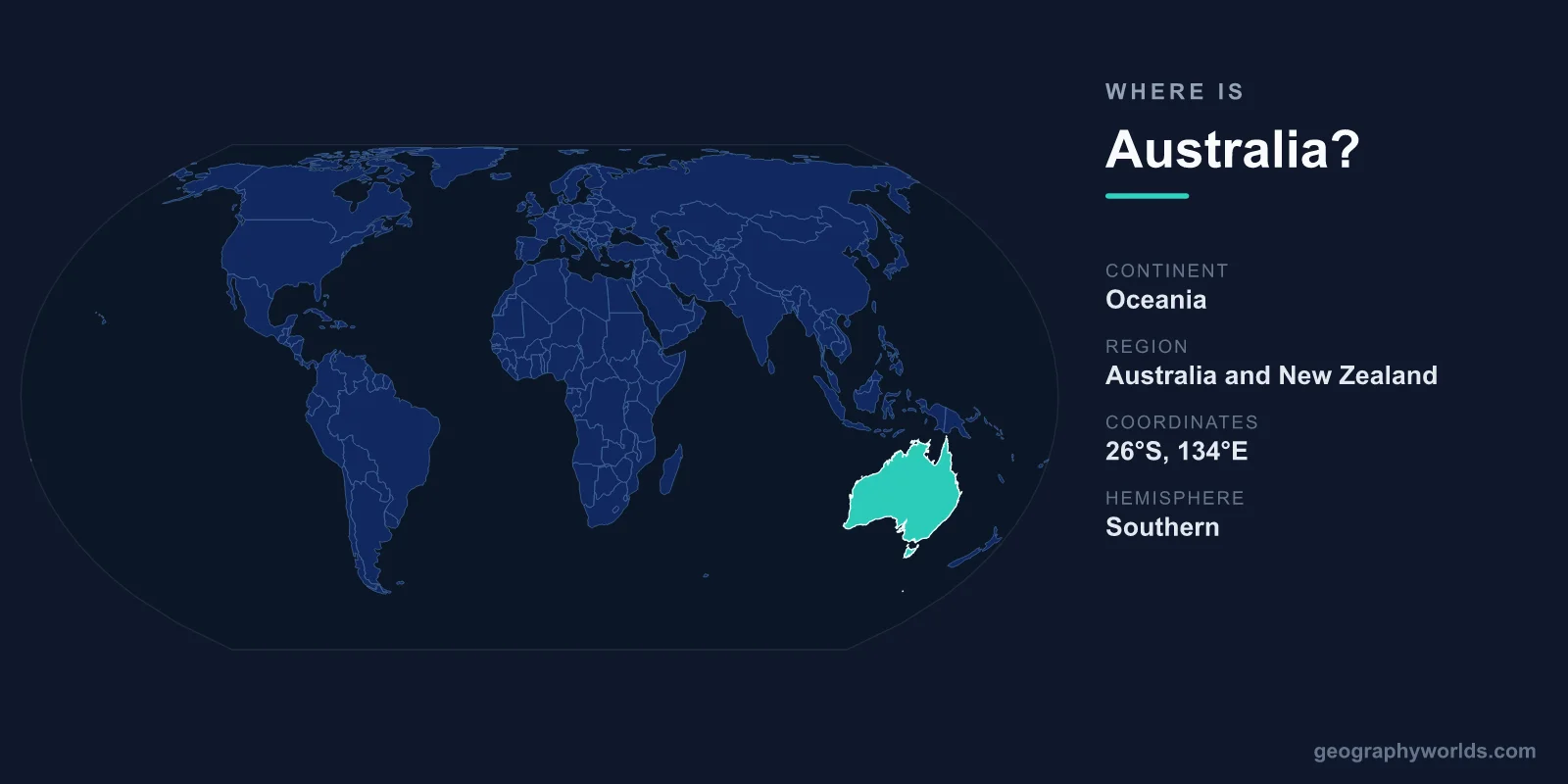
Australia lies in the Southern Hemisphere between the Indian and Pacific Oceans, making it the only country that is also a full continent. It sits southeast of Asia, separated from the mainland by the Timor and Arafura Seas, and covers 7,692,024 km². Its capital is Canberra, and it spans roughly 113°E to 154°E and 10°S to 44°S.
Where Australia Sits on the Globe
Australia occupies the southwestern corner of the Pacific region, between the equator and the cold waters of the Southern Ocean. It lies entirely within the Southern and Eastern Hemispheres, which is why its seasons run opposite to those of Europe and North America — December and January are summer months, while June and July are winter.
The continent is enormous yet remote. Its nearest neighbours are Indonesia, East Timor, and Papua New Guinea to the north, New Zealand across the Tasman Sea to the southeast, and a scattering of Pacific island nations such as the Solomon Islands and Vanuatu to the northeast. Because it is surrounded by water on every side, Australia shares no land borders with any country at all — its entire frontier is coastline, stretching for roughly 35,000 kilometres.
Australia as a Continent and a Country
Australia is unusual in that the same name describes both a sovereign nation and an entire continent. The Australian continent — often grouped with surrounding islands into the wider region of Oceania — is the smallest of the seven continents but the sixth-largest country on Earth by land area. At nearly 7.7 million km², it is comparable in size to the contiguous United States and about double the area of India.
Despite that vast footprint, the population is just over 26 million, making Australia one of the most sparsely populated countries in the world. Most people live in a thin coastal band in the southeast and southwest, clustered around cities such as Sydney, Melbourne, Brisbane, Perth, and Adelaide. The dry interior — the Outback — remains largely empty. You can read more in our australia country guide.
The Land Between Two Oceans
To the west and south, Australia faces the Indian Ocean; to the east and north, the Pacific. The narrow Bass Strait separates the mainland from the island state of Tasmania, which lies about 240 kilometres to the south. This position between two great oceans gives the country an extraordinary range of environments within a single set of borders:
- The Outback: the arid and semi-arid interior, dominated by red deserts, salt lakes, and the iconic sandstone monolith Uluru.
- The Great Barrier Reef: the world's largest coral reef system, stretching more than 2,300 kilometres along the northeastern coast off Queensland.
- The Great Dividing Range: a mountain chain running parallel to the eastern seaboard, separating the coastal plains from the inland plateau.
- The tropical north: rainforests and monsoon climates in the far north, including the Daintree and Kakadu regions.
This diversity means Australia crosses several climate zones, from tropical in the north through vast desert in the centre to temperate in the south.
Time Zones and Reaching Australia
Because it is so wide from east to west, Australia spans three main time zones: Australian Eastern, Central, and Western Standard Time. The eastern states run as far ahead as UTC+10, while Perth on the west coast sits at UTC+8. This places the country well ahead of Europe and the Americas — when it is morning in London, it is already evening in Sydney.
Australia's isolation makes it one of the more remote destinations to reach by air. Long-haul flights from Europe typically take 20 hours or more, and London lies nearly 17,000 kilometres away, while flights from East Asia and the Pacific are considerably shorter. That same remoteness has shaped its famously distinctive wildlife — kangaroos, koalas, platypuses, and wombats evolved in isolation and are found nowhere else in the wild.
Frequently Asked Questions
Is Australia in Asia or Oceania?
Australia is part of Oceania, the region that includes the Australian continent, New Zealand, and the Pacific islands. While it lies just south of Southeast Asia, it is geographically and politically distinct from the Asian continent.
What hemisphere is Australia in?
Australia lies entirely in the Southern and Eastern Hemispheres. This is why its seasons are reversed compared with the Northern Hemisphere, with summer falling around December and winter around July.
Does Australia border any countries?
No. Australia is an island continent surrounded by ocean, so it has no land borders. Its closest neighbours by sea are Indonesia, East Timor, and Papua New Guinea to the north, and New Zealand to the southeast.
What is the capital of Australia?
The capital is Canberra, a purpose-built city located inland between the larger cities of Sydney and Melbourne. Although Sydney is the biggest city, Canberra was chosen as a compromise capital and is home to the federal government.