
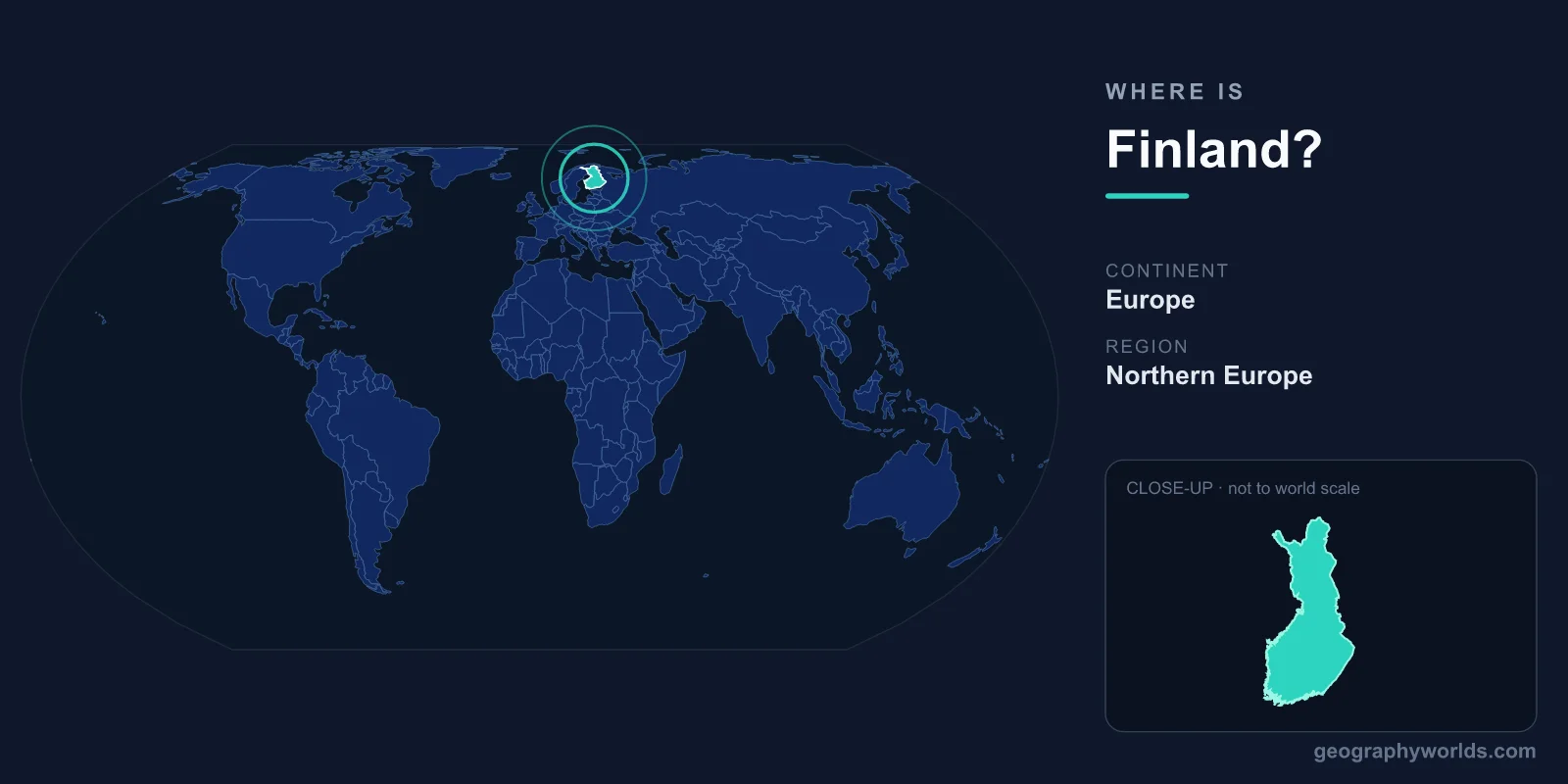
Finland is located in Northern Europe, sitting at the far north of the European continent between Sweden to the west, Norway to the north, and Russia to the east, with the Baltic Sea lapping its southern and western shores. Its capital, Helsinki, stands on the southern coast, and the country covers 338,424 km² — making Finland the northernmost member state of the European Union.
Where Exactly Is Finland on the Map?
Finland lies in the Northern and Eastern Hemispheres, stretching roughly between 60° and 70° north latitude. That places almost the entire country at the same latitude as Alaska, central Canada, and Siberia. About a quarter of Finland sits north of the Arctic Circle, in the region known as Lapland.
The country has an elongated north-south shape, reaching some 1,160 kilometres from its southern tip near Helsinki to its northernmost point at Nuorgam. Helsinki, the capital and largest city, anchors the densely populated south, where most Finns live. To find Finland on a globe, look for the eastern shore of the Baltic Sea, directly across the water from Sweden and Estonia, with the long inland border with Russia forming its eastern edge.
Which Countries Border Finland?
Finland shares land borders with three countries and sea borders with several more across the Baltic. Its neighbours have shaped centuries of trade, culture, and history.
- Sweden — to the northwest, separated in part by the Gulf of Bothnia and the Tornio River. Finland was part of the Kingdom of Sweden for over 600 years, and Swedish remains an official language.
- Norway — to the north, across the treeless fells of Lapland.
- Russia — to the east, along a border of roughly 1,340 kilometres, the longest the EU shares with Russia.
Across the Baltic Sea to the south lies Estonia, just a short ferry ride from Helsinki, while Sweden sits across the Gulf of Bothnia to the west. This position — wedged between Scandinavia and Russia — has defined Finnish history, with the country passing from Swedish to Russian rule before gaining independence in 1917.
The Land of a Thousand Lakes
Finland is famous for water. The country contains more than 180,000 lakes, which is why outsiders nicknamed it "the land of a thousand lakes" — a wild undercount. Lakes, rivers, and wetlands cover roughly a tenth of the total surface area. Lake Saimaa, in the southeast, is the largest, forming an intricate maze of islands and channels.
Forests blanket much of the rest. Around three-quarters of Finland's land is woodland, mostly pine, spruce, and birch, making it one of the most heavily forested countries in Europe. The terrain is generally low and gently rolling, scoured flat by Ice Age glaciers; the highest point, Halti, rises just 1,324 metres in the far northwest near the Norwegian border. Thousands of islands fringe the southern and southwestern coast, including the autonomous Åland archipelago in the Baltic.
A Northern Climate of Extremes
Finland's far-north position gives it dramatic seasonal swings in daylight. Above the Arctic Circle, the summer sun never fully sets for weeks — the famous "midnight sun" — while in midwinter the same region experiences kaamos, a polar twilight when the sun barely rises at all. This makes Lapland one of the best places on Earth to see the aurora borealis, or northern lights.
Despite its latitude, Finland is milder than many places equally far north, thanks to the warming influence of the Atlantic's Gulf Stream and the surrounding Baltic waters. Winters are long, snowy, and cold, especially inland and in the north, while summers are short but pleasantly warm in the south. Finland uses Eastern European Time (UTC+2), shifting to UTC+3 in summer. For a deeper look at the country's regions, seasons, and travel highlights, see our finland country guide.
People, Language, and How the Country Is Run
Finland is home to around 5.5 to 6 million people, most of them concentrated in the southern cities of Helsinki, Espoo, Vantaa, Tampere, and Turku. It is one of the most sparsely populated countries in Europe, with vast stretches of forest and lake separating its towns.
The country has two official languages: Finnish, spoken by the large majority, and Swedish, the mother tongue of a small minority along the coast and in Åland. Finnish is unusual in Europe — it belongs to the Finno-Ugric language family, related to Estonian and distantly to Hungarian, rather than to the Indo-European languages of most neighbouring nations. The Sámi languages are also spoken in Lapland. Finland is a parliamentary republic, has been a member of the European Union since 1995, uses the euro (EUR) as its currency, and joined NATO in 2023. The dominant religious tradition is Evangelical Lutheran Christianity.
Frequently Asked Questions
What continent is Finland in?
Finland is in Europe, in the Northern Europe region. It lies along the eastern shore of the Baltic Sea and is the northernmost country in the European Union.
Is Finland part of Scandinavia?
Geographically, Scandinavia usually refers to Norway, Sweden, and Denmark, so Finland is not strictly Scandinavian. However, Finland is one of the five Nordic countries, alongside Sweden, Norway, Denmark, and Iceland, and shares much of the region's culture and history.
What is the capital of Finland?
Helsinki is the capital and largest city of Finland. It sits on the country's southern coast on the Gulf of Finland, an arm of the Baltic Sea, directly across the water from Tallinn, Estonia.
How big is Finland?
Finland covers 338,424 km², making it roughly the size of Germany or the U.S. state of Montana. It is the eighth-largest country in Europe by area, yet has a relatively small population spread thinly across that land.