
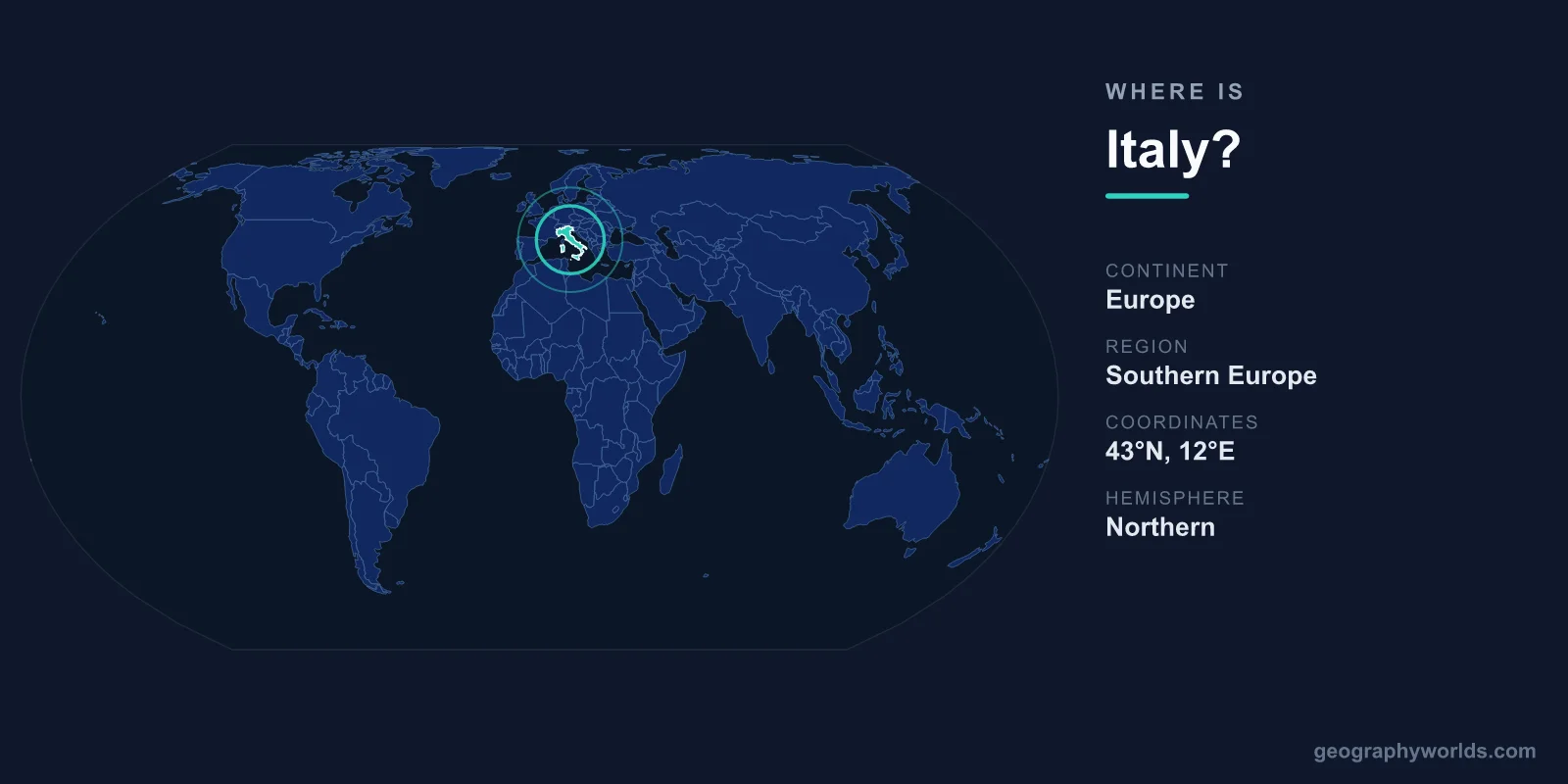
Italy is located in Southern Europe, occupying a long, boot-shaped peninsula that juts southward into the Mediterranean Sea, along with the major islands of Sicily and Sardinia. Its capital is Rome, it covers roughly 301,340 km², and it lies in both the Northern and Eastern Hemispheres, sitting at the heart of the Mediterranean world.
Where Exactly Is Italy on the Map?
Italy stretches between roughly 35 and 47 degrees north latitude and 6 to 18 degrees east longitude. The mainland is unmistakable on any map: a narrow peninsula shaped like a high-heeled boot, "kicking" the island of Sicily off its toe. To the north, the Alps form a natural wall separating Italy from the rest of continental Europe, while the long Apennine mountain range runs down the spine of the peninsula like a backbone.
The country is almost entirely surrounded by water. The Adriatic Sea lies to the east, separating Italy from the Balkan Peninsula; the Ionian Sea curves around the south; and the Tyrrhenian and Ligurian Seas wash the western coast, all of them arms of the wider Mediterranean. This central position has made Italy a natural crossroads of European, African, and Middle Eastern trade for thousands of years.
Italy is also remarkably close to North Africa. At the Strait of Sicily, only about 150 kilometers of sea separate the island of Sicily from the coast of Tunisia, a proximity that has shaped centuries of commerce, conflict, and migration across the central Mediterranean.
Which Countries Border Italy?
Despite being a peninsula, Italy shares land borders with six countries along its northern arc and within its own territory:
- France – to the northwest, across the western Alps
- Switzerland – to the north, through the high central Alps
- Austria – to the north, beyond the Dolomites
- Slovenia – to the northeast
- San Marino – a tiny independent enclave surrounded entirely by Italy
- Vatican City – the world's smallest sovereign state, landlocked within the city of Rome
San Marino and Vatican City are unusual cases: both are completely encircled by Italian territory, making Italy one of only a few countries on Earth to fully enclose two independent states. The northern land borders, by contrast, run along some of the highest terrain in Europe, with historic passes such as the Brenner Pass and the Great St Bernard Pass long serving as vital gateways between Italy and the lands to the north.
The Landscape: Mountains, Coast, and Islands
Italy's terrain is dominated by mountains and hills, with relatively little flat land. The Alps curve across the north, home to peaks such as the Italian side of Mont Blanc and the Matterhorn, while the Apennines run nearly the full length of the peninsula. The fertile Po Valley in the north is the country's most important lowland and agricultural region.
Italy also has a dramatic geological side. It is home to several active volcanoes, including Mount Vesuvius near Naples and Mount Etna on Sicily, the latter one of the most active volcanoes in the world. With around 7,600 kilometers of coastline, the country offers everything from the cliffs of the Amalfi Coast to the beaches of Sardinia. To be clear, despite its sunny reputation, Italy has a temperate Mediterranean climate rather than a tropical one.
Climate and Regions
Because Italy spans more than ten degrees of latitude, its climate changes noticeably from north to south. The Alpine north has cold, snowy winters and cooler summers, while the southern coasts and the islands enjoy hot, dry summers and mild winters typical of the Mediterranean. This range allows Italian agriculture to span rice and dairy in the Po Valley as well as olives, citrus, and vineyards across the warmer south.
The country is divided into 20 administrative regions, five of which hold special autonomous status, including Sicily, Sardinia, and the small Alpine Aosta Valley. Major cities echo this geographic spread: Milan in the industrial north, Venice on its north-eastern lagoon, Florence in the central hills of Tuscany, and Naples on the volcanic south-western coast.
Capital, People, and Region
Rome, the capital, sits on the River Tiber in the central Lazio region and serves as the political, historical, and cultural center of the nation. Italy is home to roughly 59 million people, who speak Italian as the official language. Roman Catholicism is the dominant religious and cultural tradition, reflected in landmarks like the Colosseum and St. Peter's Basilica.
As a member of the European Union, Italy uses the Euro (EUR) as its currency and operates as a parliamentary republic. For a fuller overview of its history, regions, and travel highlights, see our italy country guide.
Frequently Asked Questions
What continent is Italy on?
Italy is on the continent of Europe, specifically in the Southern Europe region. It forms part of the Mediterranean basin and is bordered to the north by the Alps.
Is Italy a peninsula or an island?
Italy is primarily a peninsula extending into the Mediterranean Sea, but it also includes two large islands, Sicily and Sardinia, as well as many smaller ones. This mix of mainland and islands gives Italy its very long coastline.
What is the capital of Italy and where is it?
The capital of Italy is Rome, located in the central part of the peninsula in the Lazio region, near the western Tyrrhenian coast. It is the country's largest city and has served as a capital since antiquity.