
Mexico is called Mexico after Mēxihco, the Nahuatl name of the island city on Lake Texcoco that the Mexica (the people usually called the Aztecs) built in the 14th century and that is now the centre of Mexico City. The Spanish spelled it México after the conquest of 1521, used it first for the city and later for the province around it, and in 1821 it became the name of the independent country. What Mēxihco itself meant is genuinely unresolved. Proposals include "place at the navel of the moon" and "place of Mexi", a secret name of the war god Huitzilopochtli, and linguists have found problems with each, so there is no expert consensus. The country also carried other names on the way. Each layer below gives a name in its own language, with its date and the source that records it.
Anáhuac: the Nahuatl word for the lake basin and the world
The oldest name in the stack is not Mexico at all. The Mexica called the Valley of Mexico, and the territory they dominated, Anáhuac. Several linguists translate it as "near or surrounded by waters", a fair description of a high basin whose floor was covered by five interconnected lakes, of which Lake Texcoco was the largest. The same word could also mean the whole inhabited world, as in the phrase Cem Anáhuac, "the entire earth". In that view the capital stood at the centre of the waters and the centre of the world at once.
Anáhuac never became the country's name, but it came close twice. The insurgent assembly that declared independence in 1813 called itself the Congress of Anáhuac. In 1820 the priest and pamphleteer Servando Teresa de Mier used Anáhuac for the whole country in a treatise on why New Spain had not yet won its freedom. The word survives in the names of a university network, a Monterrey metro station, a municipality in Nuevo León and a town in Chihuahua.
Mēxihco: the island city on Lake Texcoco, about 1325
The name that won out was attached to an island. Tenochtitlan, also called Mexico-Tenochtitlan, was built on the western side of shallow, brackish Lake Texcoco and covered an estimated 8 to 13.5 km². Its founding date is uncertain. The date 13 March 1325 was chosen in 1925 to mark the city's 600th anniversary, and it has been used ever since. The island held two Mexica city-states, Tenochtitlan and Tlatelolco, and the island as a whole was Mēxihco, pronounced [meːˈʃiʔko], "meh-SHEE-ko". Its people were the Mēxihcah, the Mexica.
Which name came first is less clear than it looks. Most popular accounts derive the place name from the people, but in many early sources "Mexica" appears simply as the term for the inhabitants of the island of Mexico. That would mean the place name came first and the people were named after it. By the time of the conquest, the city was the largest in the pre-Columbian Americas. It was joined to the mainland by causeways and supplied with fresh water by two terracotta aqueducts more than 4 km long from the springs at Chapultepec.

Mētztli and xīctli: what Mēxihco might mean
Under the name sits a layer of interpretation that has never been settled. The best-known proposal splits Mēxihco into mētztli, "moon", and xīctli, "navel", with the place suffix -co: "place at the navel (centre) of the moon". The image fits the setting. Tenochtitlan stood in the middle of Lake Texcoco, and Mesoamericans saw the outline of the linked lakes as a rabbit, the figure they also saw on the moon. The Spanish phrase el ombligo de la luna, "the belly button of the moon", is still used in speech and literature.
A second proposal, based on legend, holds that the patron war god Huitzilopochtli had a secret name, Mexitl or Mexi, so that Mexico would be "place of Mexi". A third links it to Mectli, goddess of the maguey plant. The linguist Frances Karttunen rejects the moon-navel and maguey readings because the vowel lengths in Mēxihco do not match those of the proposed parts. The 16th-century missionary Bernardino de Sahagún interpreted the name in a more mystical way, as "centre of the world", the point where the waters of Anáhuac meet. Some scholars think the other meanings, possibly including the secret name Mexi, were popular folk etymologies. A further version, publicised by the writer Arturo Ortega Morán and credited to the Nahuatl speaker Juan Luna Cárdenas, derives it from Metzico, "place of the followers of the moon". None of these has displaced the others.
Nueva España, 1521 to 1821: the Spanish name for a much larger realm
After the Mexica capital fell to Spanish and Tlaxcaltec forces in 1521, Hernán Cortés named the conquered territory Nueva España, New Spain. The crown made it a viceroyalty in 1535 and appointed Antonio de Mendoza as the first viceroy instead of Cortés. New Spain was not an older name for Mexico. It covered all of Spain's North American possessions, including the American Southwest, Florida and Central America, along with Caribbean islands and the Philippines. It was an imperial jurisdiction rather than a country, and "Mexico" stayed in use beneath it for the capital and its region.
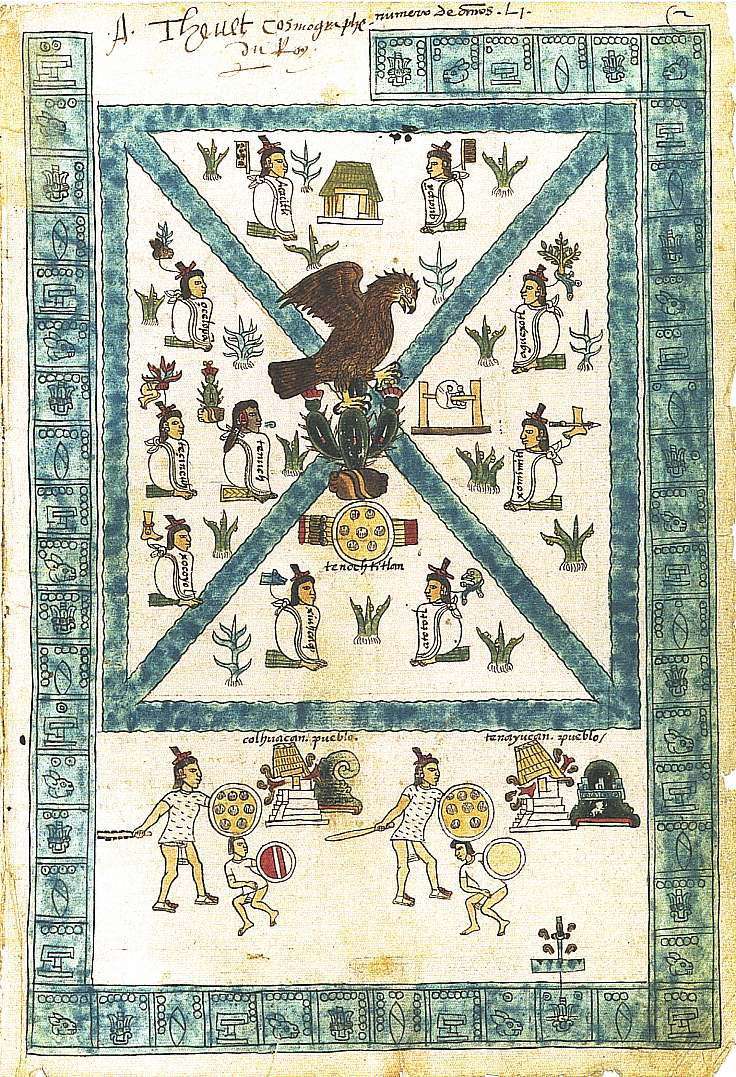
The Mexica name also survived through Mexica records made under Spanish rule. Around 1541, Mendoza had native artists and scribes trained at the Franciscan college in Tlatelolco produce the Codex Mendoza, now in the Bodleian Library in Oxford. Its opening page, shown at the top of this article, shows Tenochtitlan's founding: an eagle on a prickly pear cactus at the centre of the island, divided by canals into four quarters. The same eagle-on-cactus motif sits at the centre of Mexico's flag today.
México Tenustitlan and Ciudad de México, 1524 and 1585
The Spanish rebuilt the destroyed city in about three years. In 1524 the municipality was established as México Tenustitlan, a Spanish version of the double name, and in 1585 it officially became Ciudad de México, Mexico City. For three centuries "México" in Spanish documents meant the city and then the province or kingdom governed from it. Much of that area is now Greater Mexico City and the State of Mexico, plus parts of Puebla, Morelos and Hidalgo.
The spelling hides a sound change. In the Spanish of the 1500s, x stood for the "sh" sound, which is why the Nahuatl [meːˈʃiʔko] became México. During the 16th century the sound shifted to the harsh [x] of Scottish "loch", and spelling became inconsistent. After the Real Academia Española was founded in 1713, it decided that j should represent that sound, which produced Méjico alongside México, just as Texas sat beside Tejas and Oaxaca beside Oajaca. Mexico kept the x, and the Academy now recommends México too.
América Mexicana, 1590s and 1814
The adjective came before the country. By the 1590s, Dutch world maps such as Petrus Plancius's Orbis Terrarum Typus labelled the northern New World America Mexicana, because Mexico City was the seat of the viceroyalty. That pairing of continent and city echoes the story told in why America is called America. The independence movement took up the name. On 22 October 1814, the Congress of Anáhuac, meeting in Apatzingán in present-day Michoacán, issued the "Constitutional Decree for the Liberty of Mexican America", which named the country América Mexicana. Royalist forces defeated the insurgents and the constitution was never enacted beyond the territory they held, but it was the first constitution drafted for the country, and it put "Mexican" in the country's name. A year earlier, the 1813 declaration of independence had used a different name, América Septentrional, "Northern America".
Imperio Mexicano, 1821 to 1823: the first country called Mexico
Independence was secured in September 1821 through an alliance of royalist and insurgent forces (Spain itself did not formally recognise it until the Santa María–Calatrava Treaty of 28 December 1836), and the new state became the Imperio Mexicano, the Mexican Empire, under Agustín de Iturbide as "first Constitutional Emperor of Mexico". This was the first recorded use of Mexico as the name of a country. The empire collapsed in 1823, and with it the monarchy, but the Mexican name stuck.
Estados Unidos Mexicanos, from 4 October 1824
The republicans who replaced the empire set up a federation, and their constitution of 4 October 1824 adopted the name Estados Unidos Mexicanos, literally "Mexican United States" and officially translated as the United Mexican States. The name reflects a federation of states, today 31 states plus Mexico City. The 1857 constitution used República Mexicana as well, and the empire was briefly revived from 1863 to 1867 under Maximilian of Habsburg. The 1917 constitution, still in force, uses only Estados Unidos Mexicanos.

The newest layer is a name the country has not adopted. In November 2012, a week before leaving office, President Felipe Calderón sent Congress a bill to make the official name simply México. It needed both houses and a majority of the state legislatures, and it went nowhere. The capital's name was tidied up instead. On 29 January 2016 the Federal District, long written "México, D.F.", officially became Ciudad de México, or CDMX. The result is that "Mexico" now names a city, a state (the State of Mexico) and a country, all going back to one island in a lake that has since been largely drained, as described in our guides to Mexico City and the geography of the Aztec Empire.