

The capital of Moldova is Chișinău, a city of just over 567,000 people in the city proper and 720,128 in the wider municipality at the 2024 census. It lies almost exactly in the middle of the country on the small Bîc River, a tributary of the Dniester, about 58 kilometres from the Romanian border and 54 kilometres from the Ukrainian one. It is the country's main industrial, commercial and transport centre, and nearly a third of all Moldovans live in its metropolitan area. The city's defining trait is that it was laid out twice: a 15th-century monastery village in the valley, and an imperial Russian grid on the slope above it, later filled in with Soviet housing.
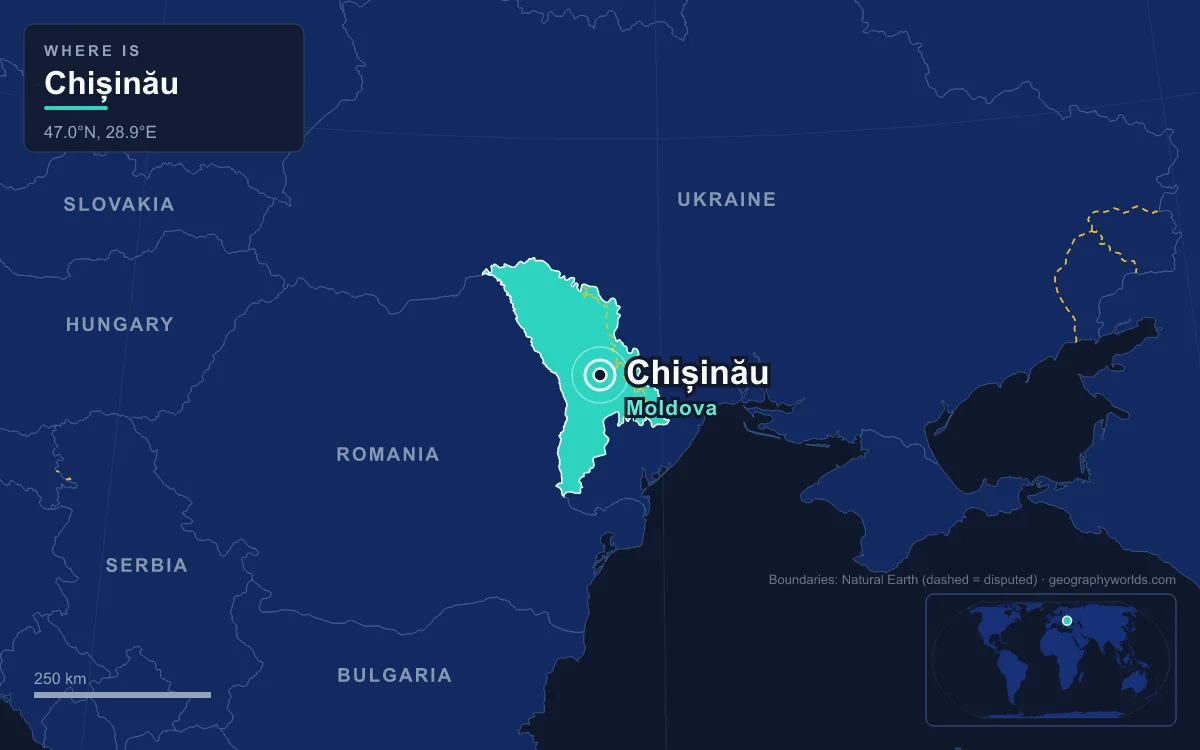
The best way to read Chișinău is on foot, starting where the town began and climbing up through each layer.
The Spring Below Măzărache Church
Begin in the lower town, at the foot of a small hill near the Bîc. Here a stone block marks the water spring that is believed to have given the city its name. One theory derives Chișinău from the archaic Romanian chișla, a spring, and nouă, new, so that the name simply means new spring. Rival theories trace it to a Hungarian place name or a Cuman word for a burial mound, and none is settled. Older English texts use the Russian form, Kishinev.
On the hill above the spring stands the Măzărache Church, built by Vasile Măzărache in 1752 and considered the oldest church in the city. It follows the indigenous Moldavian architecture of the 15th and 16th centuries and was raised on the site of a fortress that the Ottomans destroyed in the 17th century. The settlement it served was founded in 1436 as a monastery village in the Principality of Moldavia, which from the 16th century was an Ottoman vassal while keeping its autonomy. It grew slowly: at the start of the 19th century Chișinău was still a small town of about 7,000 people.

Uphill to the 1834 Grid
Walk uphill from the church and the street pattern changes abruptly, from the irregular lanes of the old town to long, straight roads crossing at right angles. That break is the work of 1812. After the Russo-Turkish War of 1806–1812, the Ottomans ceded the eastern half of Moldavia, the land between the Prut and the Dniester, to the Russian Empire. The new province was called Bessarabia, and Chișinău, a modest market town, became its capital.
The Russian administration drew up a generous development plan, and by 1834 an imperial townscape of broad, long roads had taken shape, dividing the city into the old quarter below and a new centre above. The city's building stone came from limestone quarried at nearby Cricova, and the tunnels left behind became a well-known wine cellar. Much of the new centre's architecture was the work of Alexander Bernardazzi, the Swiss-Italian-Russian architect behind the churches of Saint Theodore and Saint Panteleimon.
The railway sealed the city's role. A line to Tiraspol opened on 28 August 1871, and the Chișinău–Ungheni–Iași line followed on 1 June 1875, built in preparation for the Russo-Turkish War of 1877–1878, when the town served as the main staging area of the Russian invasion. The population was about 92,000 by 1862 and 125,787 by 1900.
Stephen the Great Park and the 1885 Pushkin Statue
The grid's main axis is Ștefan cel Mare Boulevard, and the first green space on it is the Stephen the Great Central Park, the oldest park in Moldova, covering about 7 hectares. Russian military engineers laid it out in 1818 under Alexander I, with alleys planted with acacias and limes and a wicker fence to keep out cows and goats. In 1863, at Bernardazzi's suggestion, that fence was replaced by one of cast iron made in Odessa, 460 chains weighing 5,400 kilograms.
Alexander Pushkin walked these alleys in the early 1820s, during his exile in the city, and the statue of him by Alexander Opekushin, erected in 1885 and paid for by residents at 1,000 gold roubles, is the oldest surviving monument in Chișinău; the city was only the second after Moscow to put up a Pushkin statue. The house where Pushkin lived during his exile, near the markets in the north of the city, is now a museum. At the park's entrance stands Alexandru Plămădeală's statue of Stephen the Great, erected in the late 1920s, which in 1989–1991 became the focal point of rallies and clashes between Moldovan nationalists and pro-Soviet groups.
The 1840 Triumphal Arch and Nativity Cathedral
Cross the boulevard and you reach the ceremonial heart of the city, the Great National Assembly Square. On the square stands the Triumphal Arch designed by Luca Zaushkevich and completed in 1840, and behind it, in Cathedral Park, the Cathedral of Christ's Nativity. Abram Melnikov designed the cathedral in a Neoclassical style with six Doric columns at the entrance, and it was built between 1830 and 1836 on the commission of Prince Mikhail Vorontsov, governor of New Russia.
The cathedral's story is the city's story in miniature. It was bombed in the Second World War, its bell tower was demolished in 1962, and during the Soviet period worship was banned and the building served as an exhibition centre. It returned to religious use in 1989, and a new bell tower and the present zinc dome were added in 1997.
Government House and the Victory Square of 1951
The square itself was named Victory Square in 1944, took its present shape in December 1951 and was enlarged in 1987–1988, when the ruins of the old Eparchial House were cleared. Along its side runs the six-storey, white-stone Government House, designed by Semyon Fridlin in 1964 for the Council of Ministers of the Moldavian SSR, and in front of it stands a commemorative stone to the victims of the Soviet occupation, unveiled on 28 June 2010. On 21 May 2023 the square filled with more than 75,000 people, by police estimates, at a rally supporting Moldova's bid for European Union membership.
City Hall, the Presidential Palace and 27 August 1991
A short way from the square is the City Hall, built in Italian Gothic style to house the city Duma in 1901. It was nearly destroyed in the Second World War and rebuilt afterwards from surviving images and plans. Today it is the office of the elected mayor; Ion Ceban won the post in 2019 and again in 2023.

Nearby is the Presidential Palace, built between 1984 and 1987 on the site of an 1830s German Lutheran church as the new seat of the Supreme Soviet of the Moldavian SSR. It was in this building that the Moldovan Declaration of Independence was adopted on 27 August 1991. It became the president's residence in 2001, was badly damaged during the protests of 7 April 2009, and reopened after renovation on 17 October 2018.
The walk from spring to palace is short, but it covers the city's shifts of sovereignty. After the Russian Revolution, Bessarabia declared itself the Moldavian Democratic Republic and then joined the Kingdom of Romania, and in 1919 Chișinău, with about 133,000 people, was the second-largest city in Romania after Bucharest. On 28 June 1940, following the Molotov–Ribbentrop Pact, the Soviet Union annexed Bessarabia and made Chișinău capital of the Moldavian SSR.
Jerusalem Street and the Losses of the Lower Town
Drop back down toward the lower town and you reach Jerusalem Street, where a bronze statue of Moses, unveiled on 22 April 1993, marks the main entrance to the wartime ghetto. The Jewish community had been central to the city: by 1897 some 46% of residents, over 50,000 people, were Jewish. On 19–20 April 1903 the Kishinev pogrom killed 47 Jews (some sources say 49) and wounded hundreds, prompting a petition to Tsar Nicholas II on behalf of the American people from President Theodore Roosevelt.
The Second World War was far worse. After Romanian and German forces took the city on 17 July 1941, an estimated 10,000 Jews were murdered in the first phase of occupation, and deportations to Transnistria cut the remaining Jewish population from 11,388 in autumn 1941 to 177 in 1943. Earlier, NKVD executions and deportations had followed the 1940 Soviet takeover. Nature added its own damage: a Vrancea earthquake on 10 November 1940 killed 78 people and damaged 2,795 buildings, and another on 4 March 1977 shook the city again. The Red Army recaptured Chișinău on 24 August 1944.
Out to the Sectors: Botanica, Râșcani and the Soviet Blocks
End the walk by taking a trolleybus out of the centre, and the architecture turns to concrete. Alexey Shchusev drew up a reconstruction plan in 1947–1949, and the 1950s brought Stalinist palaces and then mass-produced Khrushchyovka blocks. The biggest push came after 1971, when the Soviet Council of Ministers committed more than a billion roubles to developing the city. Buildings from 1951–1990 now make up 74.3% of the city's dwellings.
The municipality is divided into five sectors, each run by a pretor under the mayor, and each takes in a slice of the city plus suburbs; in all, the municipality counts 34 localities besides the city. In Botanica a Soviet-era amusement park stretches along the three lakes of a large park, and the older Jumbo mall serves locals, while the grand Chișinău State Circus building in Râșcani has stood idle for years amid a stalled renovation.
The concentration of wealth here is striking. Chișinău produced about 60% of Moldova's GDP in 2012, its GDP per head was 227% of the national average, and all 15 of the country's banks have their headquarters in the city. Since 2022 it has also sheltered many of the more than 100,000 Ukrainian refugees who have stayed in Moldova, and in 2023 it hosted a summit of the European Political Community.
To see how Chișinău fits the rest of the country, read our Moldova country guide, and for the breakaway region along the Dniester that the government in Chișinău does not control, see what Transnistria is.
Quick Facts About Chisinau
- Country: Moldova
- Continent: Europe (Eastern Europe)
- Country population: approximately 3.0 million
- Capital city status: Chisinau is the capital of Moldova, the seat of national government, and the location of foreign embassies, parliament, and the head of state's official residence.
Frequently Asked Questions
What is the capital of Moldova?
The capital of Moldova is Chisinau. Chisinau is the seat of national government, hosts most foreign embassies and consulates, and is typically where the head of state and parliament are located.
What continent is Chisinau in?
Chisinau, the capital of Moldova, is located in Europe, in the Eastern Europe region. As Moldova's capital, Chisinau serves as the country's primary connection to the broader Europen political, economic, and cultural sphere.
Why is Chisinau the capital of Moldova?
Chisinau was chosen as the capital of Moldova for reasons that typically combine geography, history, and politics. Capital city selections often reflect a desire for centrality (being accessible from across the country), historical importance (being a longstanding seat of government or culture), or neutrality (being acceptable to multiple regions or ethnic groups within the country). The specific reasons for Chisinau's designation are detailed in the city's history above.
What is Chisinau known for?
As the capital of Moldova, Chisinau is best known for housing the country's central government institutions — parliament, presidential or royal residences, supreme court, and key ministries. It is also typically a major cultural and economic center within Moldova, hosting national museums, embassies, and signature monuments. The introduction and history sections above provide detailed coverage of the city's specific notable institutions and landmarks.
Related Pages
- Moldova Country Guide — full geography, climate, economy, and culture overview
- Flag of Moldova — meaning, history, and design of Moldova's national flag