
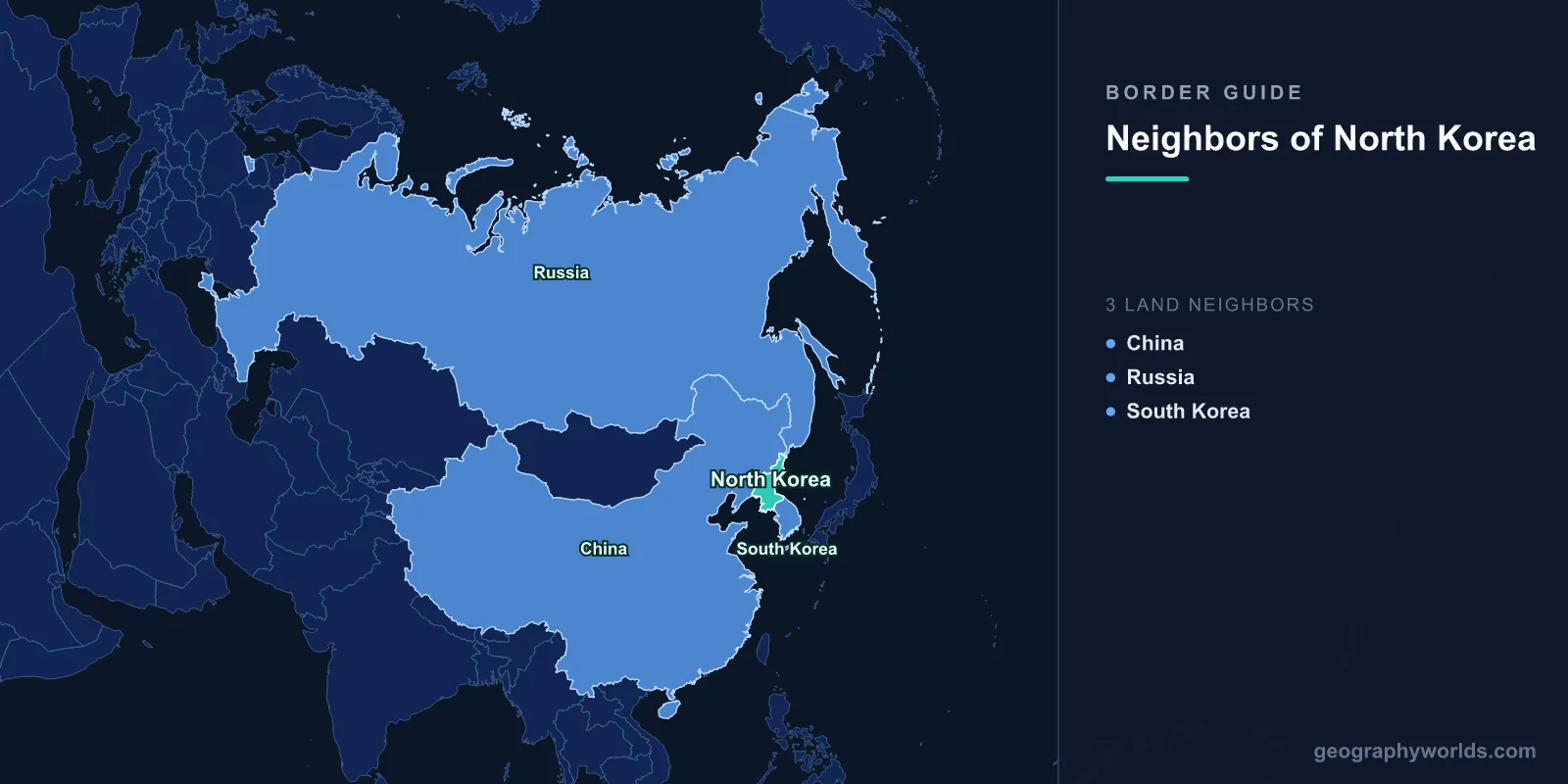
North Korea (Democratic People's Republic of Korea) shares land borders with three countries: China to the north, Russia to the far northeast, and South Korea to the south.
Introduction
North Korea's borders are among the most tightly controlled and militarized in the world. The Korean Demilitarized Zone (DMZ) separating North and South Korea is the most heavily armed border on Earth, while the Chinese and Russian borders, though somewhat less fortified, are closely monitored to prevent unauthorized crossings. North Korea's extreme isolation makes its border dynamics unique in modern geopolitics.

Overview of North Korea's Borders
- Total Land Borders: 1,607 km
- Number of Neighbors: 3 countries
- Longest Border: China (1,352 km)
- Shortest Border: Russia (17.5 km)
North Korea's borders are defined by rivers and mountains. The Yalu (Amnok) River forms most of the Chinese border in the west, while the Tumen River defines the border in the east, flowing to a tripoint with Russia before reaching the Sea of Japan. The southern border with South Korea follows the Korean Demilitarized Zone, established by the 1953 Armistice Agreement.
North Korea is one of the most isolated countries on Earth. Leaving the country without permission is a criminal offense punishable by imprisonment or execution. Despite this, thousands of North Koreans have defected, mostly crossing into China through the Yalu and Tumen rivers, particularly during the famine years of the 1990s.
Northern Neighbor: China
- Border Length: 1,352 km
- Key Rivers: Yalu (Amnok), Tumen
- Key Feature: Mount Paektu (2,744 m) on the border
China is North Korea's most important neighbor and primary economic lifeline, providing an estimated 90% of North Korea's trade and energy. The 1,352 km border follows the Yalu and Tumen rivers, which freeze in winter, historically enabling illegal crossings. The border city of Dandong (China) faces Sinuiju (North Korea) across the Yalu, connected by the Friendship Bridge.
Mount Paektu (Changbai in Chinese), at 2,744 m, sits on the Chinese-North Korean border and is considered the sacred birthplace of the Korean nation. The mountain features Heaven Lake, a caldera lake straddling the border. China and North Korea demarcated their border in 1962, with China reportedly ceding part of the mountain to North Korea as a gesture of socialist solidarity.
Northeastern Neighbor: Russia
- Border Length: 17.5 km
- Key Feature: Tumen River, Friendship Bridge
- Key Crossing: Khasan-Tumangang railway
Russia's 17.5 km border with North Korea is one of the shortest international borders in the world, following the Tumen River to the Sea of Japan. The sole crossing point is the Friendship Bridge at Khasan (Russia) - Tumangang (North Korea), a railway bridge used for limited trade. This border gained strategic significance as an alternative supply route bypassing Chinese influence.
Despite its brevity, this border has geopolitical significance. Russia provides an alternative diplomatic and economic channel for North Korea beyond China. North Korean workers have been sent to Russia's Far East for logging and construction work. The possibility of a tripartite economic zone at the Russia-China-North Korea border junction has been discussed but never realized.
Southern Neighbor: South Korea
- DMZ Length: 250 km (4 km wide)
- Key Feature: Most heavily fortified border on Earth
- Panmunjom: Joint Security Area for negotiations
The Korean Demilitarized Zone (DMZ), established by the 1953 Korean Armistice Agreement, runs 250 km across the peninsula at roughly the 38th parallel. Despite its name, the DMZ is the most heavily militarized border in the world, with approximately 2 million troops deployed on both sides, minefields, tank traps, and massive fortifications. North Korea has also built invasion tunnels under the DMZ.
Panmunjom, the Joint Security Area (JSA) within the DMZ, is the only point where North and South Korean soldiers stand face to face. It has been the site of armistice negotiations, defections, and historic inter-Korean summits. The DMZ's 70+ years of minimal human disturbance have made it an accidental wildlife sanctuary, harboring rare species including red-crowned cranes and Asiatic black bears.
Cross-Border Dynamics and Isolation
- Defectors: Over 34,000 North Koreans have defected to South Korea
- Nuclear Program: Drives border security concerns for all neighbors
- Trade Dependency: ~90% of trade through China
North Korea's borders are designed to keep people in rather than out. The regime treats unauthorized border crossing as treason. Despite this, over 34,000 North Koreans have successfully defected to South Korea, most via China and then through Southeast Asian countries. China generally returns captured North Korean defectors, a practice criticized by human rights organizations.
North Korea's nuclear weapons and ballistic missile programs have made its border security a global concern. The programs have led to UN sanctions that affect border trade with China and Russia. Despite sanctions, China continues to provide economic support, and the border remains North Korea's lifeline to the outside world. Diplomatic summits in 2018-2019 briefly raised hopes for border opening, but progress has stalled.
Key Facts
- North Korea borders 3 countries: China, Russia, and South Korea.
- The Korean DMZ is the most heavily fortified border on Earth, with approximately 2 million troops on both sides.
- China provides an estimated 90% of North Korea's trade.
- Mount Paektu on the Chinese border is considered sacred in Korean culture.
- Over 34,000 North Koreans have defected to South Korea, mostly via China.
Fun Facts
- The Korean DMZ has become an accidental nature reserve, home to rare red-crowned cranes and Asiatic black bears.
- North Korea has built at least four invasion tunnels under the DMZ, discovered between 1974 and 1990.
- The Russia-North Korea border is so short that it takes only minutes to walk its entire length.
- The Yalu River freezes in winter, historically allowing defectors to walk across to China.
Final Thoughts
North Korea's three borders encompass the extremes of modern border politics: the world's most militarized frontier with South Korea, a lifeline dependency on China, and a tiny but strategically significant connection to Russia. These borders define the most isolated nation on Earth and remain at the center of one of the world's most dangerous nuclear standoffs.
Test Your Knowledge!
Think you know which countries share borders? Try our geography games!
Play Geography Games →