
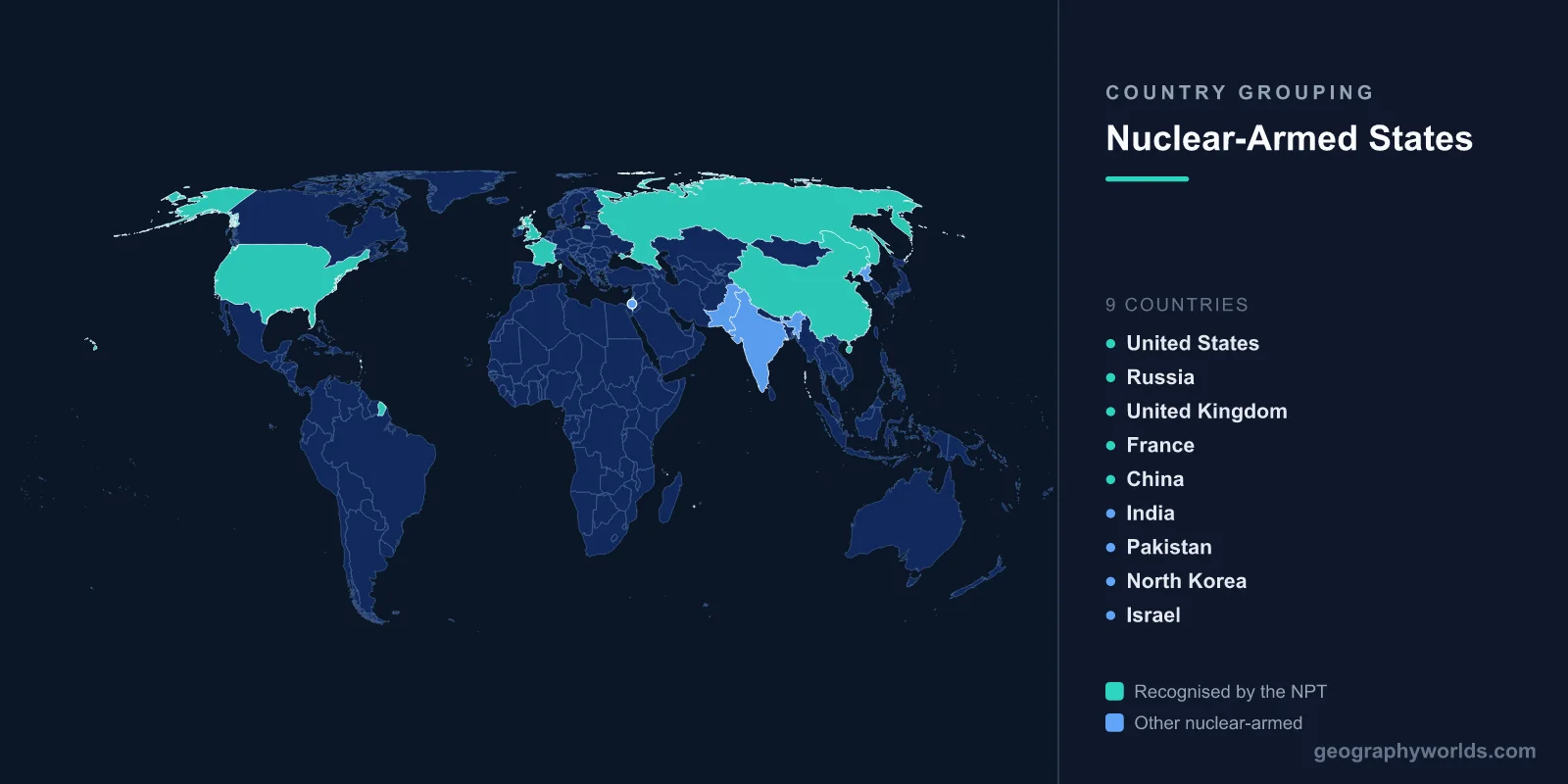
Nine countries have nuclear weapons: the United States, Russia, the United Kingdom, France, China, India, Pakistan, North Korea and Israel. SIPRI's Yearbook 2026 estimates they held about 12,187 warheads between them in January 2026. Russia (5,420) and the United States (5,042) account for roughly 86% of that total, and only the first five are recognised as nuclear-weapon states under the Non-Proliferation Treaty (NPT).
Nine Arsenals by Size, January 2026
Nobody publishes an audited count of the world's warheads. The standard reference is the annual estimate from the Stockholm International Peace Research Institute (SIPRI), built with the Federation of American Scientists (FAS) team of Hans Kristensen and Matt Korda. Their January 2026 figures appeared in the SIPRI Yearbook on 8 June 2026. The world total inventory edged down from 12,241 to 12,187. The number that matters for war planning moved the other way. The military stockpile, meaning warheads assigned to forces, rose from 9,614 to 9,745, and about 4,012 of those were deployed on missiles or at bomber and fighter bases.
Two of these figures include warheads that no military still counts. The US total includes 1,342 retired warheads waiting to be dismantled. France's 370 is new in the 2026 edition: SIPRI added 80 retired French warheads to its 290-warhead stockpile. Measured by military stockpile alone, the order is Russia (about 4,400), the United States (3,700), China (620), France (290), the United Kingdom (225), India (190), Pakistan (170), Israel (90) and North Korea (60). Our countdown of the largest nuclear arsenals goes through each force in that order.
1945 to 1964: The Five Treaty Powers Test in Turn

United States, 16 July 1945. The Manhattan Project's Trinity device detonated at Alamogordo in New Mexico. The bombs dropped on Hiroshima and Nagasaki on 6 and 9 August 1945 remain the only nuclear weapons used in war.
Soviet Union, 29 August 1949. RDS-1 was detonated at Semipalatinsk in Soviet Kazakhstan. Russia inherited the arsenal in 1991.
United Kingdom, 3 October 1952. Operation Hurricane exploded a plutonium device inside the frigate HMS Plym, anchored in the Monte Bello Islands off Western Australia. Britain now relies solely on Trident missiles carried by its Vanguard-class submarines.
France, 13 February 1960. Gerboise Bleue was detonated at Reggane in the Algerian Sahara, two years before Algerian independence. Its last test was at Fangataufa atoll in French Polynesia in January 1996.
China, 16 October 1964. Project 596 was detonated at Lop Nur in Xinjiang. China held a few hundred warheads for decades but has expanded quickly since about 2020. SIPRI says it has added roughly 100 warheads a year since 2023, and it has completed or nearly completed about 350 new ICBM silos in northern deserts.
The NPT, opened for signature on 1 July 1968 and in force from 5 March 1970, recognises as nuclear-weapon states only the countries that had exploded a device before 1 January 1967. That rule fixed the club at these five, which are also the five permanent members of the UN Security Council. France and China did not join the treaty until 1992. The US-Soviet rivalry drove the global total to a Cold War peak of about 70,300 warheads in 1986.
1967 to 2006: Four Arsenals Outside the Treaty
Israel, around 1967 (untested). Israel's programme is centred on the Dimona reactor in the Negev. It is generally believed to have assembled its first weapons around the Six-Day War, which put it ahead of India, but the government neither confirms nor denies having them. SIPRI estimates 90 warheads. A double flash seen by a US Vela satellite over the southern Indian Ocean on 22 September 1979 is suspected, but unconfirmed, to have been an Israeli test.
India, 18 May 1974. India called its "Smiling Buddha" test at Pokhran in the Rajasthan desert a "peaceful nuclear explosion". It declared itself a nuclear-weapon state after five more tests there on 11 and 13 May 1998. In 2025 India deployed its first warheads in peacetime, about 12 on canisterised missiles, and SIPRI puts its inventory at 190.
Pakistan, 28 May 1998. Pakistan answered India within a fortnight, with tests in the Ras Koh hills of Chagai district in Balochistan on 28 and 30 May. SIPRI believes its 170 warheads are stored, not mounted.
North Korea, 9 October 2006. North Korea has carried out six tests, all at Punggye-ri. The latest, on 3 September 2017, was its largest and is assessed as a thermonuclear device. SIPRI estimates it has enough fissile material for up to 90 warheads but has probably assembled fewer, perhaps up to 60.
These four states are legally in two different positions. India, Pakistan and Israel never signed the NPT, so they break no treaty commitment by holding weapons. North Korea joined in 1985 and announced on 10 January 2003 that it was withdrawing. It remains the only state to have left the treaty.
Bombs on Borrowed Soil: Nuclear Sharing
A tenth and eleventh country could appear on a map of weapon locations, but these weapons stay under another state's control. Under NATO nuclear sharing, the United States keeps B61 gravity bombs at six bases in five countries. They are Kleine Brogel (Belgium), Büchel (Germany), Aviano and Ghedi (Italy), Volkel (the Netherlands) and Incirlik (Turkey). FAS estimates about 100 bombs in total, now the B61-12 model. In wartime, Belgian, German, Italian and Dutch pilots would deliver them once Washington released them; until then US personnel hold the bombs, which is why the hosts are not counted as nuclear-armed. In July 2025, flight tracking suggested B61s had returned to RAF Lakenheath in England for the first time since 2008. Neither government has confirmed it.
Russia started its own version in 2023. In June of that year, Moscow and Minsk said the first Russian non-strategic warheads had reached Belarus, along with Iskander missiles and training for Belarusian crews. As with the NATO bombs, the warheads remain Russian property. This put nuclear weapons back on Belarusian soil 27 years after the last Soviet ones left.
The Countries That Gave Them Up
South Africa is the only country to build its own nuclear weapons and then eliminate them. It assembled six gun-type devices in the 1980s, with a seventh unfinished, and dismantled them in 1989–91 as apartheid ended. It joined the NPT in July 1991, and President F. W. de Klerk disclosed the programme to parliament on 24 March 1993.
Three Soviet successor states gave up weapons they had inherited rather than built:
- Ukraine had roughly 1,900 strategic warheads on its territory in 1991, the world's third-largest stockpile at the time. Under the Budapest Memorandum of 5 December 1994 it joined the NPT, and in return the US, UK and Russia gave security assurances. The last warheads went to Russia in June 1996.
- Kazakhstan held about 1,410 warheads and returned them by April 1995. In 1991 it had already closed Semipalatinsk, where the Soviet Union carried out 456 tests.
- Belarus returned 81 warheads for its mobile Topol missiles by November 1996.
The breakup of the Soviet Union could have created four nuclear-armed states in place of one. These transfers are the main reason it did not. Sweden, Switzerland, Brazil, Argentina, South Korea, Taiwan and Libya all began programmes and stopped short of a weapon.
Weapons Versus Reactors: Two Different Nuclear Maps
Having nuclear power does not mean having nuclear weapons, and the two maps overlap less than people often assume. The 2026 Global Energy Monitor tracker lists about 419 power reactors operating in 32 countries, and most of those countries are NPT members under International Atomic Energy Agency (IAEA) safeguards with no weapons at all. South Korea runs 26 reactors and Canada 17. Japan has 15 operable reactors and holds about 44 tonnes of separated plutonium, most of it stored in France and the UK. None of them has a bomb.
The overlap works in the other direction too. North Korea and Israel have no nuclear power stations. Their plutonium came from small production reactors at Yongbyon and Dimona. Weapons depend on fissile material, either plutonium separated from spent fuel or uranium enriched to around 90% U-235, and power-reactor fuel is enriched to only 3–5%. The rankings also differ. France ranks third for reactors but fourth for warheads. The United Kingdom ranks fifth for warheads but has just nine operating reactors. Our guide to the countries with the most nuclear reactors maps the civilian side.
Iran and the Threshold States
A "threshold" state has the material and know-how to build a weapon quickly but has not built one. Iran is the case that worries governments most, and its position has changed sharply since mid-2025. What follows reflects reporting to early November 2026.
Iran ratified the NPT in February 1970 and says it does not seek weapons. By June 2025, the IAEA estimated Iran held roughly 440 kilograms of uranium enriched to 60%. That is a short technical step from weapons grade, and IAEA Director General Rafael Grossi said it would be enough for around ten weapons if enriched further. Israel struck Iranian nuclear and military sites from 13 June 2025, and US aircraft bombed Fordow, Natanz and Isfahan on 22 June, in what became known as the Twelve-Day War. Iran then suspended cooperation with the IAEA. Britain, France and Germany triggered the restoration of UN sanctions, which took effect on 28 September 2025.
The United States and Israel attacked Iran again on 28 February 2026. The fighting has continued intermittently since. The IAEA has had no access to Iran's key sites since June 2025. It says it cannot verify where the 60% stockpile is or whether enrichment has stopped, though Grossi has said most of it is probably at Isfahan. Iranian lawmakers have registered several bills to leave the NPT, which Article X allows with three months' notice. As of 3 November 2026, the Foreign Ministry said Iran was still a party. No source shows Iran has built a weapon, and it is not counted among the nine. For the country behind the headlines, see our Iran country guide.