
Introduction
Croatia 🇭🇷 and Greece 🇬🇷 are two of the Mediterranean's most popular coastal destinations, each famous for sun-soaked shores and a scattering of islands. They share a sea and a Southern European setting, but Greece reaches farther across the map and carries a far longer recorded history. This comparison places them side by side across size, population, capitals, climate, and natural features.
Whether you are studying the region, choosing between two island-hopping holidays, or simply curious how these neighbours along the Mediterranean differ, the tables and figures below cover the essentials.
Size & Geography
| Feature | Croatia 🇭🇷 | Greece 🇬🇷 |
|---|---|---|
| Area | 56,594 km² | 131,957 km² |
| Continent | Europe | Europe |
| Region | Southern Europe | Southern Europe |
| Land Borders | Slovenia, Hungary, Serbia, Bosnia and Herzegovina, Montenegro | Albania, North Macedonia, Bulgaria, Turkey |
| Landscape | Adriatic coastline, interior plains, mountains | mountainous mainland; 6,000 islands and islets |
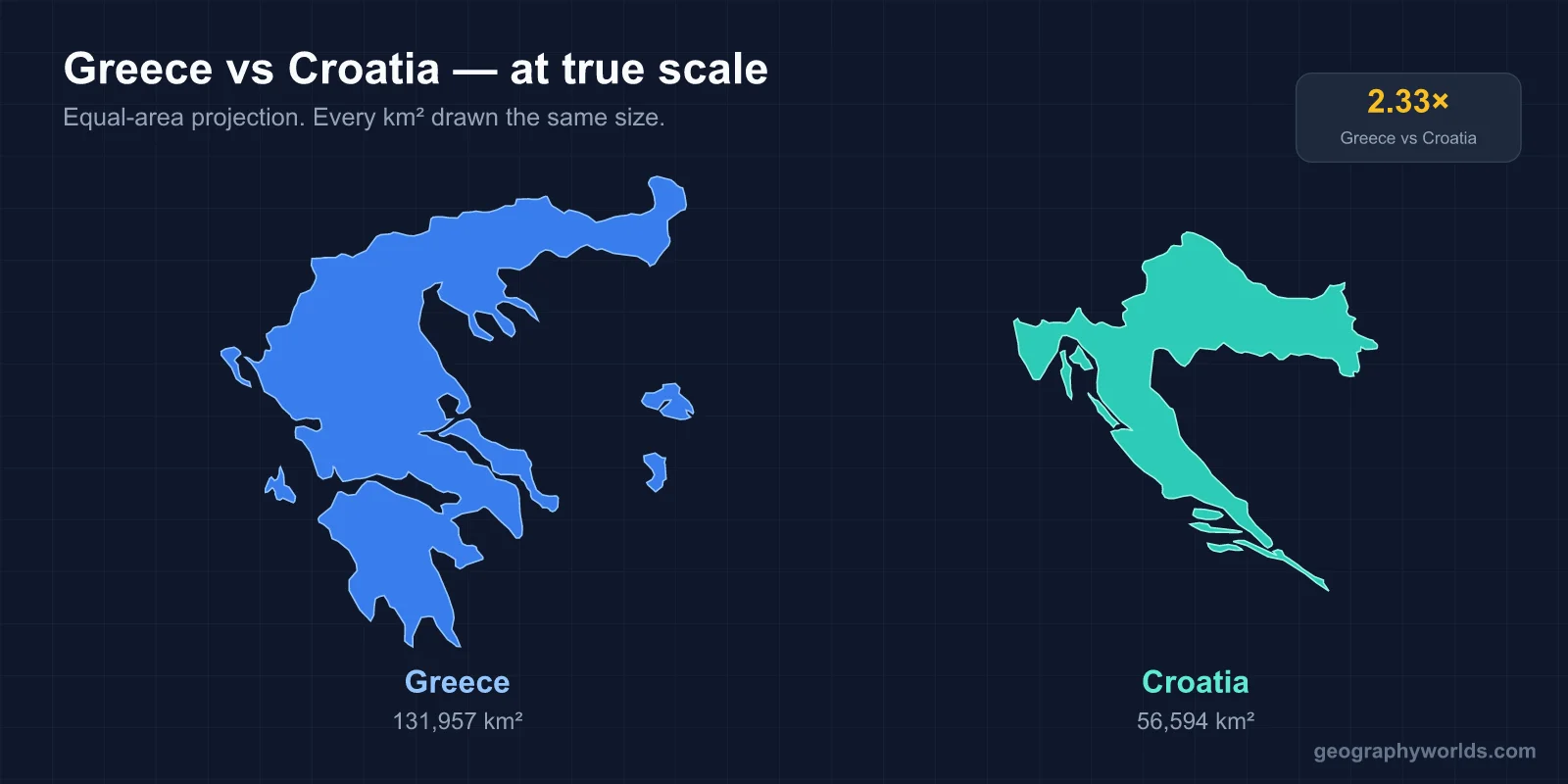
Greece is the larger country, covering 131,957 km² to Croatia's 56,594 km², roughly 2.3 times the area. Both face the sea heavily, but in different ways. Croatia wraps around the eastern Adriatic, blending coastline with interior plains and mountains, while Greece spreads across a mountainous mainland that fragments into some 6,000 islands and islets scattered through the Aegean and Ionian seas. Their land neighbours differ too, with Croatia bordering the western Balkans and Greece touching Albania, North Macedonia, Bulgaria, and Turkey.
Population & Demographics
| Metric | Croatia 🇭🇷 | Greece 🇬🇷 |
|---|---|---|
| Population | 3.8 million | 9.9 million |
| Population Density | 67.5 per km² | 75.0 per km² |
Greece is also the more populous, home to about 9.9 million people against Croatia's 3.8 million, roughly 2.6 times as many. Because Greece's larger population sits on a proportionally larger territory, the two end up close on density: 75.0 people per square kilometre in Greece versus 67.5 in Croatia, a gap of just 7.5 per km². In both countries the figures are softened by mountainous and island terrain that leaves much of the land lightly inhabited.
Capital Cities
Zagreb is the capital of Croatia, while Athens is the capital of Greece. Both are Southern European capitals, yet they sit very differently in their countries: Zagreb lies inland in Croatia's continental north, away from the famous Adriatic coast, while Athens spreads across an ancient plain near the Aegean and ranks among the oldest continuously inhabited cities in the world.
Language, Currency & Culture
| Aspect | Croatia 🇭🇷 | Greece 🇬🇷 |
|---|---|---|
| Languages | Croatian (official) | Greek (official) |
| Currency | Euro (EUR) | Euro (EUR) |
Language is one area where the two diverge sharply. Croatian is a South Slavic language written in the Latin alphabet, while Greek stands largely on its own as a branch of the Indo-European family with a distinct alphabet and a written record stretching back thousands of years. On money, however, they align: both Croatia and Greece use the Euro, so travellers moving between them face no currency change.
Climate & Natural Features
| Aspect | Croatia 🇭🇷 | Greece 🇬🇷 |
|---|---|---|
| Climate | Mediterranean along coast; continental inland | Mediterranean; mild, wet winters and hot, dry summers |
| Key Features | Dalmatian Coast, Plitvice Lakes, Dinaric Alps, 1,000+ islands | Mount Olympus, Greek islands, Peloponnese, Aegean Sea |
| Economy | tourism, shipbuilding, agriculture, food processing | tourism, shipping, agriculture, services |
Both countries enjoy the warm Mediterranean weather that underpins their tourism, though Croatia's coast gives way to a more continental climate inland, while Greece is Mediterranean throughout, with mild, wet winters and hot, dry summers. Their signature landscapes echo each other without overlapping: Croatia offers the Dalmatian Coast, the Plitvice Lakes, the Dinaric Alps, and more than 1,000 islands, while Greece counts Mount Olympus, the Greek islands, the Peloponnese, and the Aegean Sea. Tourism leads both economies, and both also lean on agriculture, with Greece adding a powerful shipping industry and Croatia a shipbuilding tradition.
What Makes Each Country Unique
Croatia is celebrated for the Dalmatian Coast, the walled city of Dubrovnik (a filming location for Game of Thrones), the Plitvice Lakes, and its more than 1,000 islands. A surprising footnote: the necktie, or cravat, traces its origins to Croatia, evolving from the scarves worn by Croatian mercenaries in 17th-century France.
Greece is best known as the cradle of ancient democracy, home to the Acropolis, a constellation of Mediterranean islands, a rich mythology, and renowned olive oil. The country has more archaeological museums than any other and is widely regarded as the birthplace of Western civilisation, democracy, and the Olympic Games.
Key Differences at a Glance
- Area: Croatia (56,594 km²) vs Greece (131,957 km²) — Greece is 2.3x larger
- Population: Croatia (3.8 million) vs Greece (9.9 million) — Greece is 2.6x more populous
- Capitals: Zagreb vs Athens
- Currency: Euro (EUR) vs Euro (EUR) — both use the Euro
- Continents: Europe vs Europe
- Density: Greece is slightly more densely populated (difference of ~7.5 people per km²)
- Languages: Croatian (official) vs Greek (official)
Verdict
Croatia and Greece are kindred Mediterranean destinations that nonetheless differ in scale and depth. Greece is the larger country by about 2.3 times and the more populous by roughly 2.6 times, yet because its size and population grow together, the two end up almost level on density. Both share the Euro, which makes the contrast feel one of degree rather than kind.
Croatia's draw lies in the Dalmatian Coast, the Plitvice Lakes, and its thousand-plus Adriatic islands, while Greece pairs its own islands and warm climate with an unrivalled ancient heritage, from the Acropolis to Mount Olympus. Tourism powers both, set against a long Mediterranean shoreline.
Viewed together, the two countries show how much variety a shared sea can support. Whether you are planning a trip, studying the Mediterranean, or simply curious, comparing them brings the region's blend of coastline and history into sharper focus.
Test Your Knowledge!
Think you know your countries? Try our interactive geography quiz!
Play Geography Games →