

Bhutan is the only sovereign state whose national flag carries a dragon, and Wales is the only other flag flown as a national flag that does. Bhutan's Druk is a white thunder dragon holding jewels in its claws; Wales' Y Ddraig Goch is a red dragon passant on green and white. Beyond those two, dragons survive on city and regional flags — Ljubljana, Moscow, Kazan, Somerset — and on one imperial flag that stopped flying in 1912.
-
 Bhutan
Druk, the thunder dragon
Bhutan
Druk, the thunder dragon
-
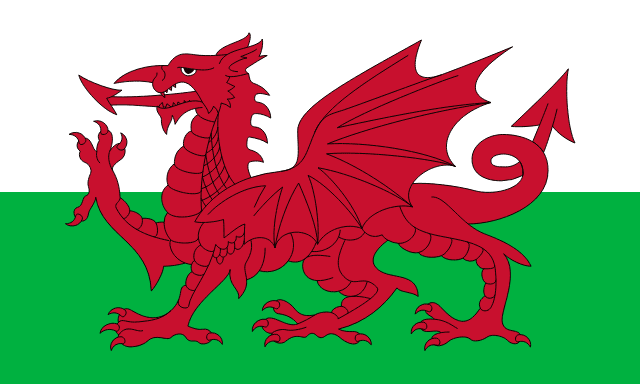 Wales
Y Ddraig Goch, the red dragon
Wales
Y Ddraig Goch, the red dragon
Bhutan Is Named After Its Dragon
Bhutan calls itself Druk Yul, the Land of the Thunder Dragon, and its king is the Druk Gyalpo, the Dragon King. The name comes from the Drukpa school of Tibetan Buddhism, founded in the twelfth century after its establishing lama reportedly heard thunder — understood as the roar of dragons — over the site where he built his monastery.
The flag divides diagonally from the lower hoist to the upper fly. The upper yellow half stands for the secular authority of the monarchy; the lower orange half for the Drukpa Buddhist tradition. The dragon straddles the division, which is the point: in Bhutan's constitutional theory neither authority sits above the other.
The jewels clutched in each claw represent the wealth and security of the nation, and the dragon's snarling mouth is officially described as protecting the country. The design dates in essence to 1947, was standardised in 1969, and its proportions and colours are set out in Bhutanese law with unusual precision.
The dragon is white, not the gold or red of Chinese and European tradition, and Bhutanese sources give the colour as a symbol of purity and of the loyalty of the country's different ethnic groups.
The Welsh Dragon Is Older Than the Flag
Wales flies a red dragon on a green and white field, and the two halves of that design have very different ages. The dragon has been associated with Welsh rulers since at least the ninth century, appearing in the Historia Brittonum in the story of Vortigern's collapsing tower, where a red dragon fights a white one — the Britons against the Saxons — and eventually wins.
Henry Tudor carried the red dragon at Bosworth Field in 1485 and claimed descent from Cadwaladr, the seventh-century Welsh king with whom the emblem was most closely linked. The Tudors put it in the royal arms, where it stayed until James I replaced it with the Scottish unicorn in 1603.
The green and white field is the Tudor livery colour, and the modern combination was only recognised officially in 1959, when the Queen approved the flag in its present form. It is the one flag of the four constituent parts of the United Kingdom that does not appear in the Union Flag, because Wales was legally annexed to England before the Union Flag was designed.
Rugby matches aside, the practical consequence is that Wales is one of the few places on earth where a dragon is an official state symbol rather than a decorative one, appearing on the Senedd, on government letterheads and on the Welsh coinage.
Four Cities That Kept Their Dragon
-
 Ljubljana, Slovenia
The Ljubljana dragon, from the city arms
Ljubljana, Slovenia
The Ljubljana dragon, from the city arms
-
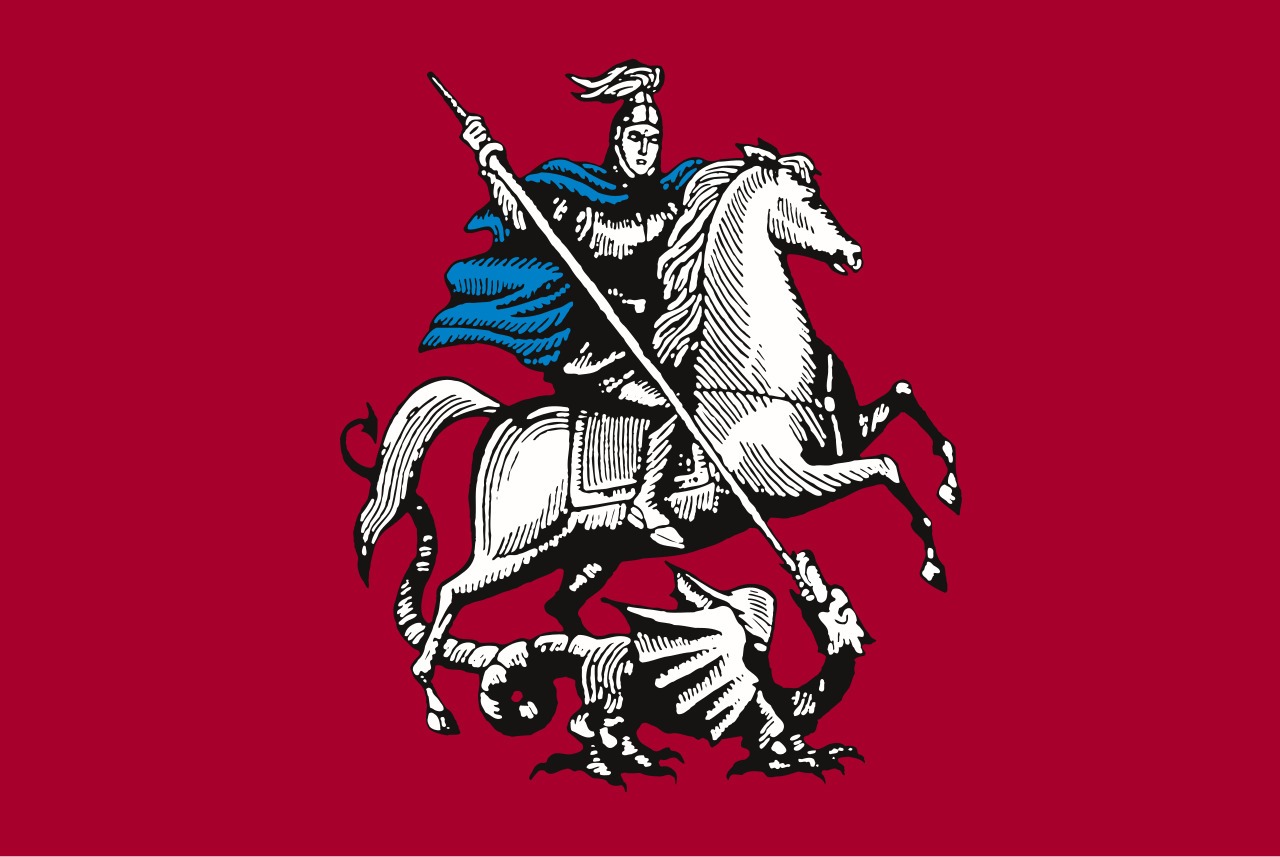 Moscow, Russia
St George spearing a dragon
Moscow, Russia
St George spearing a dragon
-
 Somerset, England
A red Wessex dragon
Somerset, England
A red Wessex dragon
-
 Kazan, Tatarstan
Zilant, a crowned winged serpent
Kazan, Tatarstan
Zilant, a crowned winged serpent
Ljubljana's dragon guards the bridge that carries its name, and the city's coat of arms has shown it on a tower since at least the fifteenth century. Two origin stories compete: one links it to Jason and the Argonauts, who in the Slovene retelling killed a monster in the marshes near the city; the other, more plausibly, derives it from St George, the city's patron.
Moscow's flag shows a horseman spearing a black dragon, and the same image sits at the centre of the Russian coat of arms. Russian heraldic tradition identifies the rider as St George, though in earlier Muscovite usage he was often read simply as the sovereign.
Kazan flies Zilant, a crowned winged serpent from Tatar legend that has been the city's emblem since the sixteenth century. Somerset's red dragon is the dragon of Wessex, revived for the county flag in 2013 from a standard associated with the Anglo-Saxon kings of the West Saxons.
China's Dragon Flag Lasted 23 Years
-
 Qing China, 1889-1912
The azure dragon chasing a red pearl
Qing China, 1889-1912
The azure dragon chasing a red pearl
Given how central the dragon is to Chinese culture, the striking fact is how briefly it appeared on a Chinese flag. Imperial China had no national flag at all in the Western sense until the nineteenth century, when dealings with foreign navies made one necessary.
A triangular yellow banner with an azure dragon was adopted for the Qing navy in 1862 and made rectangular in 1889, serving as the empire's flag until the dynasty fell in 1912. The dragon has five claws, a detail reserved by law for the emperor — lesser nobles used four, and commoners three.
The red disc in the corner is the flaming pearl the dragon pursues, a standard motif in Chinese art usually read as wisdom or the pursuit of perfection. Neither the Republic of China nor the People's Republic kept any of it, and no Chinese flag has carried a dragon since.
Eastern and Western Dragons Are Different Animals
The two dragon flags in current national use illustrate a split that runs through the whole subject. Bhutan's Druk is an East Asian dragon: long, serpentine, four-legged, wingless, associated with water, thunder and sovereignty, and unambiguously benevolent. Wales' is a Western dragon: compact, winged, clawed, standing on its hind legs in the heraldic passant posture.
The Western dragon inherited its reputation from the medieval church, where it stood for the devil, which is why so much European art shows a saint killing one. Moscow's flag and the Ljubljana arms both descend from that tradition — the dragon exists on those flags in order to be defeated.
Bhutan's cannot be read that way. Nothing in the flag opposes the dragon; it is the country. The same is broadly true of Welsh usage, which took a battle emblem rather than a religious one, and where the dragon is the winner of the fight in the founding story rather than the loser.
The Dragon Flags That Were Proposed and Rejected
Dragons have come close to reappearing on national flags more than once. When Wales campaigned for representation on the Union Flag — a periodic argument in the Senedd and in Parliament — several proposed redesigns placed the red dragon over the existing crosses, and none progressed.
Vietnam's Nguyen dynasty used dragon motifs on court banners into the twentieth century, and dragon imagery appeared on some proposed flags during the transition to independence, but the Viet Minh's red flag with a gold star was adopted instead in 1945.
Bhutan's own flag went through several dragons before the current one. The 1949 version had a green dragon; the 1956 revision made it white and turned the diagonal, and the 1969 standardisation fixed the proportions after Bhutan joined the United Nations in 1971 and needed a flag that could be manufactured to specification abroad.
Dragons That Are Not Dragons
Several flags are regularly listed as dragon flags and are not. Mexico's eagle grips a serpent, not a dragon, and the image comes from the Aztec founding legend of Tenochtitlan. Albania's double-headed eagle is a Byzantine emblem. The winged lion on Venice's flag, still used by the Veneto region, is St Mark's lion.
Malta's flag carries the George Cross awarded to the island in 1942, not a dragon, though St George is the same saint whose dragon appears on the Moscow flag — the emblem is the medal, and the dragon does not appear on it.
Nepal's flag is sometimes claimed to show a dragon in its moon emblem. It does not: the two charges are a stylised sun and a crescent moon, and the flag's real distinction is its shape, the only non-rectangular national flag in the world.
Why Dragons Nearly Vanished From Flags
Dragons were common in medieval European war banners. The Roman army adopted the draco standard from Sarmatian cavalry in the second century, a windsock in the shape of a dragon's head that whistled as the wind passed through it, and Anglo-Saxon and Welsh forces used descendants of it for centuries.
They disappeared for the same reason most heraldic charges did. When flags moved from being personal standards of a ruler to being the mark of a nation-state, and had to be manufactured in quantity, recognised at sea and reproduced cheaply, a complex creature became a liability. Bands of colour won, and by the twentieth century almost every new flag was geometric.
The dragons that survive did so by attaching to something other than a state. Wales kept its dragon because it kept an identity without a state to redesign the flag around; Bhutan kept its because the dragon is the country's name; the cities kept theirs because civic heraldry was never subject to the same pressures. Set against the world's other flag conventions — the 85 flags built from plain bands and the 99 that contain blue — two dragons in 193 countries is a measure of how completely the geometric flag won.