
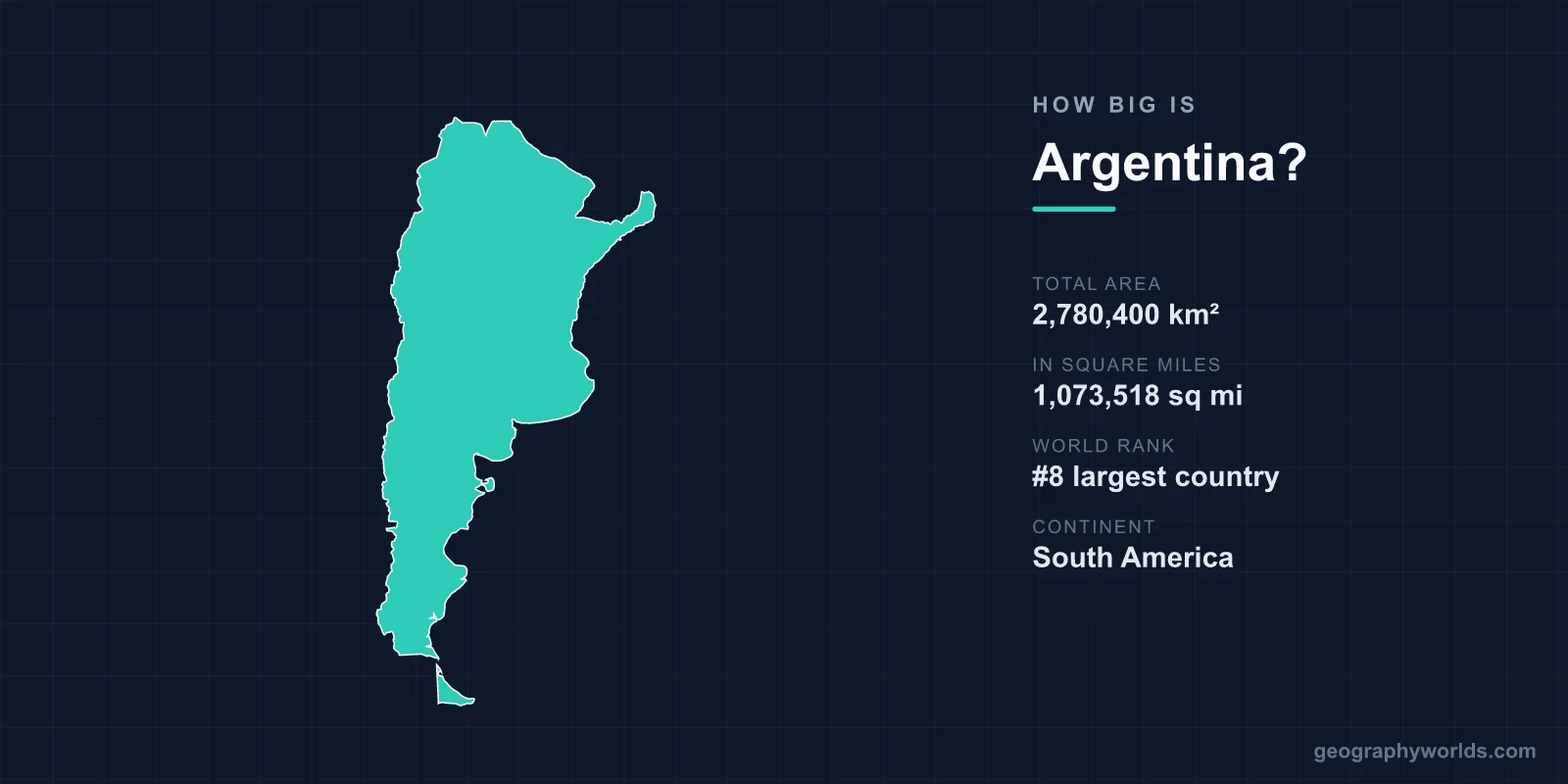
Argentina covers a total area of 2,780,400 km² (1,073,518 sq mi), making it the 8th largest country in the world and the second largest in South America after Brazil. Stretching from the subtropical north to the icy southern tip of the continent, it accounts for roughly 1.87% of the Earth's total land area — a single nation almost as large as India.
Argentina's Area in Numbers
Argentina's 2,780,400 km² ranks it eighth globally, behind Russia, Canada, the United States, China, Brazil, Australia, and India. Within the Spanish-speaking world it stands first, making it the largest Spanish-speaking country on the planet by land area. Some sources cite a slightly higher figure of around 2,791,810 km² when certain claimed Antarctic and South Atlantic territories are included, but the internationally recognised continental and offshore total is 2,780,400 km².
- Total area: 2,780,400 km² (1,073,518 sq mi)
- World rank: 8th largest country
- Continent: South America (2nd largest after Brazil)
- Share of global land: approximately 1.87%
- Capital: Buenos Aires
How Far Argentina Stretches
Argentina's most striking dimension is its length. The country extends roughly 3,500 km from its northern border with Bolivia and Paraguay down to the southern reaches of Tierra del Fuego — spanning about 34 degrees of latitude, from around 22°S to 55°S. At its widest it measures around 1,400 km from east to west, where the Atlantic coast gives way to the towering Andes that form the entire western frontier with Chile.
This north-to-south sprawl gives Argentina a coastline of about 4,989 km along the South Atlantic and creates one of the most extreme climate gradients of any single country. The far north is humid and subtropical, the central Pampas are temperate, and the southern tip is cold, wind-battered subpolar terrain. The temperature difference between the warmest northern lowlands and the glacial south can exceed 40°C.
How Argentina Compares to Other Countries
Size becomes far easier to grasp through direct comparison. Argentina is almost exactly the size of India, the world's seventh-largest country, despite having only a fraction of India's population. Set against European nations the contrast is dramatic:
- About 4.3 times larger than France (640,679 km²)
- Roughly 11 times the area of the United Kingdom
- Larger than Mexico and nearly the size of the entire European Union combined with a few extra states
- Close in size to the combined area of the central United States — you could fit it comfortably between the Rockies and the Mississippi with room to spare
Remarkably, Argentina's Patagonia region alone — the windswept southern third of the country — is larger than France and the United Kingdom put together. For an interactive look at how nations stack up by size, explore the full argentina country guide.
The Landscapes Inside Argentina's Borders
Few countries pack as much geographic variety into one territory. Argentina's enormous footprint contains subtropical rainforest, fertile grasslands, high desert, wetlands, alpine peaks, and polar glaciers — often within a single road trip.
- The Pampas: vast central grasslands among the most fertile agricultural soils on Earth, the engine of Argentina's beef and grain exports.
- The Andes: the western spine of the country, home to Aconcagua at 6,961 m (22,838 ft) — the highest peak in both the Western and Southern Hemispheres.
- Patagonia: a semi-arid steppe of immense scale, including the Perito Moreno Glacier in Los Glaciares National Park, one of the few glaciers on Earth still advancing.
- The North: the subtropical forests and dramatic Iguazú Falls on the Brazilian border.
- Tierra del Fuego: the southern archipelago whose city of Ushuaia is the southernmost city in the world.
Why Argentina Is So Large
Argentina's size is a product of colonial geography and 19th-century expansion. Carved from the Spanish Viceroyalty of the Río de la Plata, the young republic pushed its frontier southward through campaigns into Patagonia during the 1870s and 1880s, absorbing huge tracts of sparsely populated land. Much of that territory remains thinly settled today: well over a third of Argentina's roughly 46 million people live in and around Buenos Aires, leaving vast Patagonian and Andean regions among the emptiest inhabited places on the continent. The country's name itself comes from the Latin argentum, meaning silver, a reference to early European hopes for mineral wealth in the region.
Frequently Asked Questions
Is Argentina bigger than Mexico?
Yes. Argentina (2,780,400 km²) is larger than Mexico (around 1,964,000 km²) by more than 40%, making Argentina the largest Spanish-speaking country in the world by area.
What is the largest country in South America?
Brazil is the largest South American country at about 8,515,000 km². Argentina ranks second on the continent, followed by Peru, Colombia, and Bolivia.
How does Argentina's size compare to the United States?
Argentina is roughly 28% the size of the United States (9,833,000 km²). In other words, about three and a half Argentinas would fit inside the US.
What is the highest point in Argentina?
Aconcagua, at 6,961 m (22,838 ft) in the Andes near the Chilean border, is Argentina's highest point and the tallest mountain anywhere outside of Asia.