
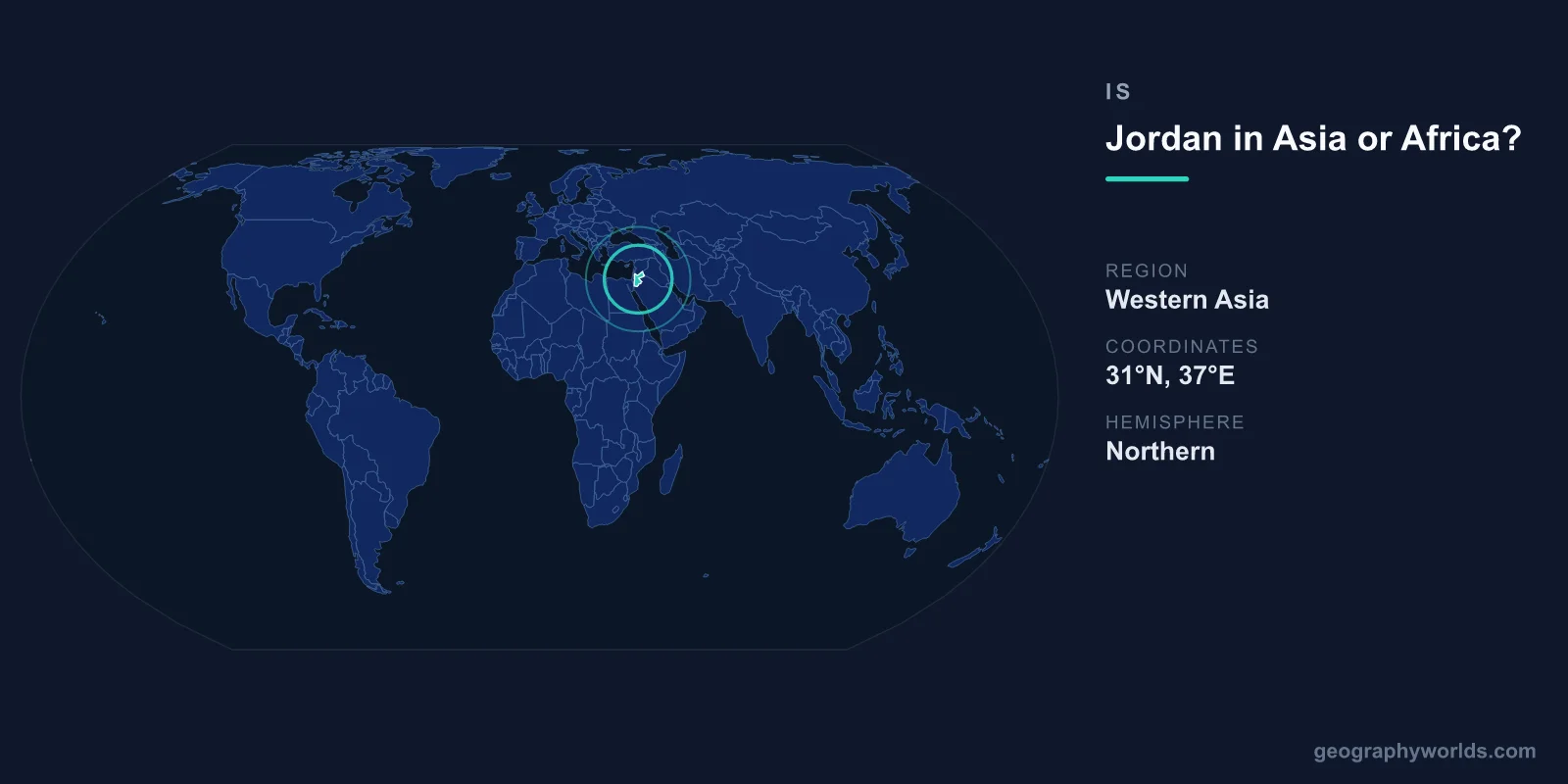
Jordan is in Asia, not Africa. It sits in the region of Western Asia commonly known as the Middle East, on the eastern side of the Jordan Rift Valley. Although the country lies remarkably close to the seam where the Asian and African landmasses meet, every square kilometre of Jordanian territory is firmly part of the Asian continent.
The Short Answer: Asia
Jordan is an Asian country. It belongs to the sub-region geographers call Western Asia, and to the broader cultural and political area known as the Middle East. The Hashemite Kingdom of Jordan shares land borders only with other Asian states and territories: Syria to the north, Iraq to the northeast, Saudi Arabia to the east and south, and Israel and the Palestinian West Bank to the west. None of Jordan's neighbours are African countries, which is a clear signal of where the kingdom sits on the map. With a capital at Amman, a population of around 11 million, and Arabic as its official language, Jordan is culturally and geographically anchored in the Arab world of southwest Asia.
Why People Confuse Jordan With Africa
The confusion is understandable, because Jordan lies right beside one of the planet's most important geological boundaries. The Jordan Rift Valley, part of the much longer Great Rift Valley system, runs along the country's western edge and marks the line where the Arabian Plate pulls away from the African Plate. Stand on Jordan's western cliffs and you are essentially looking across the boundary that separates two continents.
Just beyond that valley, to the southwest, lies Egypt's Sinai Peninsula, which is part of Africa, and the Gulf of Aqaba opens toward the Red Sea, the body of water that splits Arabia from the African continent. Jordan's dramatic desert scenery adds to the mix-up. The towering red dunes and sandstone monoliths of Wadi Rum look so much like North African or even Martian terrain that filmmakers have used the area to stand in for Mars and other worlds. Visually, parts of Jordan resemble the Sahara's fringes, even though they are unmistakably Asian.
Jordan's Place on the Map
Jordan covers roughly 89,342 square kilometres, making it a relatively compact country, comparable in size to Portugal or the US state of Indiana. It is almost entirely landlocked, with just a 26-kilometre sliver of coastline on the Gulf of Aqaba at its southern tip, giving it a single, strategically vital port. The rest of the kingdom is defined by three broad zones:
- The Jordan Rift Valley in the west, including the Jordan River and the Dead Sea, the lowest exposed land surface on Earth at more than 400 metres below sea level.
- The highlands running north to south, where Amman and most of the population are concentrated.
- The eastern desert, part of the vast Arabian Desert, which stretches toward Iraq and Saudi Arabia.
This position places Jordan at a crossroads of trade and pilgrimage routes that have linked Asia, Africa, and Europe for thousands of years, which is one reason its identity feels so continental in spirit even though its geography is purely Asian.
A Land at the Continental Crossroads
Jordan's location near the Asia-Africa hinge has shaped its history profoundly. The Nabataeans built the rose-red city of Petra here, carving temples and tombs into sandstone cliffs and growing wealthy by taxing caravans that moved incense, spices, and silk between Arabia, the Mediterranean, and Egypt. Petra is now one of the New Seven Wonders of the World and Jordan's most famous landmark. The Dead Sea, shared with Israel, draws visitors who float effortlessly in its hyper-saline water, while sites along the Jordan River carry deep religious significance for Judaism, Christianity, and Islam. For travellers wanting the full picture of the kingdom's regions, climate, and attractions, the jordan country guide goes into far more depth.
Quick Facts About Jordan
- Continent: Asia (Western Asia / Middle East)
- Capital: Amman
- Area: approximately 89,342 km²
- Population: around 11 million
- Official language: Arabic
- Coastline: a 26 km stretch on the Gulf of Aqaba (Red Sea)
Frequently Asked Questions
Is Jordan part of the Middle East?
Yes. Jordan is one of the core countries of the Middle East, a region that spans Western Asia and northeastern Africa. Within that region, Jordan sits firmly on the Asian side, bordered by Syria, Iraq, Saudi Arabia, Israel, and the Palestinian West Bank.
Is Jordan an Arab country?
Yes. Jordan is an Arab nation where Arabic is the official language and the great majority of the population are Arabs. It is a member of the Arab League and shares deep cultural, linguistic, and historical ties with its Arab neighbours.
Does Jordan border any African country?
No. Jordan does not share a land border with any African nation. Its closest approach to Africa is across the Gulf of Aqaba and the Red Sea toward Egypt's Sinai Peninsula, but the two are separated by water and by Israel's narrow southern coast.
Is Jordan close to Egypt?
Geographically, yes. Jordan's southern port of Aqaba sits across the Gulf of Aqaba from Egypt, and the two countries are only a short distance apart by sea. Despite this closeness to the African continent, Jordan itself remains entirely within Asia.