
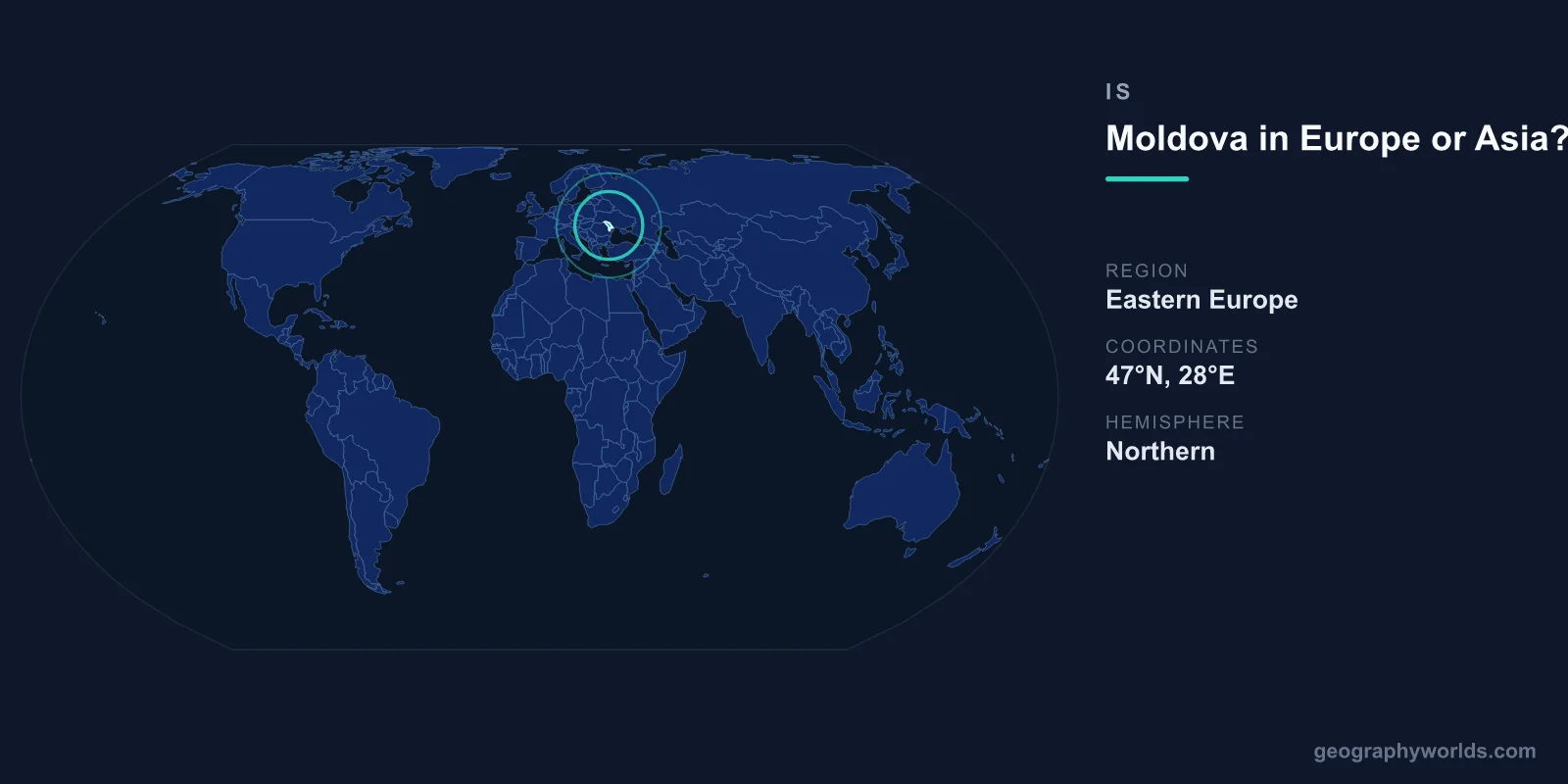
Moldova is in Europe, not Asia. It is a landlocked country in Eastern Europe, sitting between Romania to the west and Ukraine to the north, east, and south. Despite occasional confusion caused by its Soviet past and low international profile, Moldova lies firmly within the European continent, on roughly the same latitude as central France and northern Italy.
Where Exactly Is Moldova?
Moldova occupies a compact wedge of territory in the southeastern corner of the East European Plain. Its capital, Chișinău, sits at approximately 47 degrees north and 28 degrees east, placing the country well to the west of the conventional Europe-Asia boundary, which geographers draw along the Ural Mountains, the Ural River, the Caspian Sea, and the Caucasus. Moldova is nowhere near any of these dividing lines. It is hundreds of kilometres west of the Black Sea coast and over a thousand kilometres from the Caucasus, the nearest point where Europe meets Asia.
The country covers just 33,846 square kilometres, making it one of Europe's smaller nations, comparable in size to Belgium or the US state of Maryland. It is entirely surrounded by two European neighbours, with no Asian border in sight. The Prut River traces its western frontier with Romania, while the Dniester River winds through its eastern half.
Why Do People Think Moldova Might Be in Asia?
The confusion is understandable but unfounded. Several factors feed the misconception:
- Soviet history: Moldova was a Soviet republic until 1991, and many people mentally group all former Soviet states with the Central Asian republics like Kazakhstan or Uzbekistan, which genuinely straddle or lie within Asia.
- Low visibility: Moldova is one of Europe's least-visited and least-discussed countries, so many people simply have no clear mental map of where it sits.
- The Transnistria factor: The breakaway region of Transnistria, along the Ukrainian border, preserves Soviet-era symbols and maintains close ties to Russia, reinforcing an "Eastern" image that some mistakenly read as Asian.
- Relative poverty: As one of Europe's poorest countries, Moldova does not fit the prosperous Western European stereotype, which can blur perceptions of where it belongs.
None of these change the geographic reality. Moldova is unambiguously European by every standard measure: location, history, culture, and political affiliation.
Moldova's European Identity
Beyond pure geography, Moldova is deeply embedded in European institutions and culture. The country is a member of the Council of Europe and was granted European Union candidate status in June 2022, formally beginning the path toward EU membership. Its majority language, Romanian, is a Romance language closely related to Italian, French, and Spanish, and roughly the same as the language spoken in neighbouring Romania, an EU member state. Culturally, historically, and linguistically, Moldova has far more in common with the Balkans and Eastern Europe than with anywhere in Asia.
Moldovans share a Latin-rooted heritage that stretches back to Roman Dacia, and the modern nation emerged from the historical region of Bessarabia, long contested between Romania and the Russian Empire. This is a thoroughly European story.
The Landscape and People
Moldova's terrain is gently rolling steppe and hill country, with no mountains at all. Its highest point, Bălănești Hill, reaches just 430 metres. The land is famous for its fertile black soil, known as chernozem, which supports intensive agriculture and an extraordinary density of vineyards. In fact, Moldova has one of the highest concentrations of vineyards per capita in the world, and wine accounts for a significant share of its exports. The Mileștii Mici cellars hold a Guinness World Record for the largest wine collection on the planet, with over two million bottles stored in tunnels stretching for kilometres.
The population is around 2.6 million people, with Chișinău as the largest city and economic centre. The country is landlocked, with no coastline, though it lies close to the Black Sea via Ukraine. If you enjoy testing your knowledge of countries like this, try our interactive geography games.
Quick Facts
- Continent: Europe (Eastern Europe)
- Capital: Chișinău
- Area: 33,846 km²
- Population: approximately 2.6 million
- Main language: Romanian
- Neighbours: Romania and Ukraine
For a fuller picture of the country, see our moldova country guide.
Frequently Asked Questions
Is Moldova part of Europe?
Yes. Moldova is a Southeastern European country located between Romania and Ukraine. It is a member of the Council of Europe and an official candidate for European Union membership.
Is Moldova in Eastern Europe or the Balkans?
Moldova is generally classified as Eastern Europe, though it is sometimes grouped with Southeastern Europe and the Balkans because of its proximity to Romania and the lower Danube region. Either way, it is firmly within Europe.
Was Moldova part of the Soviet Union?
Yes. Moldova was the Moldavian Soviet Socialist Republic within the USSR until it declared independence in 1991. This Soviet legacy is part of why some people mistakenly associate it with Asia, but it has always been a European territory.
Is Moldova close to Asia?
No. Moldova lies far to the west of the Europe-Asia boundary, which runs along the Ural Mountains and the Caucasus. It is over a thousand kilometres from the nearest point where Europe meets Asia.