
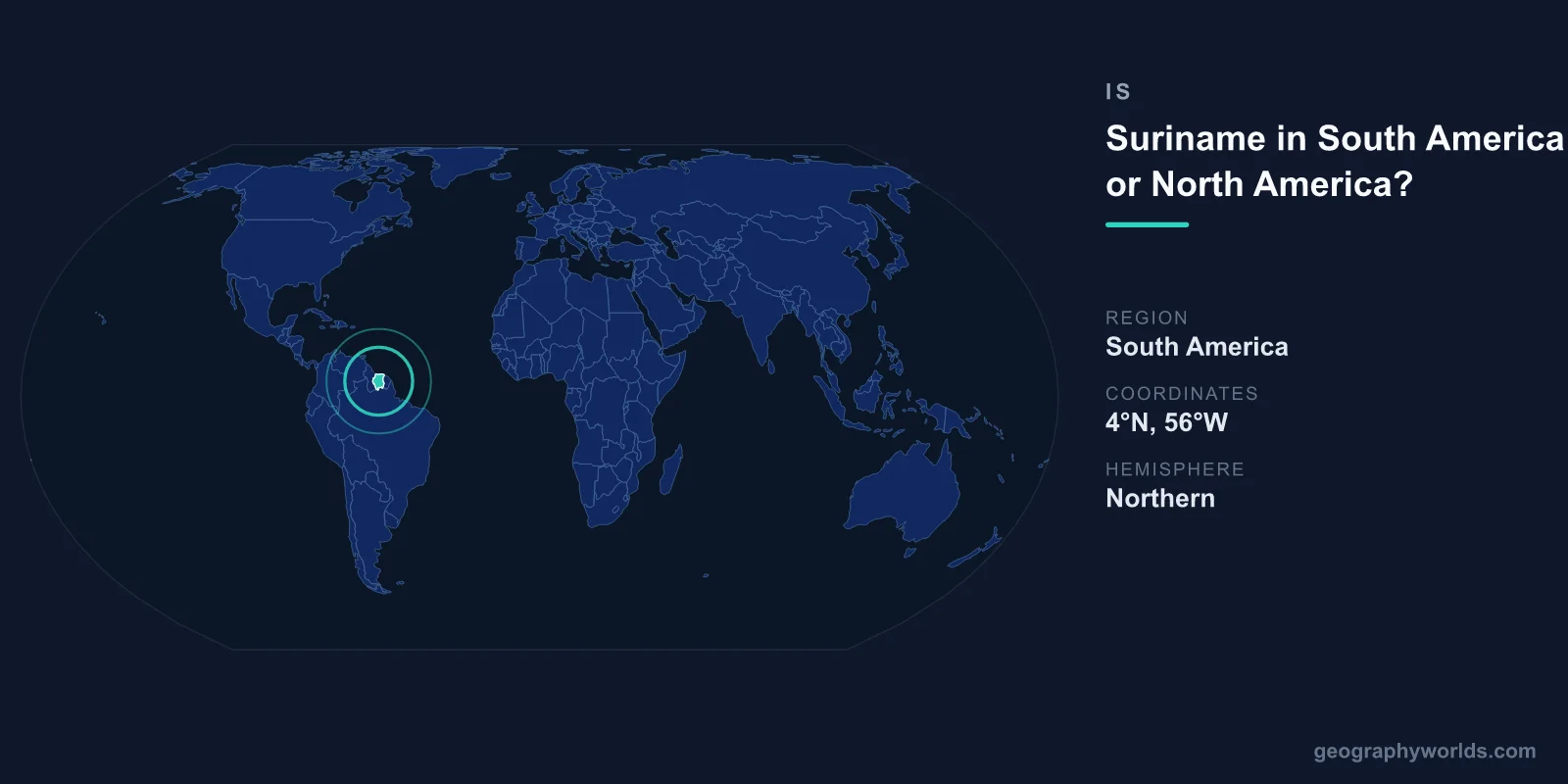
Suriname is in South America, not North America — it sits on the northeastern coast of the continent, bordered by Guyana to the west, French Guiana to the east, Brazil to the south, and the Atlantic Ocean to the north. Although its Caribbean-flavored culture and Dutch language can make it feel like an outlier, geographically Suriname is firmly part of the South American mainland and is, in fact, the continent's smallest sovereign country.
The Clear Answer: South America
There is no ambiguity in physical geography here. Suriname occupies a stretch of the Guiana Shield, an ancient geological formation that forms the northern edge of the South American continent. The entire country lies south of the Atlantic coastline and north of Brazil, well within continental South America. It is not an island, it does not sit in the Caribbean Sea, and no part of it crosses into North or Central America.
Covering about 163,820 km², Suriname is the smallest independent state in South America by area — smaller than its neighbor Guyana and only a fraction the size of giants like Brazil or Argentina. Its capital, Paramaribo, lies on the north coast near the mouth of the Suriname River, and it is here that the great majority of the population lives.
Why People Confuse Suriname's Continent
The confusion is understandable, because Suriname does not fit the stereotype of a South American nation. Several factors feed the mix-up:
- Language: Suriname is the only country in South America where Dutch is the official language — a direct legacy of its history as the colony of Dutch Guiana.
- Caribbean identity: Suriname is a member of CARICOM (the Caribbean Community) and shares strong cultural, economic, and political ties with the Caribbean rather than with Spanish- or Portuguese-speaking Latin America.
- Diversity: Its population blends Hindustani (Indo-Surinamese), Creole, Javanese, Maroon, Indigenous, Chinese, and European communities, giving it a feel closer to the multicultural Caribbean than to the Andes or the Southern Cone.
- Map placement: On many maps Suriname appears as a tiny sliver tucked between larger neighbors, so casual readers simply lose track of where the continental boundary actually falls.
None of these cultural traits change the physical reality: culture and continent are separate things, and Suriname's land sits squarely in South America.
Geographic Setting and Landscape
Suriname stretches inland from a narrow, low-lying coastal plain into a vast interior dominated by tropical rainforest. Roughly 90 percent or more of the country is forested, one of the highest proportions of any nation on Earth. Much of this wilderness is protected within the Central Suriname Nature Reserve, a UNESCO World Heritage Site that shelters jaguars, giant river otters, harpy eagles, and enormous tracts of undisturbed Amazonian-style forest.
The Atlantic Ocean defines the northern edge of the country, and the densely vegetated south rises toward the highlands of the Guiana Shield along the Brazilian frontier. Rivers — including the Suriname, Marowijne (Maroni), Coppename, and Corantijn — fan out across the landscape and have historically served as the main highways into the roadless interior, which is among the most sparsely populated regions in all of the Americas.
Key Facts at a Glance
- Continent: South America
- Region: Northeastern coast, on the Guiana Shield
- Area: about 163,820 km² (smallest country in South America)
- Capital: Paramaribo
- Population: roughly 600,000
- Official language: Dutch
- Borders: Guyana, French Guiana, Brazil, and the Atlantic Ocean
For a deeper look at the country's history, people, and travel highlights, see our suriname country guide.
Suriname and Its Neighbors
Suriname belongs to a trio sometimes called the Guianas: Guyana (a former British colony), Suriname (former Dutch), and French Guiana (still an overseas department of France). All three sit side by side on South America's northeastern shoulder, and all three share the Caribbean-leaning, English/Dutch/French-speaking character that sets them apart from the rest of the continent. Despite these European and Caribbean links, every one of them is geographically South American. Recognizing this helps explain why Suriname can feel culturally Caribbean while remaining a textbook example of a South American country.
Frequently Asked Questions
Is Suriname part of the Caribbean?
Culturally and politically, yes — Suriname is a member of CARICOM and shares deep ties with the Caribbean. Geographically, however, it lies on the South American mainland and is not a Caribbean island.
What is the smallest country in South America?
Suriname is the smallest sovereign country in South America by area, covering roughly 163,820 km², just edging out neighboring Guyana.
Why do people speak Dutch in Suriname?
Suriname was a Dutch colony for centuries, known as Dutch Guiana, and gained independence in 1975. Dutch remained the official language, making Suriname unique among South American nations.
What continent is Suriname's capital, Paramaribo, on?
Paramaribo sits on the northern coast of South America near the Atlantic Ocean. Like the rest of the country, it is entirely within the South American continent.