
Yes. The Caribbean Sea is slightly larger than the Mediterranean Sea. The Caribbean covers about 2,754,000 km², while the Mediterranean covers about 2,500,000 km². The Caribbean is about 1.10 times the size of the Mediterranean — larger by about 254,000 km², which is roughly the size of New Zealand or the United Kingdom. Both are major marginal seas with deep cultural and historical significance.
The Short Answer
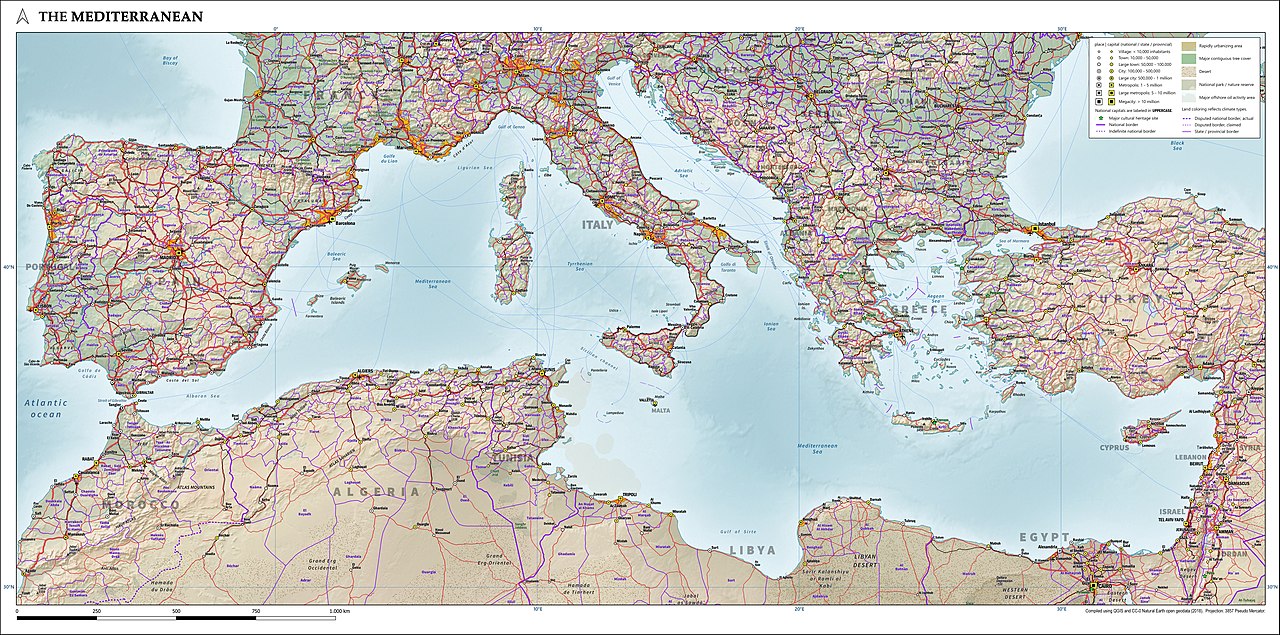
The Caribbean Sea and Mediterranean Sea are two of the most economically and historically important marginal seas in the world. A marginal sea is a partially enclosed body of saltwater connected to a larger ocean. The Caribbean connects to the Atlantic; the Mediterranean connects to the Atlantic too (via the Strait of Gibraltar) and to the Black Sea (via the Bosporus and Dardanelles).
The Caribbean is slightly larger by area, but the Mediterranean has a much longer and more storied history — it's been the center of Western civilization for thousands of years. The Caribbean became globally significant much later, during the colonial era (16th-19th centuries).

The Real Numbers
- Caribbean Sea area: 2,754,000 km² (1,063,000 sq mi)
- Mediterranean Sea area: 2,500,000 km² (965,000 sq mi)
- Difference: 254,000 km² — about the size of NZ or UK
- Ratio: Caribbean is about 1.10× the size of the Mediterranean
Both rank in the top 10 largest marginal seas in the world. The largest is the South China Sea (3.5M km²). After that come the Caribbean and Mediterranean among the top 5. Other major marginal seas include the Bering Sea, the Gulf of Mexico, the Sea of Okhotsk, the Hudson Bay, and the North Sea.
The Caribbean Sea
The Caribbean is bordered by Central America (west), South America (south), and the Antilles arc of islands (north and east). The sea is connected to the Atlantic Ocean through various passages between the islands. Major regions of the Caribbean include the Yucatán Channel, the Windward Passage, the Mona Passage, and the Cayman Trough.
The Caribbean contains over 700 islands, islets, and cays, with major countries including Cuba, Jamaica, Hispaniola (Haiti and Dominican Republic), Puerto Rico, the Bahamas (technically Atlantic, not Caribbean), Trinidad and Tobago, Aruba, Curaçao, Bonaire, and many smaller nations and territories. The region's 44 million people speak Spanish, English, French, Dutch, and various Creole languages.
The Caribbean Plate, the tectonic plate beneath the sea, creates the volcanic Antilles arc and is responsible for major earthquakes — the 2010 Haiti earthquake killed 220,000+ people.
The Mediterranean Sea
The Mediterranean is bordered by Europe (north), Africa (south), and Asia/Middle East (east). It's connected to the Atlantic via the Strait of Gibraltar (just 14 km wide at its narrowest), to the Red Sea via the Suez Canal (since 1869), and to the Black Sea via the Bosporus and Dardanelles straits.
The Mediterranean is divided into multiple sub-seas: the Aegean, the Adriatic, the Ionian, the Tyrrhenian, the Ligurian, the Balearic, and the Alboran. The region's 22 bordering countries include Spain, France, Italy, Greece, Turkey, Egypt, Libya, Tunisia, Algeria, Morocco, Israel, Lebanon, Syria, Cyprus, and Malta — with deep historical interconnections going back to ancient civilizations.
The Mediterranean sits at a tectonic boundary where the African Plate is colliding with the Eurasian Plate, creating the Alps, Apennines, Pyrenees, and Atlas Mountains, and producing earthquakes and volcanoes (Vesuvius, Etna, Stromboli).
Depth
- Caribbean average depth: 2,200 m
- Mediterranean average depth: 1,500 m
- Caribbean max depth: 7,686 m (Cayman Trough)
- Mediterranean max depth: 5,267 m (Calypso Deep in the Ionian Sea)
The Caribbean is about 47% deeper on average. The Cayman Trough is one of the deepest points in any sea — deeper than the deepest point of the Indian Ocean's Sunda Trench (7,258 m).
Climate
The Caribbean has a tropical climate. Sea surface temperatures stay between 24-30°C year-round. Hurricane season runs from June to November, with major storms (Category 4 and 5) occasionally devastating the islands and surrounding coasts. The Caribbean is famous for clear, warm water and white-sand beaches.
The Mediterranean has a temperate climate. Sea surface temperatures range from 13°C in winter (northwestern Mediterranean) to 28°C in summer. The Mediterranean climate (hot dry summers, mild wet winters) is named after this region. Storms are less severe than Caribbean hurricanes but can include strong "Medicane" tropical-like cyclones.
Economic Importance
The Mediterranean is a critical shipping route — the Strait of Gibraltar handles about 100,000 ships per year, and the Suez Canal handles about 25,000 ships per year carrying 12% of world trade. Major Mediterranean ports include Marseille, Genoa, Barcelona, Athens (Piraeus), Istanbul, Alexandria, and Algiers.
The Caribbean is also a major shipping route, especially through the Panama Canal (which connects the Caribbean to the Pacific via Central America). The canal handles about 14,000 ships annually and is one of the most important trade routes in the Western Hemisphere. Major Caribbean ports include Havana, Kingston, San Juan, and Port of Spain.
Tourism
Both are major global tourism destinations. The Caribbean receives about 30 million tourists annually, with cruise tourism being especially significant — the Caribbean is the world's largest cruise destination, receiving about 50% of global cruise passengers. Major destinations: Cuba, Jamaica, Dominican Republic, Puerto Rico, Bahamas, US Virgin Islands.
The Mediterranean receives about 360 million tourists annually — more than 10× the Caribbean. France, Spain, Italy, and Greece are top destinations. Major attractions include the French Riviera, the Italian Riviera, the Greek islands (Santorini, Mykonos), the Amalfi Coast, the Costa del Sol, Croatia's Dalmatian Coast, and Turkey's Aegean coast.
History
The Mediterranean has been the center of Western civilization for over 5,000 years. Egyptian, Phoenician, Greek, Roman, Byzantine, Islamic, and modern European civilizations have all centered here. The Mediterranean enabled the rise of Greek philosophy, Roman law, Christianity, Islam, and modern European nation-states.
The Caribbean entered the global stage in 1492 when Christopher Columbus arrived on his first transatlantic voyage. Indigenous populations (Taíno, Carib, Arawak) suffered catastrophic decline through disease and colonization. The European colonial powers (Spain, Britain, France, Netherlands) competed for Caribbean territories, primarily for sugar plantation economies that depended on African slave labor. The legacy of colonialism and slavery shapes modern Caribbean politics, culture, and demographics.
Key Facts
- The Caribbean is about 1.10× the size of the Mediterranean.
- The Caribbean is deeper on average (2,200 m vs 1,500 m).
- The Mediterranean receives about 10× more tourists than the Caribbean.
- The Caribbean is tropical; the Mediterranean is temperate.
- Both are critical shipping corridors with major canals (Panama and Suez).
Fun Facts
- The Caribbean Sea is named after the Carib people, indigenous inhabitants of the Lesser Antilles.
- The Mediterranean derives its name from Latin "medius" (middle) and "terra" (land) — "in the middle of land."
- The Caribbean has the world's 2nd-largest barrier reef (the Mesoamerican Barrier Reef System).
- The Mediterranean has actually dried up multiple times in geological history — most recently 5-6 million years ago, when it was almost entirely empty (the Messinian Salinity Crisis).
- The Caribbean is home to Cuba, the largest island in the Caribbean (109,884 km²).
- The Mediterranean is home to Sicily, the largest island in the Mediterranean (25,711 km²).
- The Caribbean is named after the Carib indigenous peoples, while the Mediterranean's name derives from Latin meaning "in the middle of land."
- The Mediterranean has been part of human history for at least 50,000 years — Neanderthals lived on its coasts before modern humans arrived.
Marine Biodiversity
The Caribbean has remarkable marine biodiversity. The Mesoamerican Barrier Reef (the world's second-largest coral reef system after the Great Barrier Reef) stretches over 1,000 km along the coasts of Mexico, Belize, Guatemala, and Honduras. The Caribbean hosts over 700 species of fish, hundreds of coral species, manatees, sea turtles, and many other marine species. However, the reef is severely threatened by climate change and pollution.
The Mediterranean has been heavily impacted by thousands of years of fishing and human activity. The sea has about 17,000 known marine species, but populations are far below historical levels. Recent decades have seen the introduction of invasive species (especially from the Red Sea through the Suez Canal — "Lessepsian migration"). The Mediterranean monk seal, once common, is now one of the world's rarest mammals.
The Bottom Line
The Caribbean Sea is slightly larger than the Mediterranean — about 10% larger by area, and about 47% deeper on average. Both are major marginal seas with profound cultural and economic significance, but the Mediterranean dominates in historical importance and tourism (about 10× more visitors annually). The Caribbean is tropical and famous for its beaches and cruises; the Mediterranean is temperate and famous for civilization and history.