
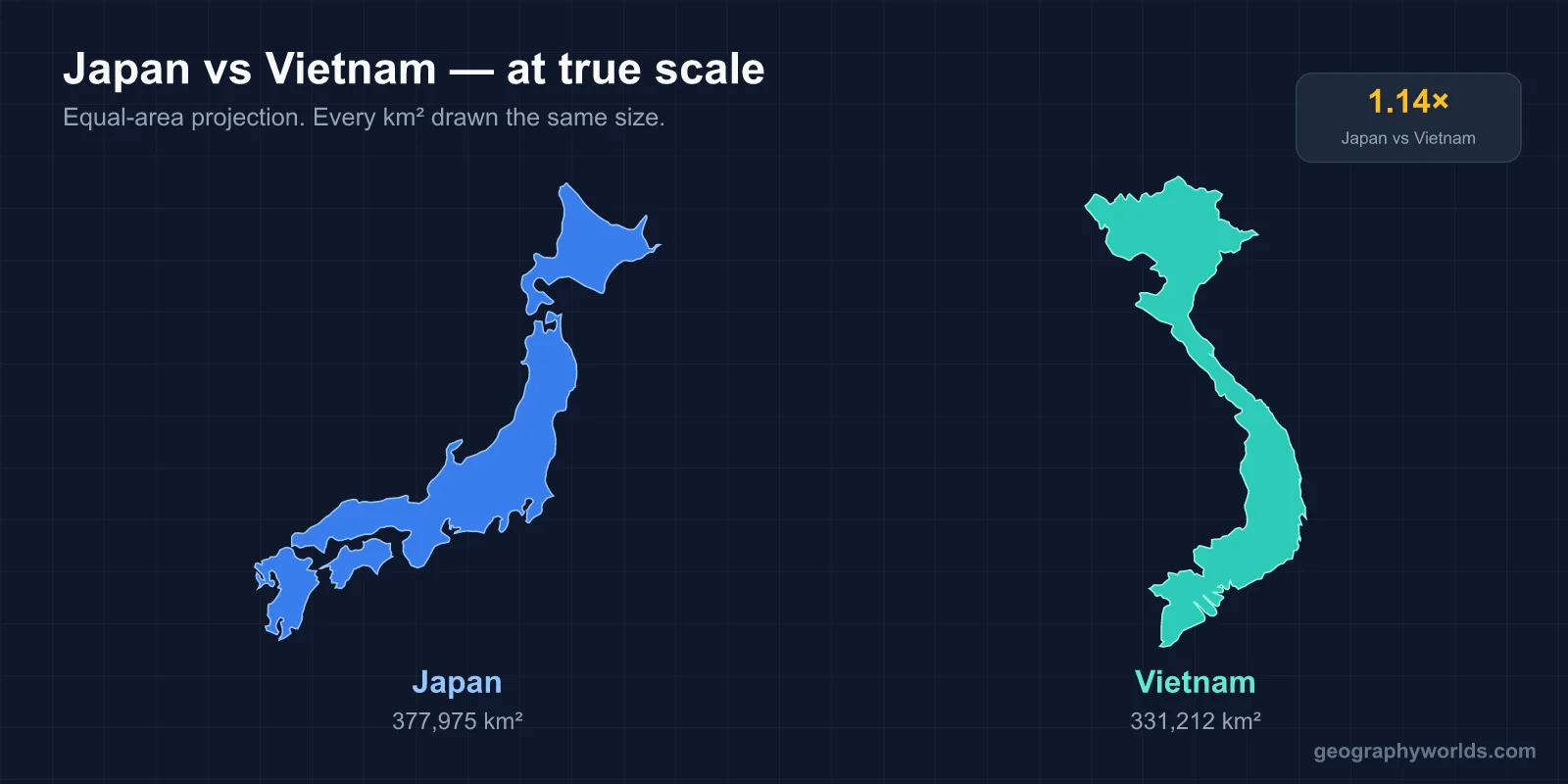
Vietnam and Japan are two of East Asia's most consequential nations — Vietnam an emerging economic power on the Southeast Asian mainland, Japan a developed island nation that has been one of the world's top economies for decades. Both have rich cultural histories and outsized regional influence. So which is bigger?
The Short Answer
No, Japan is bigger than Vietnam. Japan covers 377,975 km². Vietnam covers 331,212 km². Japan is approximately 14% larger than Vietnam. The two countries are similar in size — within 47,000 km² of each other.
Side-by-Side Numbers
- Vietnam area: 331,212 km² (127,882 sq mi)
- Japan area: 377,975 km² (145,937 sq mi)
- Difference: Japan is ~47,000 km² larger
- Ratio: Japan is ~1.14× the size of Vietnam
- Vietnam population: ~99 million
- Japan population: ~123 million
Vietnam
Vietnam is a long, S-shaped country in mainland Southeast Asia, bordered by China to the north, Laos and Cambodia to the west, and the South China Sea to the east. The country is roughly 1,650 km long from north to south, but in the narrowest part, near Đồng Hới, it is only about 50 km wide. This extreme north-south orientation gives Vietnam its distinctive shape.
Vietnam is divided into three main regions: the Red River Delta in the north (centered on Hanoi, the capital), the long narrow central coast, and the Mekong Delta in the south (centered on Ho Chi Minh City, formerly Saigon). The Truong Son Mountains (Annamite Range) run along the western border. Vietnam's highest peak is Fansipan at 3,143 m in the far northwest. The country has 3,260 km of coastline.
Japan
Japan is an East Asian island nation in the Pacific Ocean, off the coasts of China, Korea, and Russia. It consists of about 14,125 islands, with the four main ones — Honshu, Hokkaido, Kyushu, and Shikoku — accounting for the vast majority of the land area. Japan stretches about 3,000 km from Hokkaido in the north to Okinawa in the south.
Japan sits on the convergence of four tectonic plates, making it one of the most seismically and volcanically active places on Earth. About 73% of the country is mountainous, with most of the population concentrated in narrow coastal plains. Tokyo's metro area, with 37+ million people, is the largest urban area in the world. Other major cities include Yokohama, Osaka, Nagoya, Sapporo, and Fukuoka.
Population
Japan has about 123 million people; Vietnam has about 99 million. Japan has 24% more people. Both countries are relatively densely populated — Japan at 325 per km² (concentrated in coastal plains), Vietnam at 300 per km² (concentrated in the two river deltas). Both have aging populations, though Vietnam's demographic transition is more recent and the country still has a younger overall population.
Climate
Both have diverse climates due to their north-south extents. Vietnam's climate varies dramatically with latitude. The far north has a subtropical climate with cool winters that can occasionally see frost in mountain regions. The center has a tropical monsoon climate with distinct wet and dry seasons. The south has a tropical savanna climate, hot year-round. Typhoons regularly strike the central coast from August to November.
Japan spans subarctic in Hokkaido to subtropical in Okinawa. Most of Honshu has a humid subtropical climate with four distinct seasons. The Sea of Japan coast gets heavy winter snow due to cold Siberian air picking up moisture over the relatively warm sea — Sapporo gets about 5 m of snow per year. Typhoons strike Japan from late summer through early fall.
Economy
Japan has the world's 4th largest economy at about $4.2 trillion GDP, dominated by manufacturing (cars, electronics), robotics, automobiles, and increasingly services. Japan has been a global economic powerhouse since the 1960s. Vietnam has a GDP of about $430 billion, but growing rapidly — among Asia's fastest-growing economies. Major industries include manufacturing (Samsung produces most of its phones in Vietnam), textiles, footwear, furniture, seafood, and increasingly electronics. Vietnam has emerged as a major manufacturing alternative to China for many global brands.
History
Vietnam's history stretches back thousands of years. The Bronze Age Đông Sơn culture flourished from around 1000 BCE. Vietnam was under Chinese control for about 1,000 years before gaining independence. Successive Vietnamese dynasties built a country that resisted Chinese influence even while adopting its writing and Confucian institutions. The French colonized Vietnam in the 19th century. Independence wars (against the French, then the Americans) culminated in unification under communist rule in 1975.
Japan was unified under the Tokugawa shogunate (1603–1867), spent 250+ years in self-imposed isolation, then rapidly modernized after the Meiji Restoration (1868). It became Asia's first industrial power, expanded aggressively in the early 20th century, and was devastated in World War II — including the only atomic bombings in wartime history. Post-war recovery made Japan the world's 2nd largest economy by the 1970s.
Cultural Influence
Both have outsized cultural influence regionally and globally. Japan has shaped global pop culture through anime, manga, video games (Nintendo, Sony PlayStation, Sega), J-pop, traditional arts (tea ceremony, ikebana, calligraphy), cuisine (sushi, ramen, sake have spread globally), and martial arts. Japanese aesthetic principles — wabi-sabi, kaizen, minimalism — have influenced design worldwide. Vietnam's cultural influence is smaller but growing rapidly. Vietnamese cuisine — pho, bánh mì, spring rolls — has spread worldwide. Vietnamese coffee culture is increasingly recognized. The country's cinema and music are gaining international audiences. About 5 million people of Vietnamese descent live abroad, in major communities in the US (Vietnamese Americans are the 4th largest Asian American group), Australia, Canada, France, and Germany.
Tourism
Both are major tourism destinations. Japan welcomes about 32 million international visitors per year (peak before the pandemic, recovering quickly). Top draws include Tokyo, Kyoto's temples and gardens, Osaka, Hiroshima, Mount Fuji, the Japanese Alps, Hokkaido's ski resorts and food culture, and Okinawa's beaches. Vietnam welcomes about 18 million international visitors per year. Top destinations include Hạ Long Bay (a UNESCO World Heritage Site), Hội An, Hue, Sapa, the Mekong Delta, Phu Quoc, Da Nang, and the Cu Chi Tunnels.
Strategic Position
Both occupy strategically important positions in East Asia. Japan is a major US ally with the Mutual Defense Treaty, hosts significant US military presence, and is a key participant in the Quad with the US, India, and Australia. Japan is also a major economic player throughout Asia. Vietnam has been navigating its relationship with China carefully — the two share a long border and have overlapping claims in the South China Sea. Vietnam has been deepening defense and economic ties with the US, Japan, India, and South Korea in recent years.
Religion and Society
Vietnam is predominantly secular or Buddhist (about 16% Buddhist), with most Vietnamese practicing folk religion or no religion. The country has small Christian (about 8%, mostly Catholic) and Cao Dai/Hoa Hao communities. Communist-era policies discouraged religious practice, though tolerance has increased significantly since the 1990s. Japan is similarly complex religiously. Most Japanese practice elements of both Shinto and Buddhism but do not strongly identify with either as their primary religion. Shinto shrines and Buddhist temples are common across the country, often visited for specific life events (births, weddings, New Year) rather than weekly worship.
Cuisine
Both have famous food cultures. Vietnamese cuisine — pho, bánh mì, spring rolls, rice paper rolls — has spread worldwide via diaspora communities and Vietnamese restaurants globally. The food emphasizes fresh herbs, balance of flavors, light broths, and clever use of rice in all its forms. Japanese cuisine is on the UNESCO Intangible Cultural Heritage list. Sushi, ramen, tempura, kaiseki, and a vast world of regional specialties define the tradition. Tokyo has more Michelin-starred restaurants than any other city in the world.
Key Facts
- Japan is about 14% larger than Vietnam by area.
- Japan has 24% more people than Vietnam.
- Japan is the 4th largest economy in the world; Vietnam is rapidly growing.
- Vietnam is mainland; Japan is an archipelago of 14,125 islands.
- Both have significant cultural and economic influence in East Asia.
Fun Facts
- Vietnam is shaped like a long dragon; Japan is shaped like a long sweeping arc.
- Japan has more than 100 active volcanoes.
- Vietnam is the world's 2nd-largest coffee producer.
- Japan has more Michelin-starred restaurants than any other country.
- Both have major manufacturing roles in global supply chains.
The Bottom Line
Japan is bigger than Vietnam — by about 14%. The two East Asian nations have very different economic profiles (Japan is highly developed, Vietnam is rapidly developing), but both are major players in regional and global affairs. Japan dominates in high-tech manufacturing and cultural exports; Vietnam is becoming a major manufacturing alternative to China for global brands.
Quiz East Asia!
Test your knowledge of Vietnam, Japan, and great East Asian nations.
Play Geography Games →