

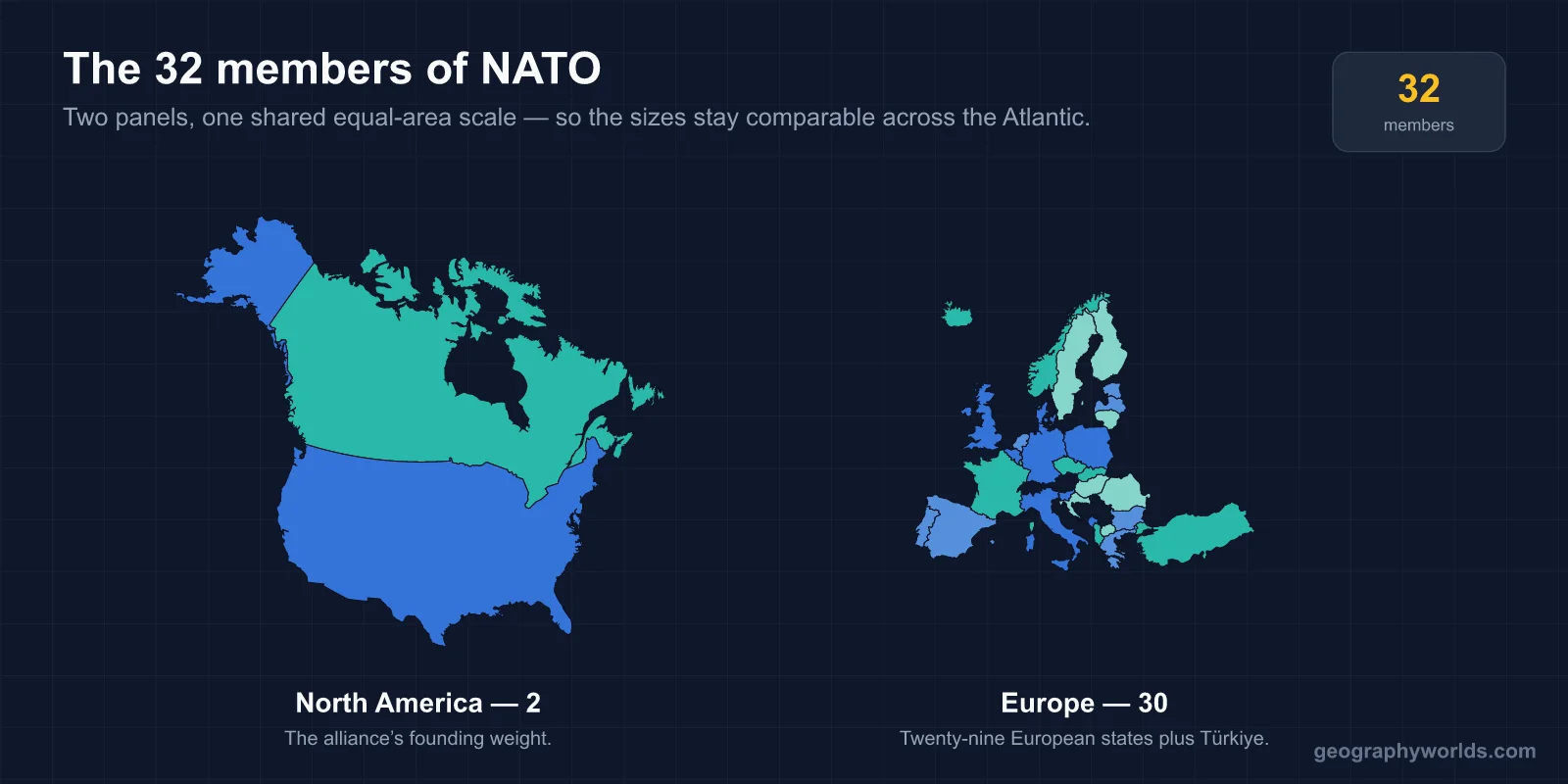
NATO has 32 member states. Finland joined in April 2023 and Sweden in March 2024, ending more than two centuries of Swedish non-alignment and adding around 1,300 km to the alliance's border with Russia. The organisation has grown from 12 founding members in 1949 to 32 across nine rounds of enlargement, and every one of them was a decision by the applicant, not an invitation.
All 32 Members, and When Each Joined
- 1949 — the founding twelve. Belgium, Canada, Denmark, France, Iceland, Italy, Luxembourg, the Netherlands, Norway, Portugal, the United Kingdom and the United States.
- 1952. Greece and Turkey, extending the alliance to the eastern Mediterranean.
- 1955. West Germany — the accession that prompted the Soviet Union to create the Warsaw Pact nine days later.
- 1982. Spain, seven years after Franco's death.
- 1999. The Czech Republic, Hungary and Poland — the first former Warsaw Pact states to join.
- 2004. Bulgaria, Estonia, Latvia, Lithuania, Romania, Slovakia and Slovenia. The largest single round, and the first to include former Soviet republics.
- 2009. Albania and Croatia.
- 2017. Montenegro. 2020. North Macedonia, which had to change its name to get in.
- 2023–24. Finland, then Sweden.
Two of these are worth pausing on. North Macedonia's accession was blocked by Greece for years over the name "Macedonia", which Greece considered a claim on its own northern province; the Prespa Agreement of 2018 settled it, the country renamed itself, and membership followed within two years. And Germany's 1955 entry is the clearest case of NATO enlargement directly producing its mirror image — the Warsaw Pact was signed on 14 May 1955, nine days after West Germany acceded.
Article 5, and the One Time It Was Used
The whole alliance rests on one sentence in Article 5 of the 1949 North Atlantic Treaty: an armed attack against one member in Europe or North America "shall be considered an attack against them all". What follows is less absolute than most people assume — each ally then takes "such action as it deems necessary, including the use of armed force". It is a commitment to respond, not an automatic declaration of war.
Article 5 has been invoked exactly once in seventy-five years, and not by a European state. NATO invoked it on 12 September 2001, the day after the attacks on New York and Washington, and the operational result was AWACS aircraft from the alliance's fleet patrolling American airspace — European planes defending the United States, the reverse of the direction the treaty was written to work in.
Article 4, which allows any member to call consultations when it feels threatened, has been used far more often — by Turkey repeatedly over Syria and Iraq, by Poland and the Baltic states in 2014, and by eight eastern members jointly in February 2022.
Why Finland and Sweden Changed Their Minds
Finland shares a 1,340 km border with Russia and had stayed formally non-aligned since the Second World War, under an arrangement often called Finlandisation. Sweden had avoided military alliances since 1814 — longer than any other country in Europe. Both applied within three months of Russia's full-scale invasion of Ukraine in February 2022.
Finnish public support for membership had sat around 20–25% for decades and rose above 70% within weeks of the invasion. Finland acceded on 4 April 2023, on the alliance's 74th anniversary, doubling NATO's land border with Russia at a stroke. Sweden's application took longer, held up first by Turkey over Kurdish groups and then by Hungary, and completed on 7 March 2024.
The practical effect is that the Baltic Sea is now ringed by NATO members on every shore except the Russian coastline at St Petersburg and the Kaliningrad exclave.
What the Alliance Actually Consists Of
NATO has a permanent civilian headquarters in Brussels and a military command, SHAPE, at Mons in Belgium. What it does not have is much of an army of its own. Almost all the forces that would fight under NATO command belong to the member states and are assigned to it only when needed.
The exceptions are small and specific: a fleet of AWACS early-warning aircraft registered in Luxembourg, a strategic airlift wing in Hungary, and the integrated air and missile defence system. Everything else — every soldier, ship and fighter — is national. The alliance is best understood as a command structure, a set of standards and a promise, rather than a standing force.
Decisions are taken by the North Atlantic Council and require consensus. There is no vote and no majority: all 32 must agree, or nothing happens. The Secretary General chairs it and is by convention a European, while the top military commander, SACEUR, has always been an American — an arrangement unbroken since Eisenhower held the post in 1951.
NATO Is Not the European Union
These two are confused more than any other pair in European institutions, and the memberships genuinely do not match.
- In NATO but not the EU: the United Kingdom, Norway, Iceland, Turkey, Albania, Montenegro, North Macedonia, Canada and the United States.
- In the EU but not NATO: Austria, Ireland, Cyprus and Malta — the four remaining neutrals, three of which have constitutional or long-standing policy reasons for staying out.
NATO is a military alliance with 32 members, headquartered in Brussels, with its military command at Mons. The European Union is a political and economic union with 27 members and its own separate defence provisions. Twenty-three countries belong to both. The overlap is large enough to blur them together and the exceptions are significant enough to matter — Turkey is one of NATO's largest militaries and has never been an EU member, and Ireland hosts EU institutions while contributing nothing to collective defence.
The Two Per Cent Argument
At the 2014 Wales summit, members agreed to "aim to move towards" spending 2% of GDP on defence within a decade. It was a guideline rather than a treaty obligation, and for most of that decade most members missed it — in 2014 only three did.
That changed quickly after 2022. The number meeting the target rose into the twenties, and Poland became the highest spender in the alliance as a share of its economy, above the United States. The dispute is not really about the percentage: the US accounts for roughly two-thirds of total NATO defence spending, and the argument over burden-sharing has recurred in almost every American administration since Eisenhower's.
Iceland complicates the arithmetic permanently — it has no standing army at all, contributes a coast guard and hosts a NATO air base, and is the only member that has never had armed forces.
France, and the Members Who Have Stepped Back
Membership has not always been continuous in practice. France withdrew from NATO's integrated military command structure in 1966 under de Gaulle, expelled NATO headquarters from Paris — which is why it moved to Brussels — and remained a treaty member without being part of the command for 43 years, rejoining fully in 2009.
Greece withdrew from the military command in 1974 over Turkey's invasion of Cyprus and returned in 1980. Spain joined in 1982, held a referendum in 1986 on whether to stay, voted yes on condition of staying outside the integrated command, and only joined it fully in 1999.
No country has ever left NATO outright. There is a mechanism — Article 13 allows a member to leave after one year's notice — and it has never been used.
The Nuclear Question
Three NATO members have nuclear weapons: the United States, the United Kingdom and France. A further five — Belgium, Germany, Italy, the Netherlands and Turkey — host American weapons on their territory under nuclear sharing arrangements dating to the Cold War, without owning or independently controlling them.
France's arsenal sits outside NATO's nuclear planning entirely, a legacy of the 1966 withdrawal from the command structure; it is the only member whose deterrent is not committed to the alliance. Britain's is assigned to NATO. That distinction is why French and British nuclear policy are discussed so differently despite similar arsenals.
Several members are also signatories to treaties that sit awkwardly with this. The Treaty on the Prohibition of Nuclear Weapons, in force since 2021, has no NATO members among its parties, though a few have attended its meetings as observers — one of the clearer illustrations that a 32-member alliance does not mean 32 identical positions.
Who Might Be Next
Ukraine and Georgia were both promised eventual membership at the 2008 Bucharest summit without being given a timetable, a formulation that satisfied neither side. Bosnia and Herzegovina has a Membership Action Plan. Ireland, Austria, Malta and Cyprus have shown no intention of applying, and Switzerland's neutrality is constitutional.
Every accession requires unanimous ratification by all existing members, which is why Sweden's took twenty months rather than the six that had been expected. That single rule — one member, one veto — is the reason enlargement has come in irregular bursts rather than a steady stream, and it is the main constraint on the alliance reaching 33.
Thirty-two members across two continents is a lot of flags to keep straight, and if you want to test which ones you can actually place, our flag quiz covers every one of them.