
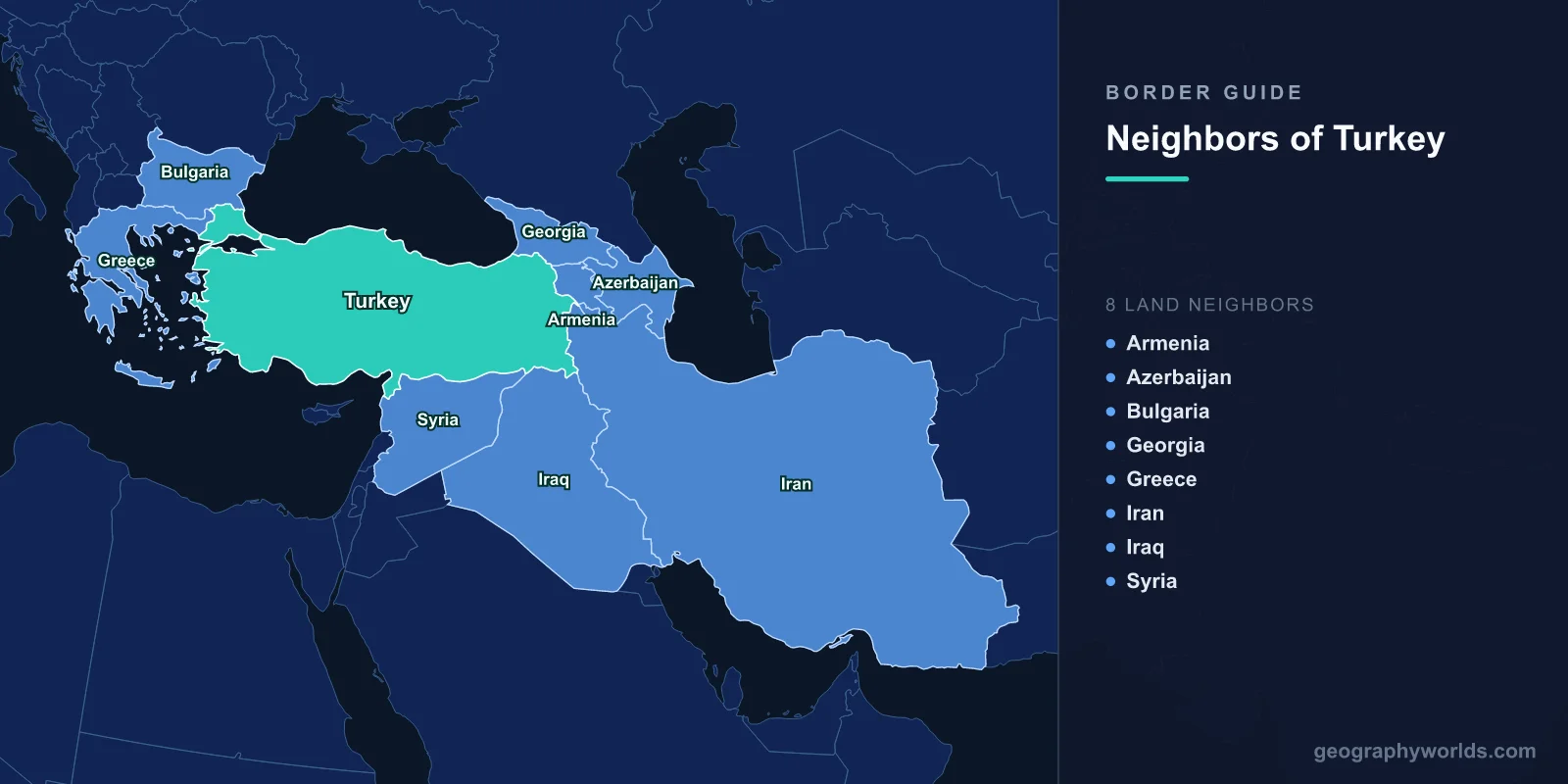
Turkey shares land borders with eight neighboring countries: Greece and Bulgaria to the northwest in Europe, and Georgia, Armenia, Azerbaijan, Iran, Iraq, and Syria across its eastern and southern frontiers in Asia. Together these borders stretch roughly 2,627 kilometers, wrapping around a country that uniquely straddles two continents and connects the Balkans, the Caucasus, and the Middle East.
The Full List of Turkey's Land Neighbors
Turkey's position as a bridge between Europe and Asia gives it an unusually diverse set of neighbors. Clockwise from the northwest, its eight bordering countries are:
- Bulgaria — about 223 km of border in Turkish Thrace, the European part of the country.
- Greece — roughly 192 km, largely following the Maritsa (Meriç) River.
- Georgia — around 273 km along the northeastern Black Sea coast and Caucasus foothills.
- Armenia — about 311 km, a border that has been officially closed since 1993.
- Azerbaijan — a short 17 km frontier with the Nakhchivan exclave, Turkey's gateway to a close ally.
- Iran — roughly 534 km of mountainous border in the east.
- Iraq — about 367 km across rugged Kurdish-populated highlands.
- Syria — Turkey's longest land border at approximately 822 km.
Only two of these neighbors, Greece and Bulgaria, lie on the European side. The remaining six are in Asia, reflecting that the overwhelming majority of Turkey's territory sits in Anatolia.
European Neighbors: Greece and Bulgaria
Turkey's frontier with Europe is concentrated in Eastern Thrace, a compact region west of Istanbul. The border with Bulgaria runs through the Strandzha mountains and forests, a NATO-era boundary that today is an external frontier of the European Union. The line with Greece follows the winding Maritsa River for most of its length, with the city of Edirne sitting close to where the three countries nearly meet. Both borders are heavily watched as crossing points between the EU and Asia, and they carry significant road and rail traffic, including routes that historically formed part of the path of the Orient Express.
Caucasus Neighbors: Georgia, Armenia, and Azerbaijan
In the northeast, Turkey meets the three nations of the South Caucasus. The border with Georgia is the most active, with crossings near the Black Sea facilitating trade and tourism. The frontier with Armenia tells a more complicated story: it has remained sealed since 1993 over disputes linked to Nagorno-Karabakh, leaving the two countries without open land traffic or formal diplomatic relations for decades. By contrast, the tiny 17-kilometer border with Azerbaijan—touching only the Nakhchivan exclave—belies an extremely close political and cultural alliance, often summed up by the phrase "one nation, two states." For more on these relationships, see our turkey country guide.
Middle Eastern Neighbors: Iran, Iraq, and Syria
Turkey's southern and southeastern borders place it firmly within the geopolitics of the Middle East. The boundary with Iran is one of the oldest stable borders in the world, largely unchanged since the Treaty of Zuhab in 1639, and it climbs through high mountains near the towering Mount Ararat. The frontier with Iraq crosses the Hakkari highlands and is a focal point for cross-border security and Kurdish affairs. Turkey's longest land border is with Syria, stretching more than 800 kilometers across the south; this border has been central to refugee movements, trade, and conflict in recent years, and Turkey hosts millions of Syrians who crossed it during the Syrian civil war.
Maritime Neighbors Across the Seas
Beyond its land frontiers, Turkey is bordered by four seas—the Black Sea, the Mediterranean, the Aegean, and the small inland Sea of Marmara. These waters create maritime boundaries with several additional states. Across the Black Sea lie Russia, Ukraine, Romania, and Bulgaria, while Cyprus sits close offshore in the Mediterranean, and numerous Greek islands dot the Aegean only a few kilometers from the Turkish coast. The Turkish Straits—the Bosporus and Dardanelles—are among the world's most strategically important waterways, linking the Black Sea to the Mediterranean and dividing Turkey's European and Asian halves.
Frequently Asked Questions
How many countries border Turkey?
Turkey borders eight countries by land: Greece, Bulgaria, Georgia, Armenia, Azerbaijan, Iran, Iraq, and Syria. It also shares maritime borders with several others, including Russia, Ukraine, Romania, and Cyprus.
Which country has the longest border with Turkey?
Syria shares the longest land border with Turkey, running approximately 822 kilometers along the country's southern edge. Iran has the second-longest at roughly 534 kilometers.
Which borders does Turkey share in Europe?
Turkey's only European land borders are with Greece and Bulgaria, both located in Eastern Thrace, the part of Turkey west of the Bosporus.
Is the border between Turkey and Armenia open?
No. The Turkey–Armenia border has been officially closed since 1993, and the two countries do not maintain formal diplomatic relations, though periodic efforts at normalization have taken place.