
Introduction
Sweden 🇸🇪 and Denmark 🇩🇰 are Scandinavian neighbors linked across the Øresund strait, where a single bridge now carries traffic between the two countries. They share a Nordic heritage and a closely related language, but one is a sprawling northern expanse of forest and lake while the other is a compact, low-lying patchwork of peninsula and islands.
This comparison sets Sweden and Denmark side by side across size, population, capitals, language, and landscape, giving you the essential facts whether you are studying the region or planning to cross that famous bridge yourself.
Size & Geography
| Feature | Sweden 🇸🇪 | Denmark 🇩🇰 |
|---|---|---|
| Area | 450,295 km² | 43,094 km² |
| Continent | Europe | Europe |
| Region | Northern Europe | Northern Europe |
| Land Borders | Norway, Finland | Germany |
| Landscape | mostly flat or gently rolling; mountains in west | low, flat; gently rolling plains |
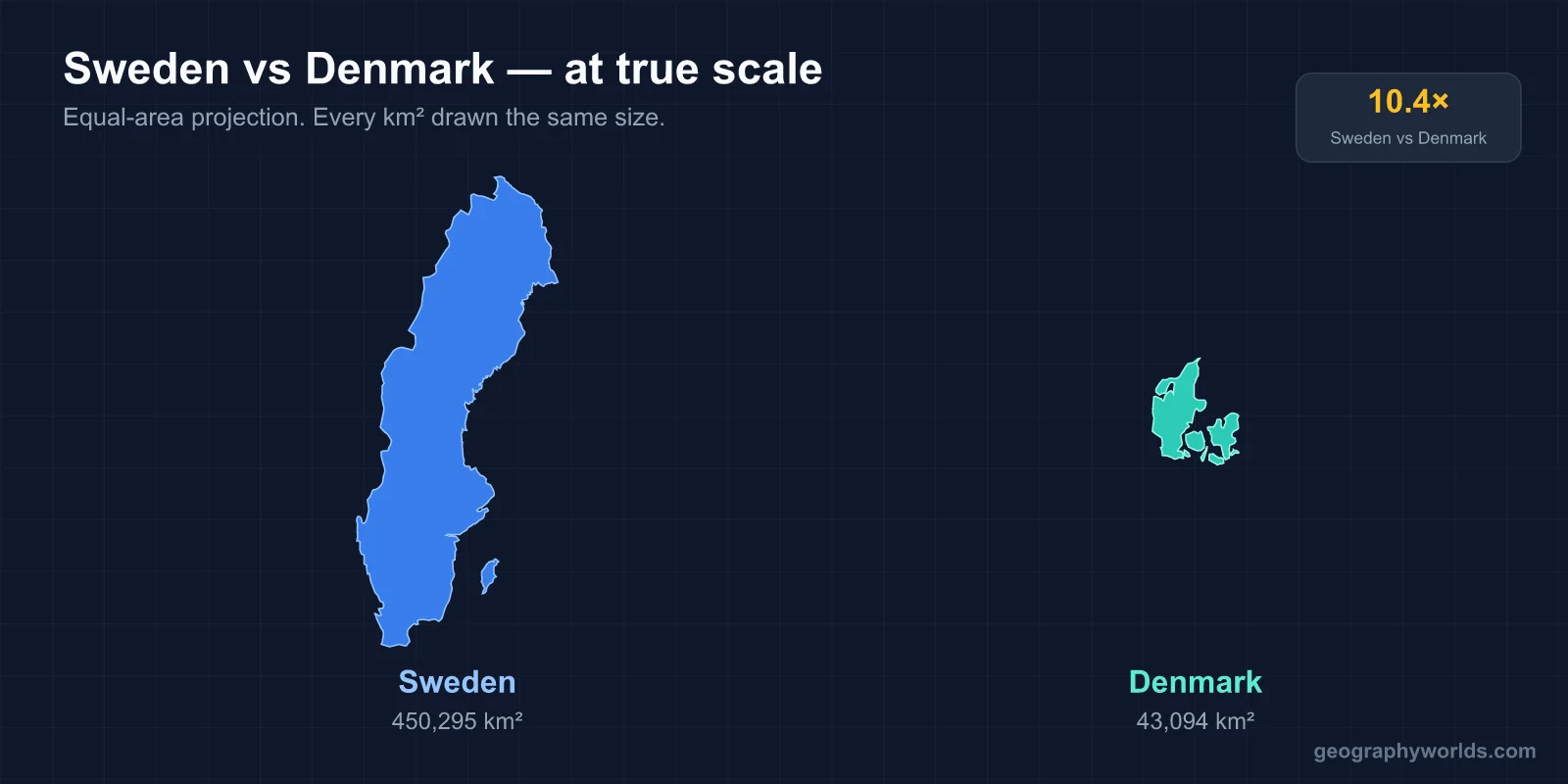
The size gap is enormous: Sweden's 450,295 km² is roughly 10.4 times Denmark's 43,094 km², making Sweden one of Europe's larger countries and Denmark one of its smaller. Sweden stretches far north and rises to mountains along its western border with Norway, while Denmark is uniformly low and flat — gently rolling plains across the Jutland peninsula and a scatter of islands. Their land borders point in opposite directions, too: Sweden connects northward to Norway and Finland, while Denmark's only land frontier is with Germany to the south.
Population & Demographics
| Metric | Sweden 🇸🇪 | Denmark 🇩🇰 |
|---|---|---|
| Population | 10.7 million | 6.0 million |
| Population Density | 23.8 per km² | 139.8 per km² |
Sweden's 10.7 million people are about 1.8 times Denmark's 6.0 million, so the populations are far closer than the land areas would suggest. That mismatch produces the most striking number in this comparison: density. Denmark packs 139.8 people into every square kilometer, while Sweden manages just 23.8 — a difference of about 116.0 people per km². With a similar-sized population squeezed into a fraction of the territory, Denmark is one of the more crowded countries in the Nordic region, and Sweden one of the emptiest.
Capital Cities
Stockholm is the capital of Sweden, built across islands where Lake Mälaren opens onto the Baltic, while Copenhagen is the capital of Denmark, sitting on the eastern coast of the island of Zealand. Both are Northern European capitals near the water, and the Øresund link puts Copenhagen within easy reach of the Swedish coast just across the strait.
Language, Currency & Culture
| Aspect | Sweden 🇸🇪 | Denmark 🇩🇰 |
|---|---|---|
| Languages | Swedish (official) | Danish (official) |
| Currency | Swedish Krona (SEK) | Danish Krone (DKK) |
Swedish and Danish are the official languages of their respective countries, and the two are close enough kin that speakers can often follow one another in writing, though spoken Danish takes Swedes some getting used to. Each country also keeps its own currency rather than the euro: Sweden uses the Swedish Krona (SEK) and Denmark the Danish Krone (DKK), the names themselves a sign of how closely the two cultures track each other.
Climate & Natural Features
| Aspect | Sweden 🇸🇪 | Denmark 🇩🇰 |
|---|---|---|
| Climate | temperate in south; subarctic in north | temperate; mild, windy winters and cool summers |
| Key Features | Swedish Lapland, Stockholm Archipelago, forests and lakes | Faroe Islands connection, Zealand, Jutland, coastal dunes |
| Economy | automotive, telecommunications, pharmaceuticals, forestry | wind energy, pharmaceuticals, shipping, agriculture |
Sweden's long north-to-south reach gives it two climates in one country — temperate in the south, subarctic in the far north — while compact Denmark stays uniformly temperate, with mild, windy winters and cool summers shaped by the surrounding seas. The landscapes match that contrast: Sweden is defined by Swedish Lapland, the Stockholm Archipelago, and a vast interior of forests and lakes, while Denmark is a country of Zealand and Jutland, coastal dunes, and a wider kingdom that extends out to the Faroe Islands. Pharmaceuticals feature in both economies; Sweden adds automotive, telecommunications, and forestry, while Denmark is a leader in wind energy and a major force in shipping and agriculture.
What Makes Each Country Unique
Sweden is internationally renowned for IKEA, Spotify, the Nobel Prize, Viking heritage, and stunning Northern Lights. Sweden invented the three-point seatbelt, the pacemaker, and dynamite — and awards the Nobel Prize for global achievements.
Denmark is best known for LEGO, Hans Christian Andersen fairy tales, hygge (cozy living), and progressive social welfare. Denmark's Faroe Islands have more sheep than people, and the Kingdom of Denmark includes Greenland — the world's largest island.
Key Differences at a Glance
- Area: Sweden (450,295 km²) vs Denmark (43,094 km²) — Sweden is 10.4x larger
- Population: Sweden (10.7 million) vs Denmark (6.0 million) — Sweden is 1.8x more populous
- Capitals: Stockholm vs Copenhagen
- Currency: Swedish Krona (SEK) vs Danish Krone (DKK)
- Continents: Europe vs Europe
- Density: Denmark is more densely populated (difference of ~116.0 people per km²)
- Languages: Swedish (official) vs Danish (official)
Verdict
Sweden and Denmark are about as close as two countries can be culturally while differing wildly in scale. Sweden is more than ten times Denmark's size and holds 1.8 times its population, yet that combination flips the density picture entirely: Denmark is one of the most crowded countries in the Nordic region while Sweden is among the most thinly spread, a gap of about 116 people per km².
Geography drives the contrast. Sweden is a land of Lapland, forests, and lakes stretching toward the Arctic, while Denmark is a low, sea-surrounded country of Zealand, Jutland, and coastal dunes whose kingdom reaches all the way to Greenland. Their economies share a pharmaceutical strength but otherwise specialize differently, Sweden in automotive and telecoms, Denmark in wind energy and shipping.
Comparing them is one of the best ways to see how shared roots and very different geography can sit side by side. Across the Øresund, Sweden and Denmark remain close kin that still feel like two distinct worlds.
Test Your Knowledge!
Think you know your countries? Try our interactive geography quiz!
Play Geography Games →