
Introduction
Sweden 🇸🇪 and Norway 🇳🇴 sit side by side on the Scandinavian Peninsula, share a long land border, and are often spoken of in the same breath. Look closer, though, and two distinct countries emerge, one shaped by forests, lakes, and gentle plains, the other by fjords, plateaus, and a coast carved by ice. This comparison weighs them across area, population, capitals, climate, and the things each is famous for.
Whether you are revising for geography, planning a Nordic trip, or simply curious how the two siblings differ, the tables and notes below cover the essentials.
Size & Geography
| Feature | Sweden 🇸🇪 | Norway 🇳🇴 |
|---|---|---|
| Area | 450,295 km² | 385,207 km² |
| Continent | Europe | Europe |
| Region | Northern Europe | Northern Europe |
| Land Borders | Norway, Finland | Sweden, Finland, Russia |
| Landscape | mostly flat or gently rolling; mountains in west | glaciated; mostly high plateaus and rugged mountains with fjords |
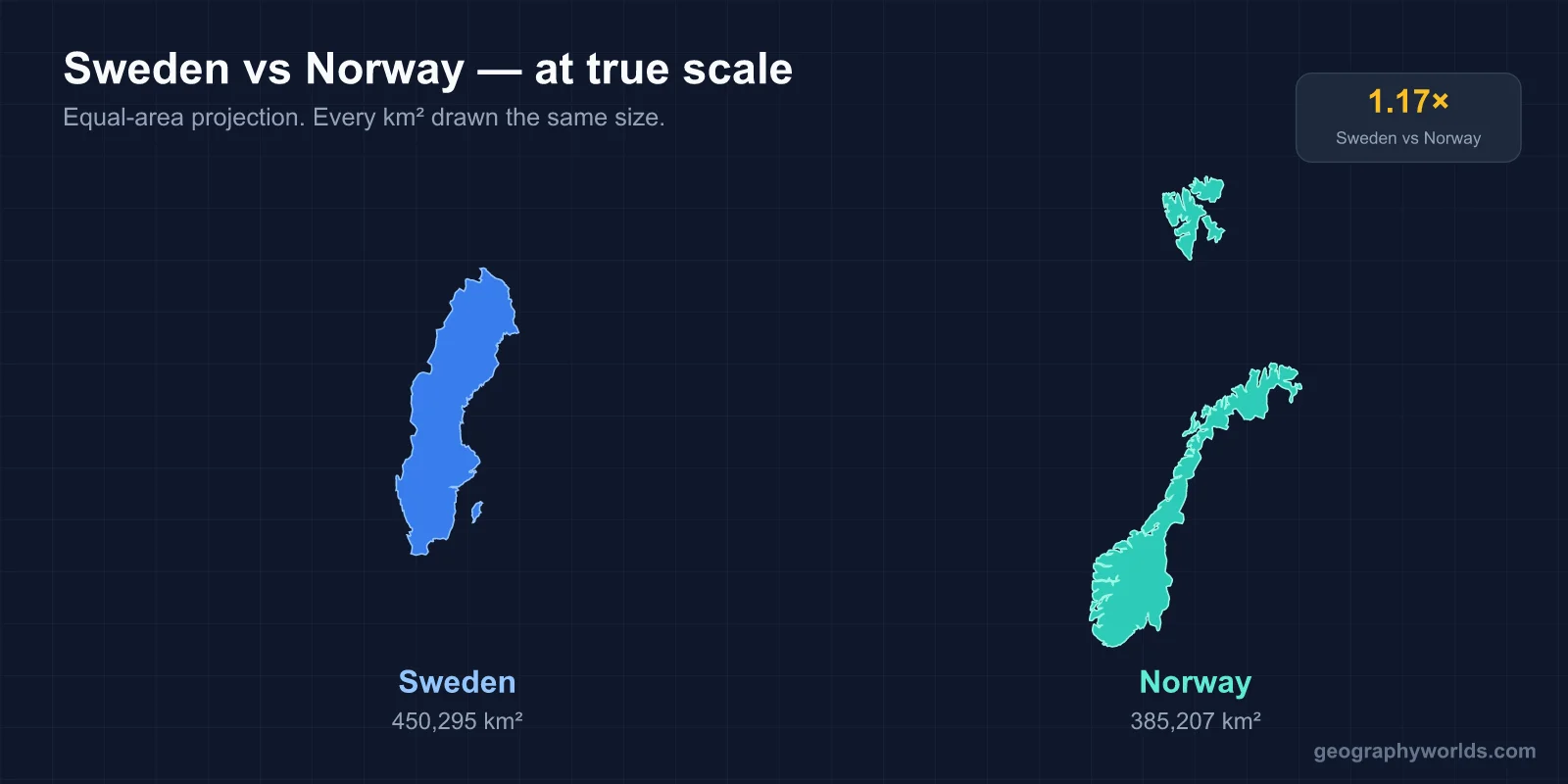
The two are close in size: Sweden's 450,295 km² edges out Norway's 385,207 km² by a factor of about 1.2. The contrast is really in the terrain. Sweden is largely flat or gently rolling, with mountains rising only along its western edge where it meets Norway, while Norway is a glaciated land of high plateaus and rugged peaks split by deep fjords. That mountain spine is, in effect, the border the two share. Norway also reaches far enough northeast to touch Russia, a neighbor Sweden does not have.
Population & Demographics
| Metric | Sweden 🇸🇪 | Norway 🇳🇴 |
|---|---|---|
| Population | 10.7 million | 5.7 million |
| Population Density | 23.8 per km² | 14.7 per km² |
Sweden is clearly the more populous of the two, with 10.7 million people to Norway's 5.7 million, roughly 1.9 times as many. Because its slightly larger area holds nearly double the people, Sweden is also denser at 23.8 per km² against Norway's 14.7, a difference of about 9.1. Even so, both rank among the most thinly populated countries in Europe, with vast tracts of forest, mountain, and Arctic terrain left to nature.
Capital Cities
Both capitals lie in the more habitable south of each country. Stockholm, built across a cluster of islands where Lake Mälaren meets the Baltic, is Sweden's capital, while Oslo sits at the head of a long fjord as Norway's. Both are firmly in Northern Europe.
Language, Currency & Culture
| Aspect | Sweden 🇸🇪 | Norway 🇳🇴 |
|---|---|---|
| Languages | Swedish (official) | Norwegian (Bokmål and Nynorsk, both official), Sámi |
| Currency | Swedish Krona (SEK) | Norwegian Krone (NOK) |
Swedish and Norwegian both descend from Old Norse and remain close enough that speakers can often understand one another. Sweden recognizes Swedish as its official language, while Norway maintains two written standards, Bokmål and Nynorsk, both official, alongside Sámi in the north. Each keeps its own krona, the Swedish Krona (SEK) and the Norwegian Krone (NOK), and neither has adopted the euro.
Climate & Natural Features
| Aspect | Sweden 🇸🇪 | Norway 🇳🇴 |
|---|---|---|
| Climate | temperate in south; subarctic in north | temperate along coast; colder interior |
| Key Features | Swedish Lapland, Stockholm Archipelago, forests and lakes | Fjords, Northern Lights, Lofoten Islands, midnight sun |
| Economy | automotive, telecommunications, pharmaceuticals, forestry | oil and gas, fishing, shipping, hydropower |
Both countries run from temperate conditions in the south to far harsher ones further north, but the Atlantic shapes Norway's coast, keeping it milder and wetter than its colder interior, while Sweden grades from a temperate south into a subarctic north. Sweden's signature scenery is its endless forests, lakes, the Stockholm Archipelago, and the Arctic expanse of Swedish Lapland; Norway's is its fjords, the Lofoten Islands, the midnight sun, and the Northern Lights. The economies diverge sharply too. Sweden built its wealth on industry, automotive, telecommunications, pharmaceuticals, and forestry, whereas Norway's rests on oil and gas, fishing, shipping, and hydropower.
What Makes Each Country Unique
Sweden is known worldwide for IKEA, Spotify, the Nobel Prize, Viking heritage, and dazzling displays of the Northern Lights. It gave the world the three-point seatbelt, the pacemaker, and dynamite, and each year awards the Nobel Prize for achievements across the globe.
Norway is celebrated for its dramatic fjords, Northern Lights, midnight sun, Viking history, and oil wealth. Its coastline is so jagged that, straightened out with all its fjords and islands, it would stretch over 100,000 km, enough to wrap around the Earth two and a half times.
Key Differences at a Glance
- Area: Sweden (450,295 km²) vs Norway (385,207 km²) — Sweden is 1.2x larger
- Population: Sweden (10.7 million) vs Norway (5.7 million) — Sweden is 1.9x more populous
- Capitals: Stockholm vs Oslo
- Currency: Swedish Krona (SEK) vs Norwegian Krone (NOK)
- Continents: Europe vs Europe
- Density: Sweden is more densely populated (difference of ~9.1 people per km²)
- Languages: Swedish (official) vs Norwegian (Bokmål and Nynorsk)
Verdict
Sweden and Norway are close in size yet distinct in character. Sweden is the slightly larger country, about 1.2 times Norway's area, and the more populous, with roughly 1.9 times as many people, which also makes it the denser of the two despite both being sparsely settled by European standards.
Sweden's identity rests on forests, lakes, and Swedish Lapland, with an economy anchored in industry from automotive to forestry. Norway's is written in its fjords and Atlantic coast, its milder coastal climate, and an economy powered above all by oil and gas. Same peninsula, two very different landscapes.
Compared side by side, the two Scandinavian neighbors show how a shared border and tangled history can still produce countries with their own clear personalities. Whether you are visiting, studying, or just curious, setting them together brings the region into sharper focus.
Test Your Knowledge!
Think you know your countries? Try our interactive geography quiz!
Play Geography Games →