
Two Countries, One Very Long Border
How do United States 🇺🇸 and Canada 🇨🇦 compare? North American neighbors.
Which Is Actually Bigger
| Feature | United States 🇺🇸 | Canada 🇨🇦 |
|---|---|---|
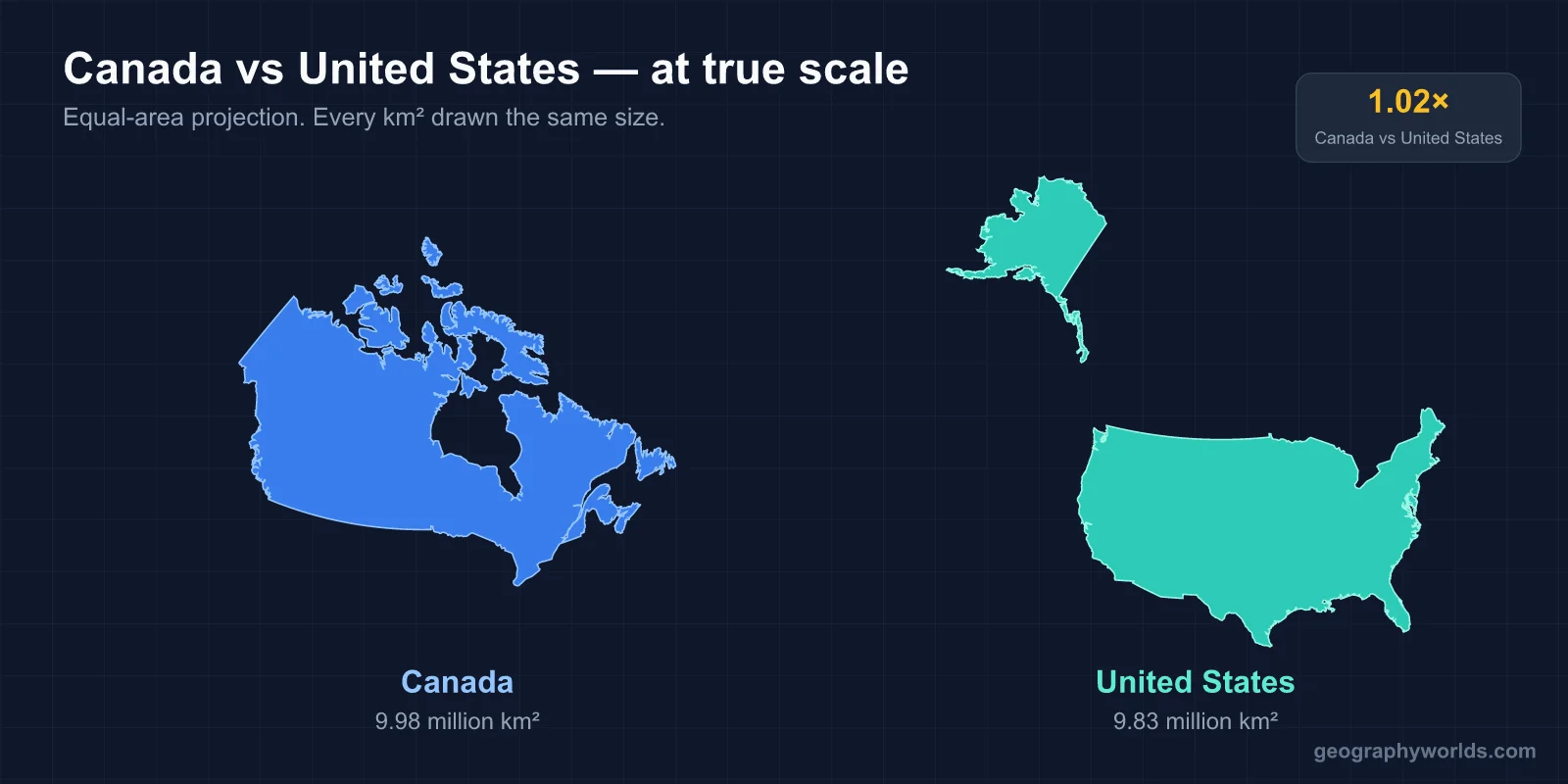
| Area | 9,833,517 km² | 9,984,670 km² |
| Continent | North America | North America |
| Region | North America | North America |
| Land Borders | Canada, Mexico | United States |
| Landscape | vast central plain, mountains in west, hills in east | vast land with Arctic tundra, prairies, forests, and mountains |
Canada is marginally larger on paper, at roughly 9.98 million square kilometres against 9.83 million, which makes the two the second and third largest countries in the world. The figure is misleading: a very large share of Canada is Arctic tundra, boreal forest and permafrost, and around 90 per cent of Canadians live within about 160 kilometres of the American border. By habitable land the United States is far the bigger country. United States features vast central plain, mountains in west, hills in east, while Canada is characterized by vast land with Arctic tundra, prairies, forests, and mountains.
Eight Times the People
| Metric | United States 🇺🇸 | Canada 🇨🇦 |
|---|---|---|
| Population | 349.0 million | 40.5 million |
| Population Density | 35.5 per km² | 4.1 per km² |
United States has a larger population, approximately 8.6 times that of Canada. In terms of population density, United States is more densely populated, with a difference of about 31.4 people per km².
Washington and Ottawa
Washington, D.C. serves as the capital of United States, while Ottawa is the capital of Canada. Both were deliberate compromises rather than existing major cities. Washington was placed on the Potomac in 1790 to settle a dispute between northern and southern states, on land ceded by Maryland and Virginia. Ottawa was chosen by Queen Victoria in 1857 because it sat on the boundary between Canada West and Canada East, was defensible at a distance from the American frontier, and satisfied neither Toronto nor Montreal.
Language, Money and the Bilingual Question
| Aspect | United States 🇺🇸 | Canada 🇨🇦 |
|---|---|---|
| Languages | English (de facto), Spanish widely spoken | English and French (both official) |
| Currency | United States Dollar (USD) | Canadian Dollar (CAD) |
In United States, English (de facto) is widely spoken, while Canada uses English and French (both official).
Climate, From Hawaii to the High Arctic
| Aspect | United States 🇺🇸 | Canada 🇨🇦 |
|---|---|---|
| Climate | mostly temperate; tropical in Hawaii and Florida; arctic in Alaska | varies from temperate in south to arctic in north |
| Key Features | Grand Canyon, Great Lakes, Rocky Mountains, Mississippi River | Rocky Mountains, Niagara Falls, Arctic Archipelago, Great Lakes |
| Economy | technology, finance, healthcare, military, agriculture | oil and gas, mining, lumber, agriculture, technology |
United States has a mostly temperate; tropical in Hawaii and Florida; arctic in Alaska climate, featuring notable landmarks such as Grand Canyon, Great Lakes, Rocky Mountains, Mississippi River. Meanwhile, Canada experiences a varies from temperate in south to arctic in north climate and is known for Rocky Mountains, Niagara Falls, Arctic Archipelago, Great Lakes.
Where the People Actually Live
The population gap, roughly 340 million against 41 million, is only part of the story. The distribution differs more than the total.
Canada is one of the most urbanised countries in the world, with more than four in five people in cities and over a third in the three metropolitan areas of Toronto, Montreal and Vancouver — a concentration visible in the ranking of Canada's largest cities. Outside that southern band the country is close to empty: the territories cover about a third of the landmass and hold under 150,000 people.
The United States is more evenly spread, with large metropolitan areas across four time zones and a substantial population in the interior. That difference shapes almost everything downstream, from how each country builds transport to how their politics divide between urban and rural.
Immigration Runs on Different Rules
Canada selects a large share of its permanent residents through a points system introduced in 1967, scoring applicants on age, education, language and work experience, and it takes in among the highest numbers per head of any large economy. Around a quarter of residents were born abroad.
The United States admits the larger absolute number but allocates most permanent visas through family sponsorship rather than skills, with employment-based categories capped and subject to per-country limits that produce decades-long backlogs for applicants from India and China.
The result is visible in the cities. Toronto and Vancouver have foreign-born shares above most American metropolitan areas, and Canadian public debate about immigration has historically centred on housing and capacity rather than on legal status.
The Border Itself
The frontier between them runs about 8,891 kilometres including Alaska, which makes it the longest international border in the world. Much of it follows the 49th parallel, a straight line agreed in 1818 and extended to the Pacific in 1846, which is why the western provinces and states end in a ruler-drawn edge.
It was demilitarised by the Rush-Bagot agreement of 1817, and the Boundary Waters Treaty of 1909 created the International Joint Commission, which still arbitrates disputes over the shared lakes and rivers of the Great Lakes region. A cleared strip six metres wide, the Slash, is maintained along the forested sections so the line stays visible.
The oddities are well known: Point Roberts in Washington state is reached by land only through British Columbia, and the Northwest Angle in Minnesota sits above the 49th parallel because the original treaty relied on a faulty map of the Mississippi's source.
Two Very Different Federations
Both are federal states, and they divide power almost oppositely. The American constitution enumerates federal powers and reserves the remainder to the states. The Canadian constitution enumerates provincial powers and gives the residual to Ottawa, which was a deliberate reaction to the American Civil War.
In practice the Canadian provinces have become the stronger of the two sets. They run health care, education and natural resources, and Quebec collects its own income tax and selects its own immigrants.
The systems of government differ more than the federalism. Canada is a constitutional monarchy with a Westminster parliament, where the executive sits in the legislature and a government falls if it loses a confidence vote. The United States separates the executive from Congress entirely, with fixed terms and no confidence mechanism.
Health Care Is the Comparison People Actually Make
Canada's single-payer system, established province by province through the 1960s and standardised by the Canada Health Act of 1984, covers physician and hospital care with no charge at the point of use, funded by taxation. It does not cover most prescription drugs, dental or vision care outside hospital.
The United States spends roughly twice as much per head on health and covers its population through a mixture of employer insurance, Medicare for those over 65, Medicaid for low income, and the individual marketplace.
The trade-offs are documented rather than disputed. Canada reports longer waits for elective procedures and specialist referrals; the United States reports better access to advanced imaging and elective surgery for the insured, alongside medical debt and uninsurance rates that have no Canadian equivalent.
The Economies Are Joined at the Hip
These are among the largest trading partners in the world. Roughly three quarters of Canadian exports go to the United States, while Canada is the largest export market for a substantial number of American states.
The relationship has been governed successively by the 1988 free trade agreement, NAFTA from 1994, and USMCA from 2020, each renegotiation fought largely over dairy quotas, softwood lumber and automotive rules of origin.
The asymmetry is the defining feature. The American economy is roughly ten times larger, so a trade dispute that is a minor irritation in Washington can be a national economic event in Ottawa. Pierre Trudeau's line about sleeping next to an elephant remains the standard Canadian formulation of it.
What Each Is Known For
United States is internationally renowned for Hollywood, Silicon Valley, national parks, the Statue of Liberty, and cultural influence worldwide. The United States has more tornadoes than any other country, averaging about 1,200 per year, mostly in "Tornado Alley."
Canada is best known for maple syrup, Niagara Falls, the Rocky Mountains, hockey, and multicultural cities. Canada has the longest coastline of any country in the world at over 202,000 km — and more lakes than all other countries combined.
The Differences That Matter Most
- Area: United States (9,833,517 km²) vs Canada (9,984,670 km²) — Canada is 1.0x larger
- Population: United States (349.0 million) vs Canada (40.5 million) — United States is 8.6x more populous
- Capitals: Washington, D.C. vs Ottawa
- Currency: United States Dollar (USD) vs Canadian Dollar (CAD)
- Continents: North America vs North America
- Density: United States is more densely populated (difference of ~31.4 people per km²)
- Languages: English (de facto) vs English and French (both official)
So Which Country Wins
United States and Canada — north american neighbors — each offer unique geographic characteristics that make them fascinating to compare. While Canada claims the larger land area (1.0x), United States leads in population (8.6x), showing how size and population don't always go hand in hand.
United States stands out for its mostly temperate; tropical in Hawaii and Florida; arctic in Alaska climate and landmarks like Grand Canyon, whereas Canada is defined by its varies from temperate in south to arctic in north climate and features such as Rocky Mountains. Economically, United States focuses on technology while Canada drives growth through oil and gas.
Both nations contribute uniquely to our world's geographic tapestry.