
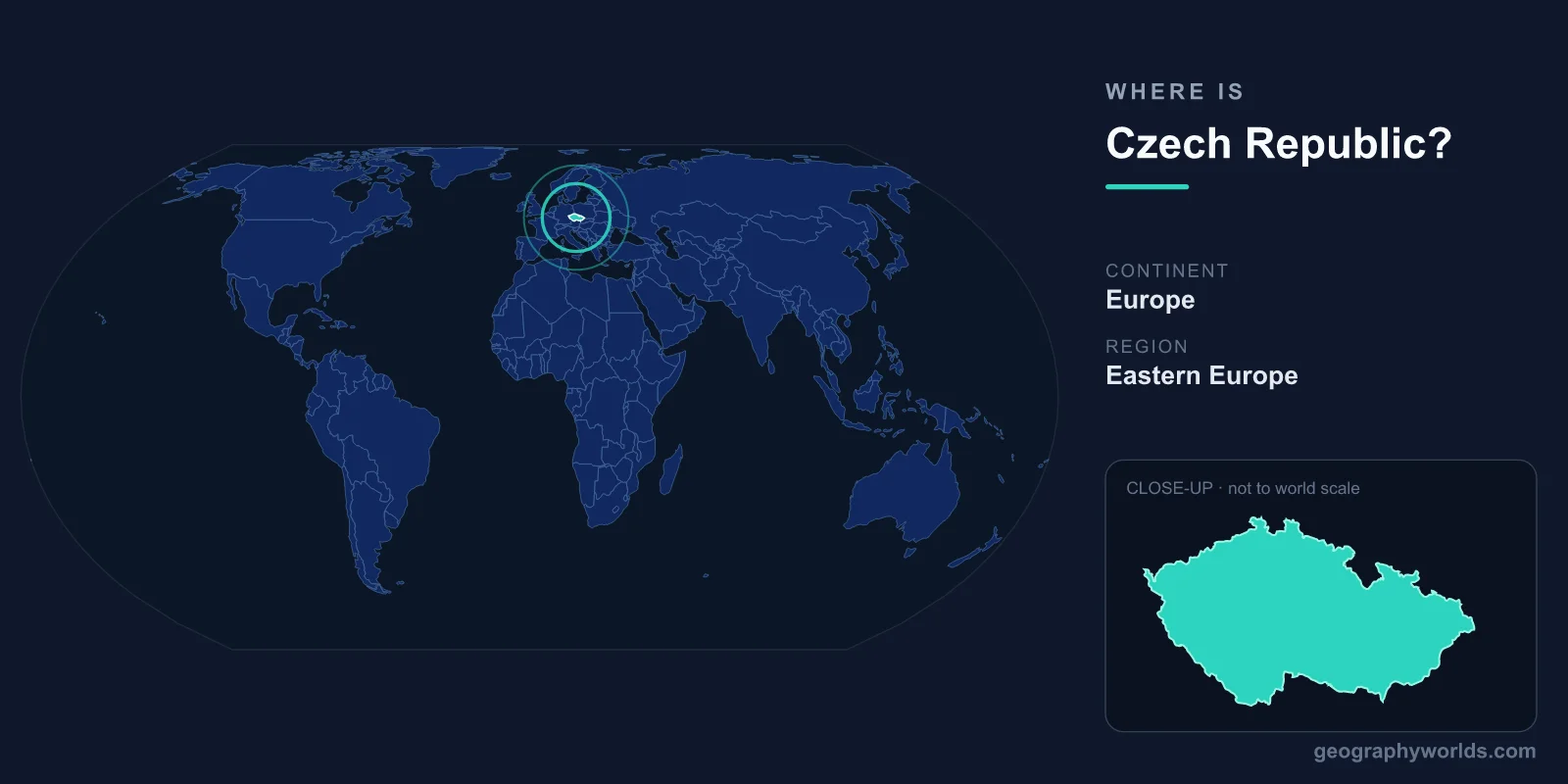
The Czech Republic is a landlocked country in the heart of Central Europe, bordered by Germany to the west, Poland to the north, Slovakia to the east, and Austria to the south. Its capital, Prague, sits roughly in the center of the country, and the nation covers an area of about 78,865 km² in the Northern and Eastern Hemispheres.
Where Exactly Is the Czech Republic?
The Czech Republic lies near the geographic middle of the European continent, occupying part of the historic region long known as Bohemia, Moravia, and Czech Silesia. It is positioned roughly between latitudes 48° and 51° North and longitudes 12° and 19° East, placing it squarely in the Central European time zone (CET). Because it touches no sea, it is one of Europe's classic landlocked states, with the nearest coastlines—the Baltic and the Adriatic—each several hundred kilometers away.
Prague, the capital and largest city, serves as the political, economic, and cultural center. Other major cities include Brno in the southeast, Ostrava near the Polish border, and Plzeň (Pilsen) in the west. The country's central position has historically made it a crossroads of trade routes and cultures linking Western, Northern, Southern, and Eastern Europe.
Which Countries Border the Czech Republic?
The Czech Republic shares land borders with four neighboring countries, each shaping a different edge of the nation:
- Germany — the longest border, running along the western and northwestern frontier, including the forested Šumava and Krušné (Ore) Mountains.
- Poland — to the north and northeast, separated in places by the Sudetes mountain range and the Krkonoše (Giant Mountains).
- Slovakia — to the east, a frontier created in 1993 when Czechoslovakia peacefully split into two states.
- Austria — to the south, marking the boundary with the Danube region of Central Europe.
This four-country embrace means the Czech Republic has no coastline but enjoys easy overland connections in every direction, reinforcing its role as a logistical and cultural hub.
The Czech Landscape and Terrain
Despite its modest size—comparable to Croatia, Costa Rica, or the U.S. state of South Carolina—the Czech Republic has remarkably varied terrain. The western region of Bohemia forms a basin ringed by low mountain ranges, giving it a natural bowl-like shape. The eastern region of Moravia is generally lower and more open, draining toward the Danube basin.
The country's highest point is Sněžka (1,603 m) in the Krkonoše Mountains on the Polish border. Major rivers include the Vltava, which flows through Prague, and the Elbe (Labe), which carries Czech waters north into Germany and eventually the North Sea. Rolling hills, fertile lowlands, dense forests, and mineral-rich highlands all coexist within a country you can cross by car in just a few hours.
People, Language, and Government
The Czech Republic is home to roughly 10.5 to 11 million people, the overwhelming majority of whom speak Czech, a West Slavic language closely related to Slovak and Polish. The country is among the more secular nations in Europe, with a large share of the population identifying as non-religious, alongside a historic Roman Catholic and Protestant heritage.
Politically, the Czech Republic is a parliamentary republic with Prague as its seat of government. It uses the Czech koruna (CZK) as its currency rather than the euro, even though it is a member of the European Union, NATO, and the Schengen Area. For a deeper look at its history, regions, and travel highlights, see our czech republic country guide.
Frequently Asked Questions
Is the Czech Republic in Eastern or Central Europe?
Geographically and politically, the Czech Republic is firmly in Central Europe. While it was grouped with the "Eastern Bloc" during the Cold War, that label was political rather than geographic. Prague actually lies west of Vienna, Austria—a useful reminder of just how central the country really is.
Is the Czech Republic the same as Czechoslovakia?
No. Czechoslovakia existed from 1918 until the end of 1992. On January 1, 1993, it peacefully divided into two independent nations—the Czech Republic and Slovakia—in what is often called the "Velvet Divorce." The Czech Republic also uses the short-form name "Czechia."
Does the Czech Republic have a coastline?
No. The Czech Republic is completely landlocked, with no access to the sea. The nearest coastlines are the Baltic Sea to the north and the Adriatic Sea to the south, both several hundred kilometers from its borders.
What is the capital of the Czech Republic and where is it located?
The capital is Prague (Praha), located on the Vltava River in the central-western part of the country, within the Bohemian region. It is the nation's largest city and its main political, economic, and tourist center.