
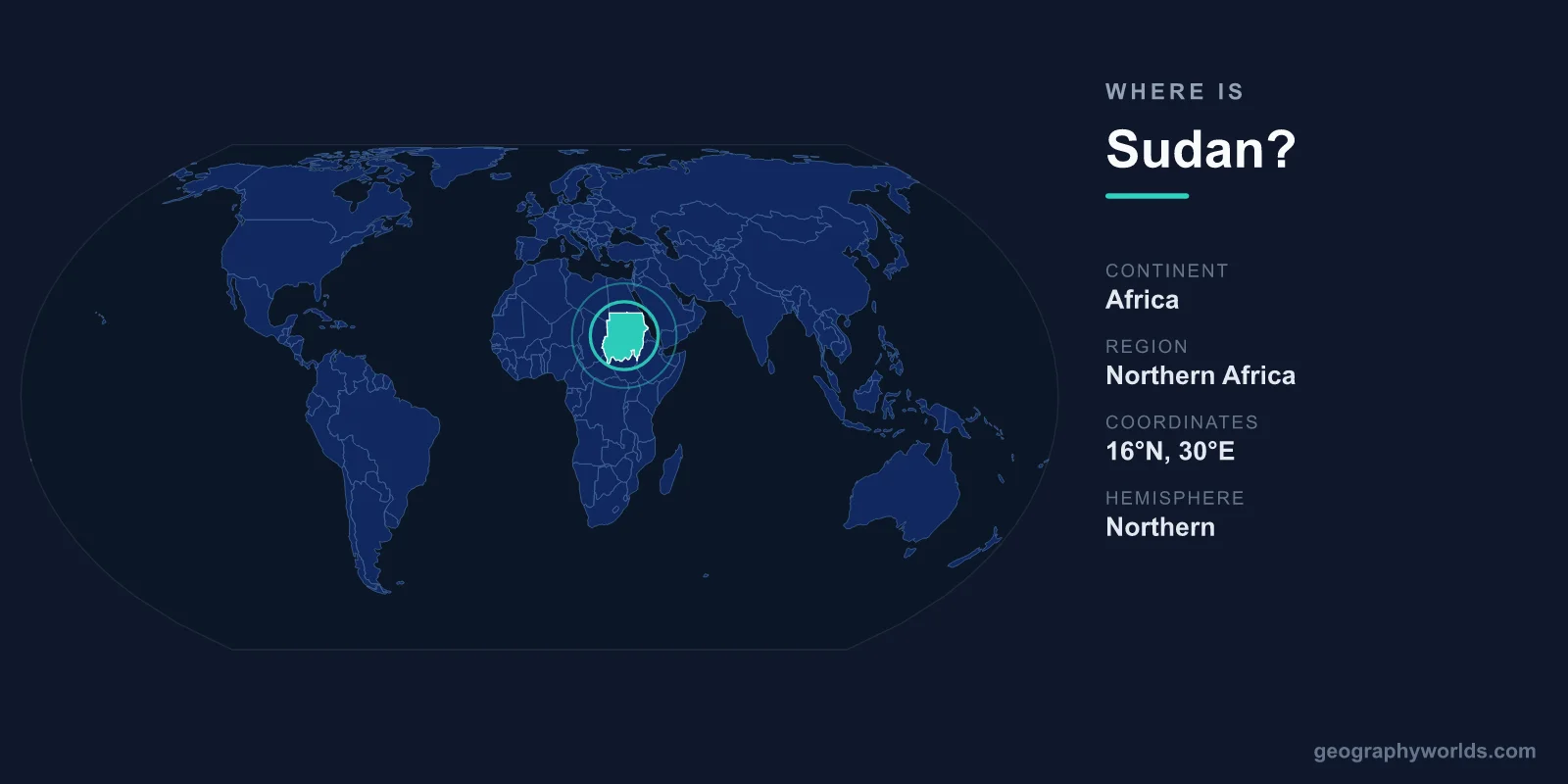
Sudan is located in northeastern Africa, at the meeting point of the Blue and White Nile rivers, bordered by seven countries and the Red Sea, with its capital at Khartoum and a total area of 1,886,068 km². It sits in the northern and eastern hemispheres, forming a vast bridge between the Arab world to the north and Sub-Saharan Africa to the south.
Where Exactly Is Sudan on the Map?
Sudan occupies a strategic position in the northeastern quadrant of the African continent, roughly between latitudes 8° and 23° North and longitudes 21° and 39° East. To the north lies Egypt, to the east the Red Sea and Eritrea, and to the south the newly independent nation of South Sudan. This places Sudan in a transitional zone where the Sahara Desert gradually gives way to the savannah grasslands of the Sahel.
Because it straddles such a wide band of latitude, Sudan is sometimes described as a land of two worlds: an Arab, Islamic, desert north and a more tropical, agricultural belt further south. Its sheer scale is hard to overstate. At nearly 1.9 million square kilometres, Sudan is the third-largest country in Africa and larger than the whole of Western Europe combined.
The Nile: Sudan's Defining Feature
No description of Sudan's geography is complete without the Nile. The country is where the two great branches of the river unite. The Blue Nile, carrying highland waters from Lake Tana in Ethiopia, meets the White Nile, which flows up from the great lakes of East Africa, at Khartoum. The point of confluence, known as al-Mogran, is one of the most significant hydrological landmarks on Earth.
From Khartoum the combined river flows north through the deserts of Nubia toward Egypt and the Mediterranean. The Nile has shaped Sudanese settlement for millennia, concentrating population, agriculture, and ancient cities along its fertile banks while the surrounding desert remains sparsely inhabited.
Which Countries Border Sudan?
Sudan shares land borders with seven nations, making it one of the most connected countries in its region. These long frontiers have historically positioned Sudan as a crossroads for trade, pilgrimage, and the movement of peoples between North, East, and Central Africa.
- Egypt – to the north, along the Nubian Desert
- Libya – to the northwest
- Chad – to the west, across the Darfur region
- Central African Republic – to the southwest
- South Sudan – to the south, independent since 2011
- Ethiopia – to the southeast, near the Blue Nile highlands
- Eritrea – to the east, toward the Red Sea coast
In addition to these land neighbours, Sudan has a long coastline along the Red Sea to the northeast, where Port Sudan serves as the country's principal maritime gateway and a vital link to global shipping lanes through the Suez Canal.
Landscape, Climate, and Landmarks
Given its enormous size, Sudan contains a remarkable range of environments. The far north is dominated by the arid expanse of the Sahara and Nubian deserts, where rainfall is almost nonexistent. Moving south, the terrain shifts into semi-arid steppe and then into the greener savannahs of the Sahel, where seasonal rains support farming and grazing. Mountain ranges such as the Marrah Mountains in Darfur and the Red Sea Hills in the east break up the otherwise flat plains.
The country is also rich in history. The Pyramids of Meroë, built by the Kushite kings of the ancient kingdom of Kush, are among Sudan's most celebrated landmarks. There are in fact more pyramids in Sudan than in neighbouring Egypt, a fact that surprises many travellers. These steep, narrow monuments along the Nile are a UNESCO World Heritage Site and a testament to the region's deep civilisational roots.
People, Capital, and Everyday Life
Khartoum, the capital, sits at the heart of the country at the Nile confluence and functions as Sudan's political, administrative, and commercial centre. The wider metropolitan area, which includes Omdurman and Khartoum North, is home to several million residents. Nationwide, Sudan's population numbers roughly 45 million people.
Arabic is the dominant language, with English also widely used in official and educational settings, and Islam (predominantly Sunni) is the most practised religion, shaping daily routines, festivals, and customs. The national currency is the Sudanese Pound (SDG). For a deeper look at the country's history, culture, and travel highlights, see our sudan country guide.
Frequently Asked Questions
What continent is Sudan in?
Sudan is in Africa, specifically in the northeastern region of the continent. It lies in both the Northern and Eastern Hemispheres, with the Tropic of Cancer cutting across its northern deserts.
Is Sudan the same as South Sudan?
No. South Sudan became an independent country in 2011 after seceding from Sudan, making it the world's newest internationally recognised nation. The two are now separate states sharing a long southern border.
What is the capital of Sudan?
The capital is Khartoum, located where the Blue Nile and White Nile join to form the main River Nile. It is the country's largest urban centre and its hub of government and trade.
Does Sudan have a coastline?
Yes. Sudan has a substantial coastline along the Red Sea in the northeast. Port Sudan is the main seaport, connecting the country to international trade routes via the Suez Canal.