
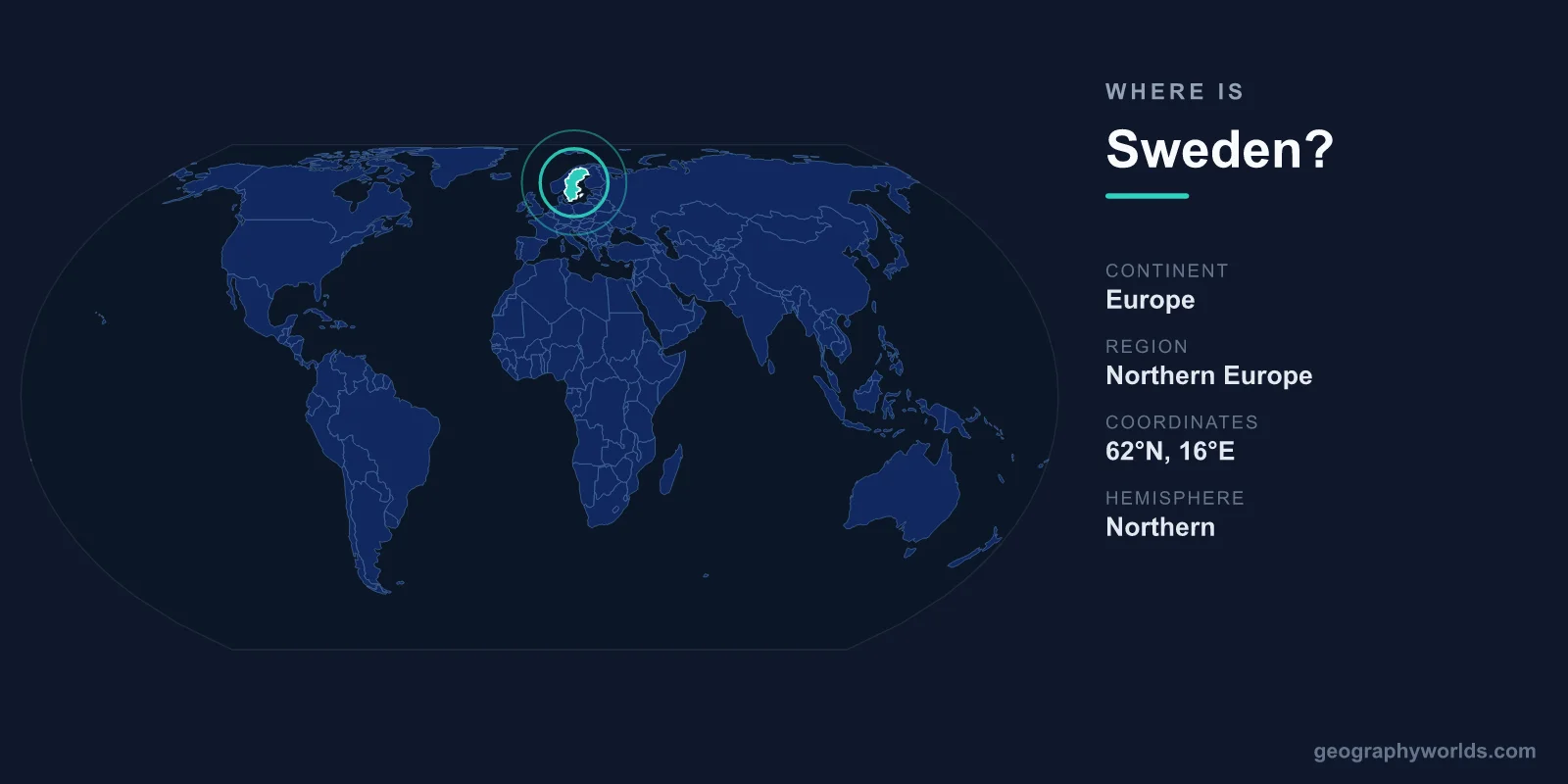
Sweden is a Scandinavian country in Northern Europe, occupying the eastern side of the Scandinavian Peninsula, where it is bordered by Norway to the west, Finland to the northeast, and the Baltic Sea to the east and south. Its capital, Stockholm, sits on the country's eastern coast, and Sweden covers roughly 450,295 km², making it one of Europe's largest nations by area.
Where Sweden Sits on the Map
Sweden lies entirely in the Northern and Eastern Hemispheres, on the continent of Europe. Stretching from about 55°N near the southern tip of Skåne to well above 69°N inside the Arctic Circle, it is a long, narrow country running roughly 1,570 km from north to south. This north-south reach means a single nation contains everything from gentle farmland in the south to subarctic tundra and mountains in the far north.
Find the Baltic Sea on a map and Sweden is the broad landmass forming its western shore. Across the water to the east lie Finland and the Baltic states, while Denmark sits just to the southwest, connected to Sweden by the Öresund Bridge between Malmö and Copenhagen. To learn more, see our sweden country guide.
Countries That Border Sweden
Sweden shares land borders with two countries, both reflecting its position on the Scandinavian Peninsula:
- Norway – to the west and northwest, along a roughly 1,600 km border that runs the length of the Scandinavian mountain range (the Scandes).
- Finland – to the northeast, where the Torne River forms much of the natural boundary.
Although Denmark shares no land border with Sweden, the two are closely linked by the Öresund crossing, one of the busiest fixed links in the region. Beyond its land neighbours, Sweden's long Baltic coastline gives it close maritime ties to Finland, Estonia, Latvia, Lithuania, Poland, and Germany.
Landscape and Geography
Sweden's terrain was shaped by ice and water. Glaciers from the last ice age carved thousands of lakes and rounded the bedrock, leaving the country dotted with roughly 100,000 lakes. The largest, Vänern, is the biggest lake in the European Union. Forests of pine, spruce, and birch blanket more than half the land area, making timber and forestry central to the national economy.
The west is dominated by the Scandinavian Mountains, which rise along the Norwegian border and include Kebnekaise, Sweden's highest peak at about 2,097 metres. The far north, known as Lapland (Sápmi), reaches into the Arctic and experiences the midnight sun in summer and polar night in winter. By contrast, the south and central regions are lower, more fertile, and home to most of the population. Sweden's coastline is famously fragmented, fringed by tens of thousands of islands; the Stockholm archipelago alone contains around 30,000 islands, islets, and skerries.
Climate Across the Country
Because Sweden spans such a wide range of latitudes, its climate varies considerably. The south enjoys a relatively mild, temperate climate moderated by the Gulf Stream and Atlantic air, with warm summers and cool, often snowy winters. Central Sweden has more pronounced seasons, while the north endures long, dark, bitterly cold winters and short, intense summers. This climatic diversity supports everything from agriculture in Skåne to reindeer herding in the Arctic north, and it makes Sweden a year-round destination for both summer hiking and winter sports such as cross-country skiing.
People, Cities, and Culture
Sweden is home to roughly 10 million people, most of whom live in the southern third of the country. Stockholm, built across 14 islands, is the political, cultural, and economic heart of the nation. Other major cities include Gothenburg (Göteborg) on the west coast, a key port and industrial centre, and Malmö in the far south, linked directly to Denmark. Swedish is the official language, and the country has a long Lutheran Christian heritage that still shapes its calendar and traditions, from Midsummer to the Lucia celebrations. Sweden is a parliamentary constitutional monarchy and uses the Swedish krona (SEK) rather than the euro, despite being a member of the European Union.
Frequently Asked Questions
What continent is Sweden on?
Sweden is in Europe, specifically in the Northern Europe region known as Scandinavia. It occupies the eastern portion of the Scandinavian Peninsula alongside Norway.
Is Sweden part of Scandinavia?
Yes. Sweden, Norway, and Denmark form the core of Scandinavia. When Finland and Iceland are included, the broader grouping is usually called the Nordic countries.
What is the capital of Sweden?
The capital is Stockholm, located on Sweden's eastern Baltic coast. It is the country's largest city and is famously spread across a cluster of islands connected by bridges.
Does Sweden use the euro?
No. Although Sweden is a member of the European Union, it has kept its own currency, the Swedish krona (SEK), for everyday transactions.