
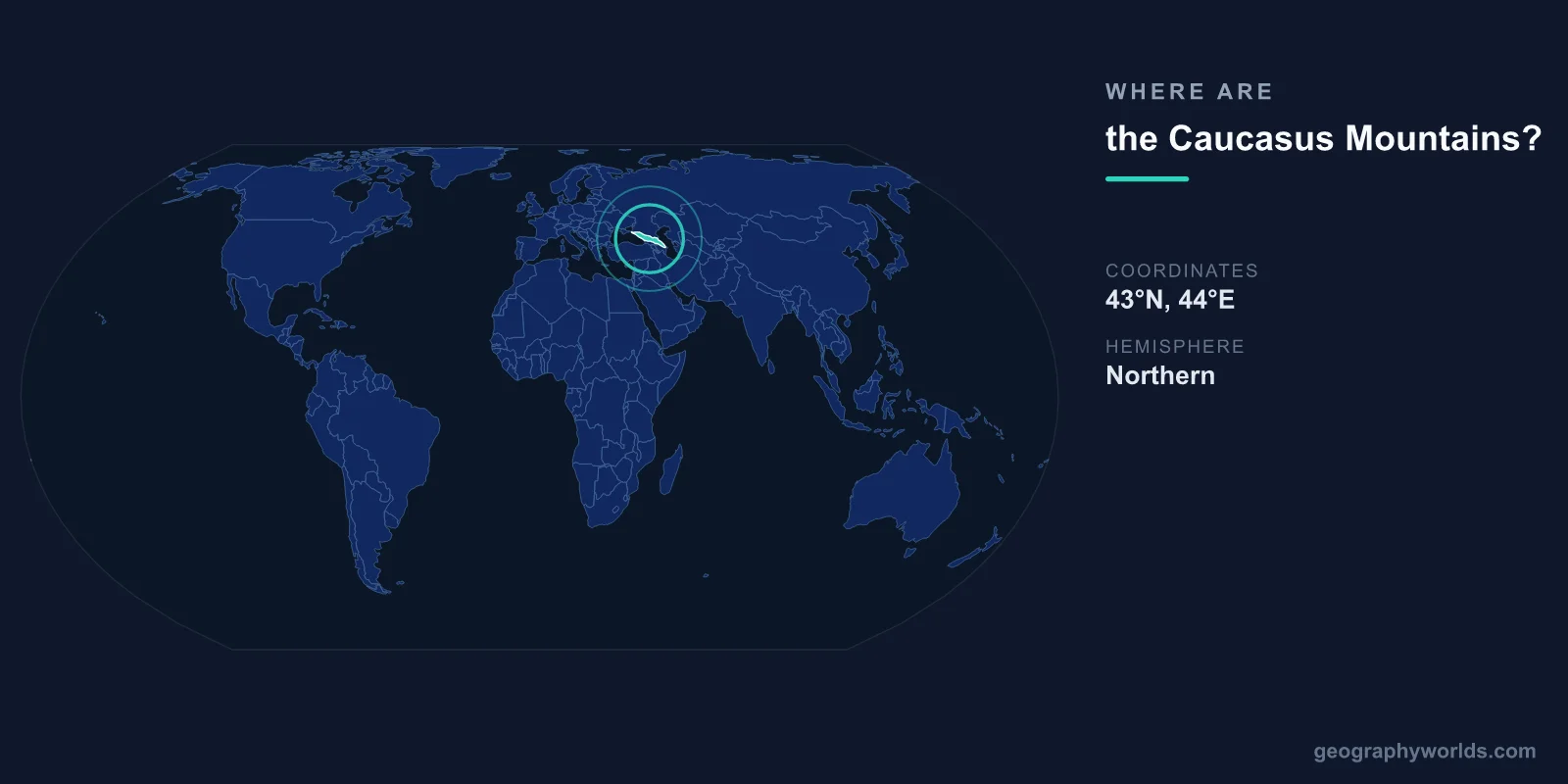
The Caucasus Mountains are located between southeastern Europe and western Asia, centered at approximately 42°N latitude and 44°E longitude. They stretch roughly 1,100 kilometers from the Black Sea in the west to the Caspian Sea in the east, forming a natural barrier between Russia to the north and Georgia, Armenia, and Azerbaijan to the south.
Introduction
The Greater Caucasus range, with its highest peak Mount Elbrus at 5,642 meters, is often cited as the boundary between Europe and Asia. If this definition is accepted, Elbrus — not Mont Blanc — is the highest peak in Europe. The Caucasus region is one of the most ethnically and linguistically diverse areas on Earth.

Exact Location & Coordinates
- Center Coordinates: 42°N, 44°E
- Region: Between southeastern Europe and western Asia
- Extent: ~1,100 km from Black Sea to Caspian Sea
- Mount Elbrus: 43°21'N, 42°26'E, 5,642 m
On a world map, the Caucasus Mountains are located in the isthmus between the Black Sea and the Caspian Sea. Find the Black Sea and trace eastward — the Caucasus runs as a wall across this narrow land bridge. The mountains separate Russia from the countries of the South Caucasus (Georgia, Armenia, Azerbaijan).
The range is oriented roughly west-northwest to east-southeast. Its western end reaches the Black Sea coast near Sochi, Russia (host of the 2014 Winter Olympics), while its eastern end descends to the Caspian coast near Baku, Azerbaijan.
Surrounding Countries & Borders
- Russia: Northern slopes (North Caucasus)
- Georgia: Southern slopes (central)
- Azerbaijan: Southeastern section
- Armenia: South of the Lesser Caucasus
Russia's North Caucasus region includes the republics of Chechnya, Dagestan, Ingushetia, North Ossetia, Kabardino-Balkaria, and Karachay-Cherkessia, each with distinct ethnic groups and languages. The Russian city of Sochi, on the Black Sea coast at the western end of the range, hosted the 2014 Winter Olympics.
Georgia occupies the central south Caucasus, with Tbilisi as its capital. Azerbaijan lies to the southeast, with its capital Baku on the Caspian coast. Armenia, though south of the main Caucasus range, is culturally part of the Caucasus region and sits within the Lesser Caucasus range that parallels the Greater Caucasus to the south.
Geographic Context
- Continental Boundary: Often cited as the Europe-Asia border
- Two Ranges: Greater Caucasus (north) and Lesser Caucasus (south)
- Key Passes: Dariel Pass, Roki Tunnel
The Greater Caucasus is the main, higher range, containing all the peaks above 4,000 meters. The Lesser Caucasus, roughly 100 kilometers to the south, is lower (up to ~3,700 m) and runs through Georgia, Armenia, and into Turkey. Between them lies the Transcaucasus depression, where Tbilisi and other cities are located.
The Caucasus has served as both barrier and bridge between civilizations. The few passes through the mountains, such as the Dariel (Darial) Pass between Russia and Georgia, have been strategically important for millennia. The ancient Silk Road passed through the Caucasus region, contributing to its extraordinary cultural diversity.
Physical Characteristics
- Highest Peak: Mount Elbrus, 5,642 m (Europe's highest if Caucasus = Europe)
- Other Major Peaks: Kazbek (5,033 m), Shkhara (5,193 m)
- Glaciers: ~2,000 glaciers in the Greater Caucasus
- Volcanic Activity: Elbrus is a dormant volcano
Mount Elbrus is a dormant volcano with two summits (5,642 m and 5,621 m), making it significantly higher than any peak in the Alps. It last erupted roughly 2,000 years ago. Elbrus sits in Kabardino-Balkaria, Russia, and is one of the Seven Summits (if the Europe-Asia boundary includes the Caucasus in Europe).
The Greater Caucasus is heavily glaciated above 3,000 meters, with roughly 2,000 glaciers covering about 1,400 square kilometers. Like Alpine glaciers, Caucasus glaciers are retreating due to climate change. The range also experiences significant seismic activity, with destructive earthquakes occurring periodically.
Why It Matters
- Continental Boundary: One of the proposed borders between Europe and Asia
- Biodiversity: One of 36 global biodiversity hotspots
- Linguistic Diversity: Over 50 distinct languages spoken in the region
The Caucasus is one of the most ethnically and linguistically diverse regions on Earth. Over 50 distinct languages from multiple language families are spoken in the region, including Kartvelian (Georgian), Northeast Caucasian (including Chechen and Avar), and Northwest Caucasian languages found nowhere else. Dagestan alone has over 30 ethnic groups.
The region is recognized as one of 36 global biodiversity hotspots, with high levels of plant and animal endemism. The Caucasus leopard, brown bear, chamois, and over 6,000 plant species inhabit the mountains. The region's complex topography creates numerous isolated habitats that promote speciation and diversity.
Key Facts
- The Caucasus Mountains are centered at approximately 42°N, 44°E between the Black Sea and Caspian Sea.
- They stretch ~1,100 km across Russia, Georgia, Azerbaijan, and Armenia.
- Mount Elbrus at 5,642 m is the highest peak — Europe's tallest if the Caucasus is in Europe.
- The range is often cited as the natural boundary between Europe and Asia.
- Over 50 distinct languages are spoken in the Caucasus region.
Fun Facts
- If the Caucasus is considered part of Europe, then Elbrus — not Mont Blanc — is Europe's highest peak.
- Dagestan in the North Caucasus is the most linguistically diverse region on Earth for its size.
- Sochi, host of the 2014 Winter Olympics, sits at the western end of the Caucasus on the Black Sea.
- The Caucasus region has been continuously inhabited for over 1.5 million years, with some of Europe's oldest human remains.
Final Thoughts
The Caucasus Mountains span the isthmus between the Black Sea and Caspian Sea at approximately 42°N, 44°E, forming a natural barrier often cited as the boundary between Europe and Asia. With Elbrus reaching 5,642 meters and over 50 languages spoken in the region, the Caucasus is both a geographic and cultural landmark on the world map. Its role as a continental boundary, biodiversity hotspot, and crossroads of civilizations makes it one of the most significant mountain ranges on Earth.
Test Your Knowledge!
Think you know where things are on the map? Test your skills!
Play Geography Games →