
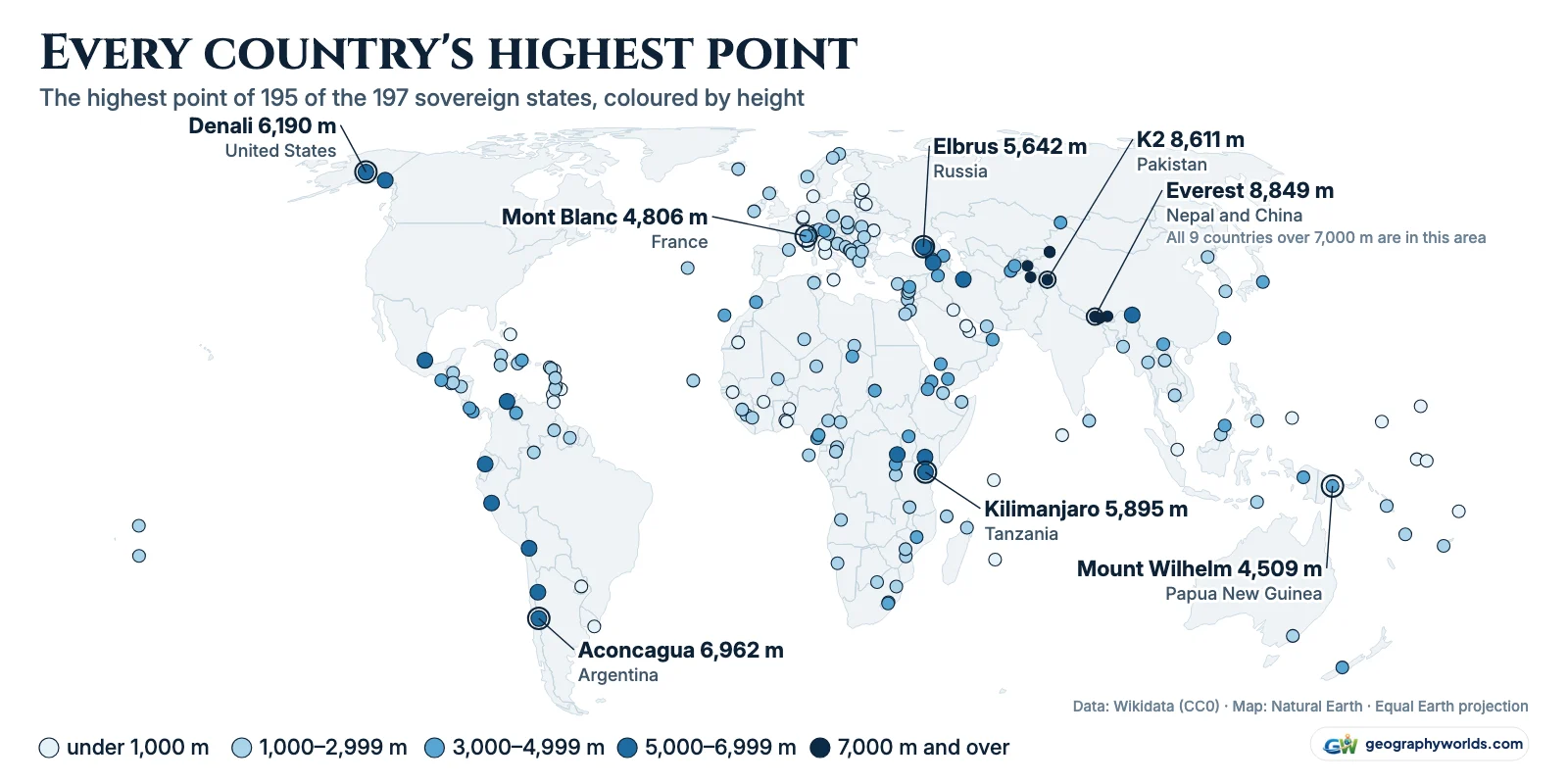
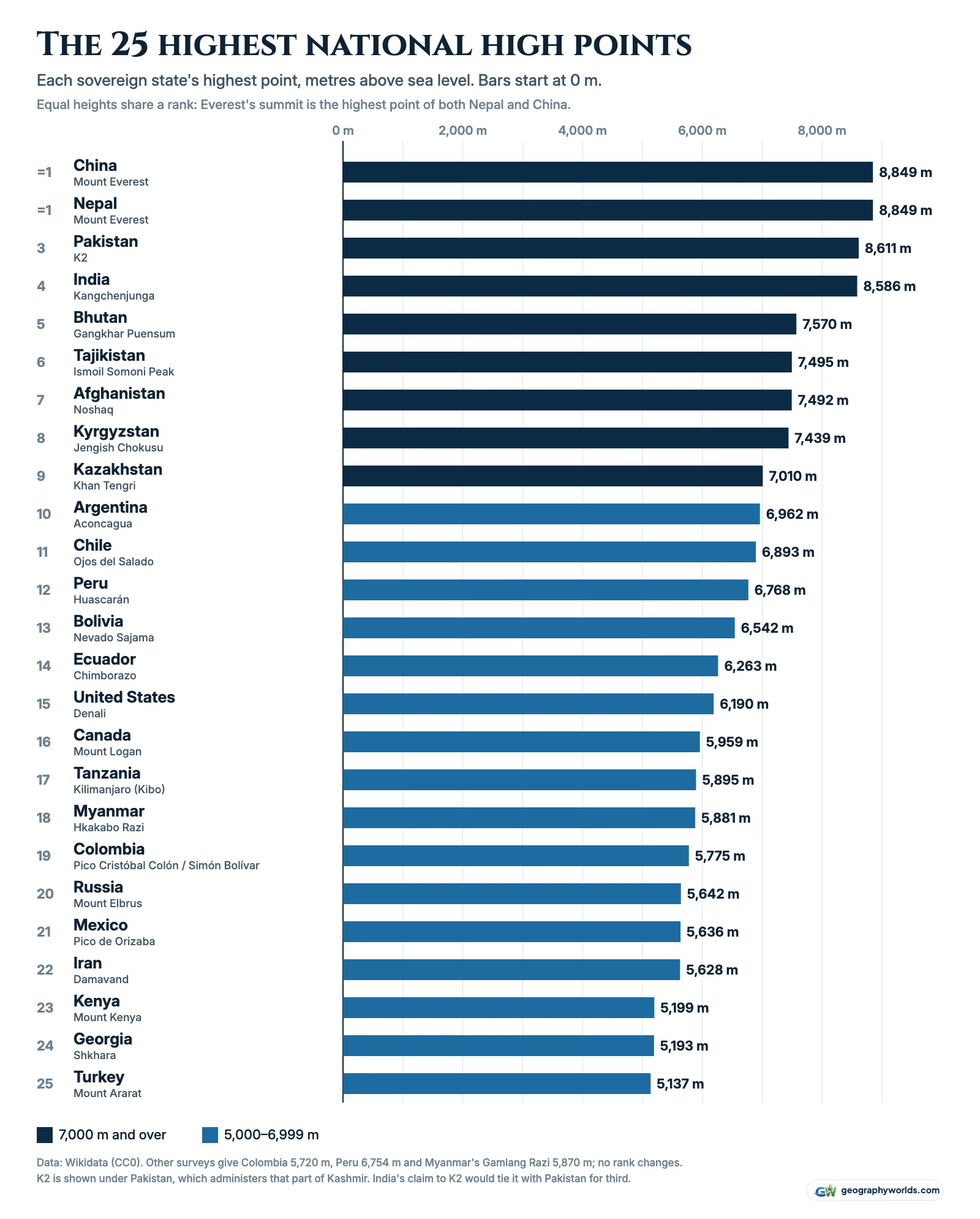
Nepal and China have the highest mountain of any country: they share the summit of Mount Everest, 8,848.86 m above sea level. Pakistan comes third with K2 (8,611 m) and India fourth with Kangchenjunga (8,586 m), followed by Bhutan (Gangkhar Puensum, 7,570 m), Tajikistan (Ismoil Somoni Peak, 7,495 m), Afghanistan (Noshaq, 7,492 m), Kyrgyzstan (Jengish Chokusu, 7,439 m) and Kazakhstan (Khan Tengri, 7,010 m). Those nine are the only countries whose highest point tops 7,000 m, and all of them are in Asia. Outside Asia the highest is Argentina's Aconcagua, at 6,962 m.
The ranking compares one number per country: the height of its highest point. We took that point for all 197 sovereign states (the 193 UN members plus Kosovo, Palestine, Taiwan and Vatican City) from Wikidata, the open database behind Wikipedia, and compared every height with the CIA World Factbook's final edition. Where sources disagree, or a summit sits on a disputed border, the sections below say which figure we used.
Asia: nine countries above 7,000 m, and two that share the top
Asia holds 13 of the top 25 places. Everest's summit is the highest point of both Nepal and China, and both Wikidata and the Factbook list it for each. Its height is the one Nepal's Survey Department fixed after its own GPS and gravity survey, 8,848.86 m, which Nepal and China announced jointly on 8 December 2020. That ties the two countries for first place, so Pakistan is third rather than second.
K2 rises from the Karakoram, partly in Pakistan-administered Gilgit-Baltistan and partly in the China-administered Trans-Karakoram Tract, as its Wikipedia entry describes. Kashmir is disputed, and this ranking follows who administers each side. On that basis India's high point is Kangchenjunga, the figure both of our sources give, at 8,586 m. India's claim to the whole of Kashmir would give it K2 and a share of third place with Pakistan.
The next places are tight. Tajikistan's Ismoil Somoni Peak, 7,495 m, beats Afghanistan's Noshaq by 3 m, and both sources agree on both numbers. Kyrgyzstan's Jengish Chokusu is 7,439 m and Kazakhstan's Khan Tengri 7,010 m, the last country above 7,000 m.
Further down, Asia's numbers get less certain. Myanmar's Hkakabo Razi is listed at 5,881 m, a figure that dates from surveys in 1925. A 2013 expedition took survey-grade GPS to the top of neighbouring Gamlang Razi and measured 5,870 m, plus or minus 2 m, reported The American Surveyor, and the Factbook now names Gamlang Razi as Myanmar's high point. Until someone takes a GPS to Hkakabo Razi's summit, which peak is higher remains open; Myanmar ranks 18th either way. Iran's Damavand is 5,628 m on Wikidata (which also lists 5,610 m) and 5,625 m in the Factbook.
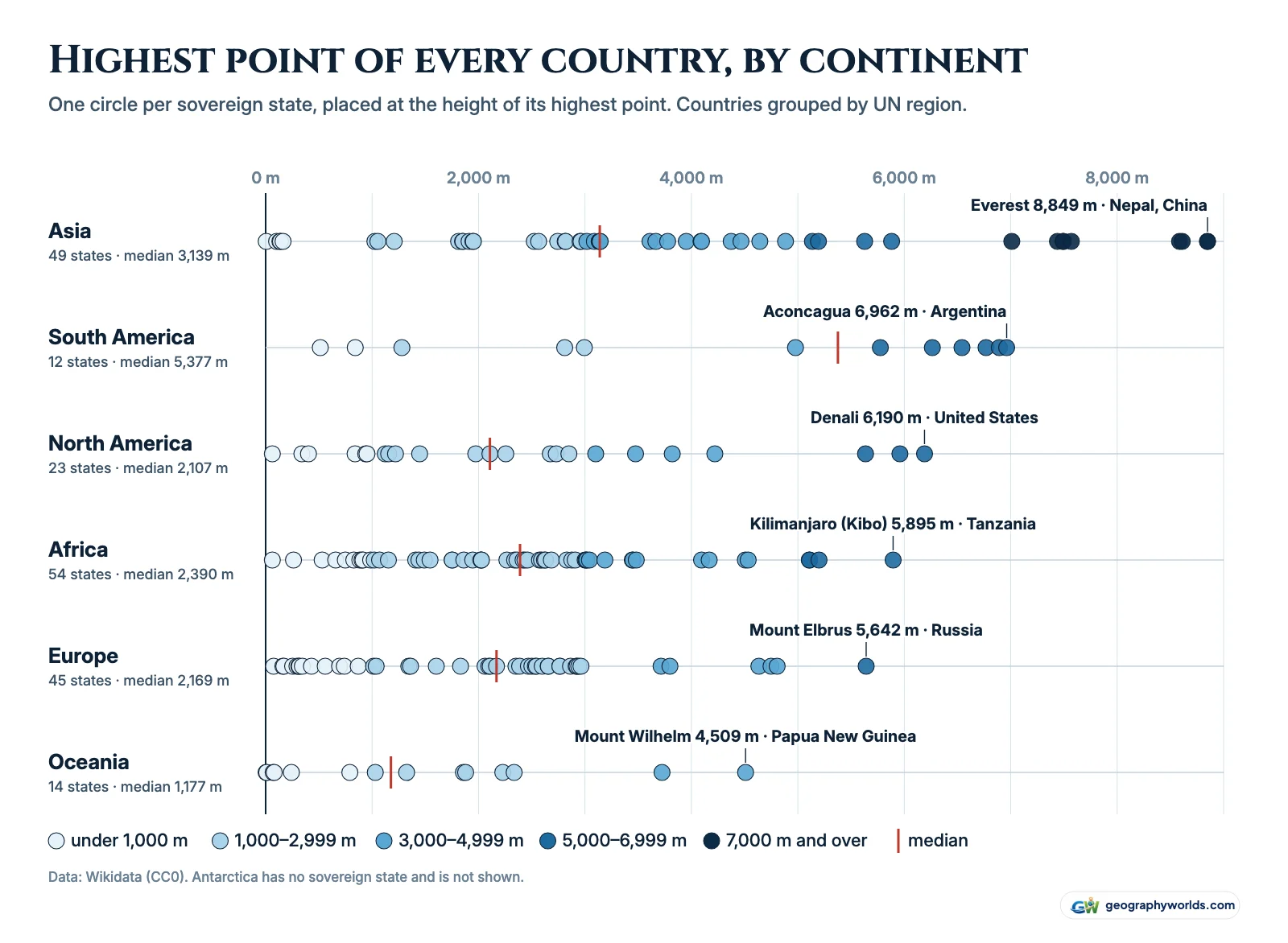
The UN counts Georgia and Turkey as Asian, so their peaks belong here: Georgia's Shkhara is 5,193 m and Turkey's Mount Ararat 5,137 m. So does Indonesia's Puncak Jaya, 4,884 m, though it stands on the island of New Guinea, which makes it the highest peak in Oceania by most geographic definitions. Across all 49 Asian states, the middle high point is 3,139 m, the highest median of any continent except South America.

| Rank | Country | Highest point | Height (m) | Other published heights (m) |
|---|---|---|---|---|
| 1 | China | Mount Everest | 8,849 | — |
| 1 | Nepal | Mount Everest | 8,849 | — |
| 3 | Pakistan | K2 | 8,611 | — |
| 4 | India | Kangchenjunga | 8,586 | — |
| 5 | Bhutan | Gangkhar Puensum | 7,570 | — |
| 6 | Tajikistan | Ismoil Somoni Peak | 7,495 | — |
| 7 | Afghanistan | Noshaq | 7,492 | — |
| 8 | Kyrgyzstan | Jengish Chokusu | 7,439 | — |
| 9 | Kazakhstan | Khan Tengri | 7,010 | — |
| 10 | Argentina | Aconcagua | 6,962 | — |
| 11 | Chile | Ojos del Salado | 6,893 | — |
| 12 | Peru | Huascarán | 6,768 | Factbook 6,746; INAIGEM 2017 6,754 |
| 13 | Bolivia | Nevado Sajama | 6,542 | — |
| 14 | Ecuador | Chimborazo | 6,263 | Factbook 6,267 |
| 15 | United States | Denali | 6,190 | — |
| 16 | Canada | Mount Logan | 5,959 | — |
| 17 | Tanzania | Kilimanjaro (Kibo) | 5,895 | — |
| 18 | Myanmar | Hkakabo Razi | 5,881 | Factbook 5,870 (Gamlang Razi) |
| 19 | Colombia | Pico Cristóbal Colón / Simón Bolívar | 5,775 | Factbook 5,730; 2024 GPS survey (Bolívar) 5,720 |
| 20 | Russia | Mount Elbrus | 5,642 | — |
| 21 | Mexico | Pico de Orizaba | 5,636 | — |
| 22 | Iran | Damavand | 5,628 | Factbook 5,625 |
| 23 | Kenya | Mount Kenya | 5,199 | — |
| 24 | Georgia | Shkhara | 5,193 | — |
| 25 | Turkey | Mount Ararat | 5,137 | — |
South America: the Andes fill ranks 10 to 14
Every one of the next five countries is Andean, and all five have high points above 6,000 m: Argentina's Aconcagua (6,962 m), Chile's Ojos del Salado (6,893 m), Peru's Huascarán (6,768 m), Bolivia's Nevado Sajama (6,542 m) and Ecuador's Chimborazo (6,263.47 m; the Factbook gives 6,267 m). With only 12 countries, South America has the highest median of any continent, 5,377 m.
Huascarán has three heights in circulation. The 6,768 m on Wikidata comes from a German expedition in the 1930s, the Factbook's 6,746 m from a 1970s survey, and a 2017 GPS survey by Peru's glacier institute INAIGEM gave about 6,754 m, according to the Andes Website's summary of the surveys. Peru is 12th on all three.

Colombia is the case where the ice has moved the number. Its twin summits in the Sierra Nevada de Santa Marta, Pico Cristóbal Colón and Pico Simón Bolívar, are listed at 5,775 m, the 1939 figure for Colón (the same survey gave Bolívar 5,773 m); the Factbook gives 5,730 m. A team that carried differential GPS to both tops in December 2024 measured Simón Bolívar at 5,720.42 m and Cristóbal Colón at 5,712.79 m, and its 2025 paper puts the loss down to shrinking ice caps. That would make Bolívar, not Colón, Colombia's highest point. On any of these figures Colombia stays 19th. Venezuela's Pico Bolívar (4,978 m) misses the top 25, in 28th place.
North America: Denali, Mount Logan and Pico de Orizaba
The United States leads North America with Denali, 6,190 m. That is the figure the US Geological Survey adopted in 2015, when a GPS survey of the summit gave 20,310 feet, 10 feet lower than the 1950s value it replaced. Canada's Mount Logan (5,959 m) is next, then Mexico's Pico de Orizaba (5,636 m), 8 m above Iran's Damavand. Guatemala's Volcán Tajumulco, 4,220 m, is the highest point in Central America, as the Factbook notes. The median for the continent's 23 states is only 2,107 m.
Africa: Kilimanjaro, Mount Kenya and a summit two countries share
Tanzania's Kilimanjaro, 5,895 m, is Africa's highest point and 17th in the world. Kenya follows with Mount Kenya (5,199 m), just 6 m above Georgia's Shkhara. Margherita Peak on Mount Stanley is the high point of both DR Congo and Uganda at 5,109 m, so the two share 26th place. Ethiopia's Ras Dashen is 4,533 m on Wikidata and 4,550 m in the Factbook. In all, eight of Africa's 54 states have a high point above 4,000 m: Tanzania, Kenya, DR Congo, Uganda, Ethiopia, Rwanda, Morocco and Cameroon.
Europe: Elbrus, and a border that runs across Mont Blanc
Russia's Mount Elbrus, 5,642 m, is Europe's highest national high point and 20th in the world. Whether it counts as European is a question our guide to the highest mountain in Europe takes up. Here countries are grouped by UN region, which puts Russia in Europe and Georgia in Asia.
Next comes Mont Blanc, and the only place where our choice of source can change an order. France's high point is the summit, measured at 4,805.59 m by Haute-Savoie's surveyors in September 2023, 2.22 m lower than in 2021; the Factbook's older figure is 4,810 m. France and Italy have never agreed where their border crosses the mountain. French maps drawn after the 1860 Treaty of Turin put the summit in France, while Italy treats the watershed, which runs over the top, as the border, as Connexion France explains. We follow the Factbook and give Italy its undisputed high point, Mont Blanc de Courmayeur at 4,748 m. On Italy's reading it would tie France instead. Switzerland's Dufourspitze (4,634 m) completes Europe's four countries above 4,000 m, and the median for Europe's 45 states is 2,169 m.
Oceania: Mount Wilhelm, once New Guinea's west is set aside
Papua New Guinea's Mount Wilhelm, 4,509 m, is the highest national high point among Oceania's 14 states. Puncak Jaya on the same island is higher, at 4,884 m, but Indonesia counts as an Asian country. New Zealand's Aoraki / Mount Cook (3,724 m) is second. Australia's high point is Mount Kosciuszko, 2,228 m. Wikidata lists Mawson Peak on Heard Island, an external territory, for Australia; we use the mainland, as the Factbook does. Greenland, self-governing and listed separately by the Factbook, is likewise left out, so Denmark's high point is Møllehøj rather than Gunnbjørn Fjeld (3,694 m). Oceania also holds one of the two flattest countries: Tuvalu's highest ground, on Niulakita, is 4.6 m. The Maldives competes for the lowest high point; its natural high point is usually given as 2.4 m, though Wikidata also lists 5.1 m on Villingili and the Factbook gives 5 m.
How the heights were checked
For Nepal it holds five different heights for Everest, one of them in feet; for Colombia it names two peaks; for Australia it prefers a peak on Heard Island, in the southern Indian Ocean. We dropped deprecated statements, converted feet to metres, used the most recent dated survey where a peak had one, and otherwise took the value closest to the Factbook. Four countries needed a different point altogether: Australia, Italy and Denmark for the reasons above, and Serbia because Kosovo is counted separately. The Gambia has no highest point on Wikidata, so its 63 m comes from the Factbook alone.
Of the 192 countries where we used Wikidata's own statement, 171 are within 10 m of the Factbook. Of the 21 that differ by more, four differ by over 100 m (Israel, Kuwait, Saudi Arabia and Senegal), because the two sources name different points. Israel's is the largest gap: the Factbook names Mitspe Shlagim, 2,224 m, on Mount Hermon, in the part of the Golan Heights Israel has occupied since 1967; this ranking does not credit a state with land it holds beyond its internationally recognised borders, and the Golan is recognised as Syrian territory (UN Security Council Resolution 497 declared Israel's 1981 Golan Heights law void), so we keep Wikidata's Mount Meron, 1,208 m. Kashmir is handled differently because it has no settled sovereign, so there the line of control decides. Among the 31 highest, only Peru, Myanmar and Colombia differ by more than 10 m, and no rank changes on the Factbook's numbers. Heights themselves are a moving target: snow, ice, and the reference surface all matter, as our explainer on how mountains are measured sets out.
You can download the data as a CSV, with every state's chosen peak, its coordinates, all of Wikidata's values and the Factbook figure; anyone who wants to redraw the ranking under another rule, say giving India K2 or Italy the main summit of Mont Blanc, can change a cell and chart the result in Parity.
- Wikidata: highest point (P610) of every sovereign state (Q3624078), with the elevation (P2044) and coordinates (P625) of each peak: queried 10 October 2026 through the SPARQL endpoint; CC0 (public domain dedication)
- CIA World Factbook, field listing 'Elevation' (final edition, archived 4 February 2026): highest point of every country; public domain US government work, read from the Internet Archive copy
- Natural Earth v5.1.2, admin-0 countries: UN region of each country for the continent grouping; public domain
- Natural Earth country outlines (via world-atlas): public domain; hero map
A country's single highest point says little about how high the rest of it sits; Bhutan and Tajikistan top that table too, and our ranking of the countries with the highest average elevation measures every square kilometre instead of one summit.