
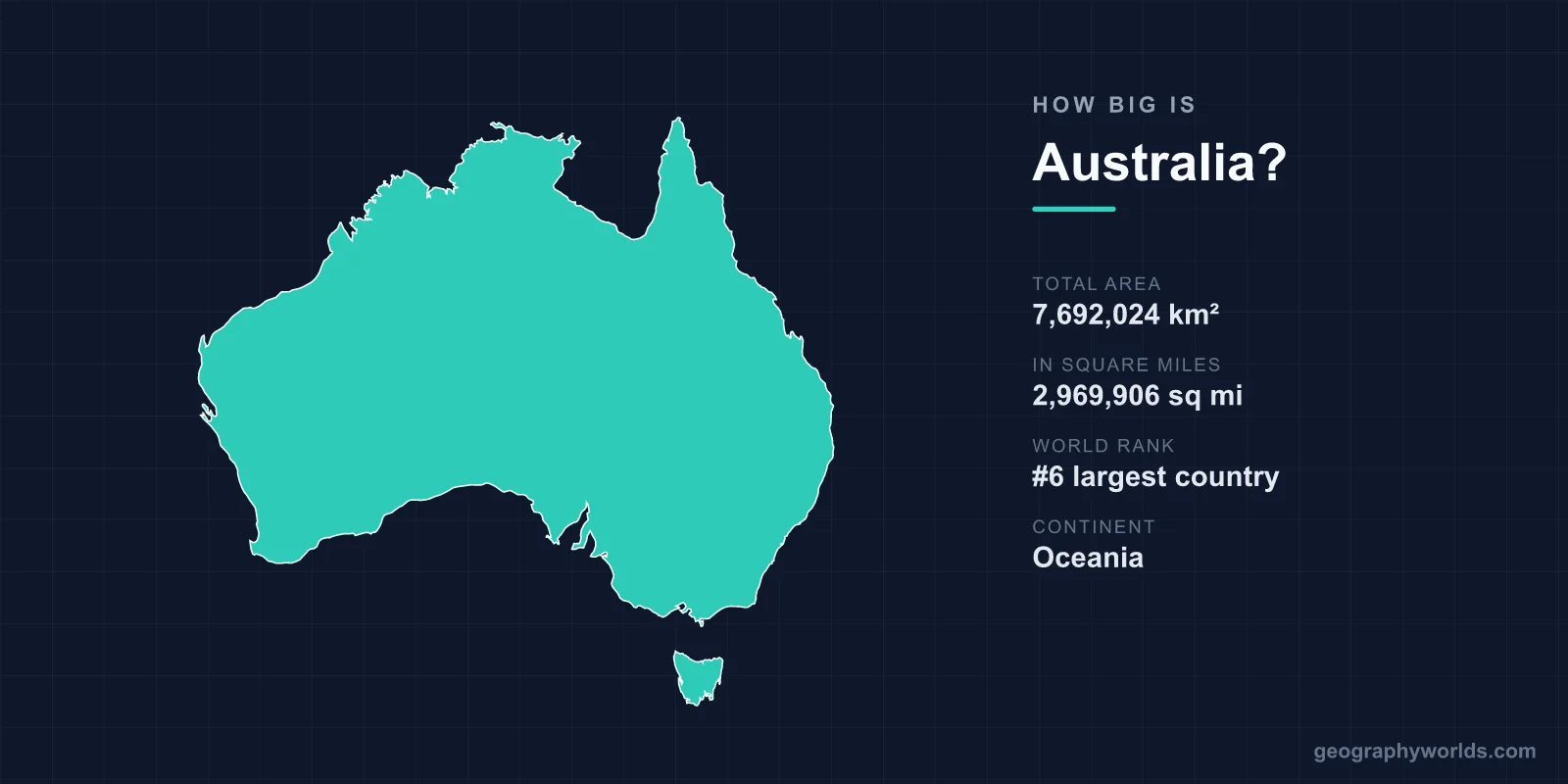
Australia covers a total area of 7,692,024 km² (2,969,906 sq mi), making it the sixth largest country in the world — roughly the same size as the contiguous United States. It is the only place on Earth that is simultaneously a country, a continent and an island, and that triple identity is exactly why its scale feels so hard to grasp from a map.
Australia's Area in Numbers
At 7,692,024 km², Australia accounts for about 5.16% of the planet's total land area of roughly 148.94 million km². It ranks behind only Russia, Canada, China, the United States and Brazil. To picture it another way, the country stretches approximately 3,860 km from its northern tip to its southern coast and around 4,100 km from east to west — distances that comfortably cover several climate zones in a single national border.
- Total area: 7,692,024 km² (2,969,906 sq mi)
- World rank: 6th largest country
- Share of world land: ~5.16%
- Coastline: about 25,760 km
- Highest point: Mount Kosciuszko, 2,228 m (7,310 ft)
How Australia Compares to Other Countries
Size becomes meaningful only through comparison. Australia is almost identical in area to the contiguous United States (the 48 states excluding Alaska and Hawaii), which makes it a useful mental yardstick for North American readers. For European readers, the contrast is even more dramatic: you could fit the United Kingdom, at 243,610 km², inside Australia roughly 31 times. The entire continent of Europe, often imagined as enormous, is only a little larger than Australia overall.
Yet despite being the sixth largest nation, Australia is the smallest of the seven continents by land area. That paradox — vast as a country, modest as a continent — sits at the heart of what makes its geography distinctive. You can learn more in our australia country guide.
A Continent of Deserts and Empty Space
What truly defines Australia's size is not just the headline figure but how little of it people use. The interior, known as the Outback, is dominated by arid and semi-arid plains and some of the world's most isolated deserts, including the Simpson, the Great Victoria and the Gibson. Only about 6% of the continent receives reliable enough rainfall for farming, and large stretches of the centre are nearly uninhabited.
This has produced one of the most lopsided population distributions on Earth. More than 85% of Australians live within 50 km of the coast, clustered in cities such as Sydney, Melbourne, Brisbane and Perth. The capital, Canberra, sits inland by deliberate design, chosen as a compromise between rival coastal cities. The result is a country where enormous territory coexists with a relatively small population of around 26 million people.
Landmarks That Reveal the Scale
Several features of Australia are so large they are easier to understand than the country itself. The Great Barrier Reef, the world's largest coral reef system, runs for more than 2,300 km along the northeast coast and is visible from space. The Great Dividing Range, Australia's principal mountain chain, extends down the entire eastern side of the continent for roughly 3,500 km.
Human-made structures echo this enormity. Highway 1 loops the whole continent across more than 14,500 km, making it the longest national highway on the planet. The Dingo Fence, built to protect southeastern grazing land, stretches about 5,614 km — the longest fence on Earth. Even Australia's administrative divisions are giants: Western Australia alone is comparable in size to Western Europe, and the island of Tasmania is larger than Sri Lanka.
Why Australia's Size Matters
The continent's dimensions shape almost everything about it. Three main time zones span the mainland, so the sun can be rising in Perth while the eastern states are already well into the afternoon. The spread of latitudes — from tropical rainforests and mangroves in the far north to cool temperate forests in Tasmania — means the country experiences several distinct climates at once. That diversity, combined with long isolation, also helped produce the unique wildlife, from kangaroos to platypuses, found nowhere else.
Frequently Asked Questions
Is Australia bigger than the United States?
No. The United States, including Alaska and Hawaii, has a larger total area at about 9.83 million km². However, Australia is very close in size to the contiguous (lower 48) United States, which is why the two are often compared.
Is Australia a country or a continent?
It is both. Australia is the only nation that occupies an entire continent, and it is also the world's largest island. This makes it unique among countries and is part of why its geography is so distinctive.
Why does Australia rank 6th in the world by size?
Australia's 7,692,024 km² place it behind Russia, Canada, China, the United States and Brazil. It is the largest country in Oceania and far larger than any of its regional neighbours.
How much of Australia is desert?
A large share of the interior is arid or semi-arid, and only about 6% of the continent receives enough rainfall for reliable agriculture. This is why the population is concentrated along the coasts rather than inland.