
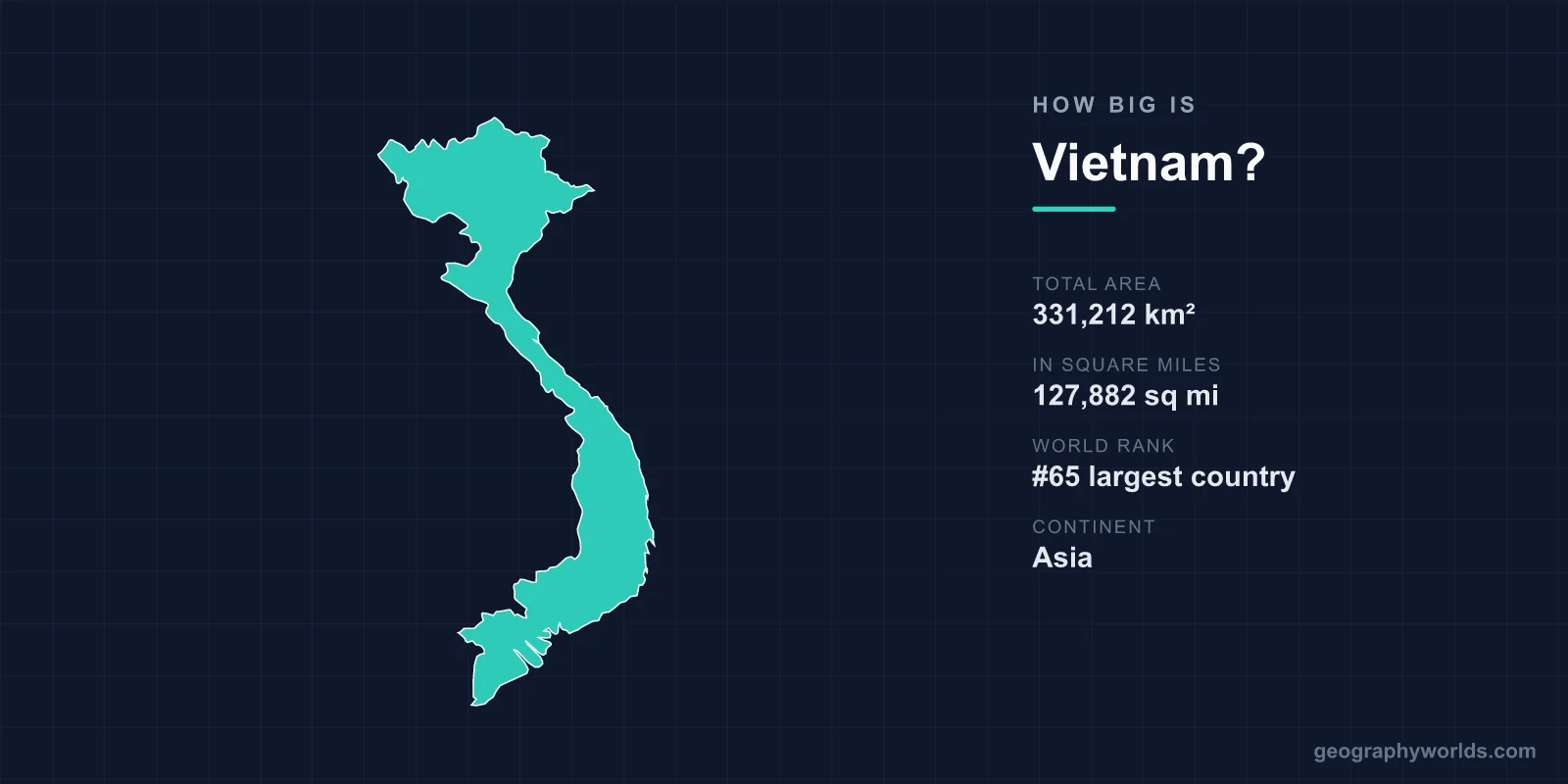
Vietnam covers a total area of 331,212 km² (127,882 sq mi), making it the 65th largest country in the world — roughly the size of the U.S. state of New Mexico or about 88% the size of Japan. Though modest in total area, Vietnam's extraordinary shape and geography pack a remarkable variety of landscapes into a relatively compact footprint in Southeast Asia.
How Big Is Vietnam Compared to Other Places?
At 331,212 km², Vietnam accounts for roughly 0.22% of Earth's total land area of about 148.94 million km². That places it 65th globally — larger than Italy or the United Kingdom, but well behind giant neighbours like China. A few comparisons help put the number in context:
- vs. New Mexico: almost identical in area
- vs. Japan (377,975 km²): Vietnam is about 88% the size
- vs. France (640,679 km²): Vietnam is roughly 52% the size
- vs. the Philippines (300,000 km²): the two are very close in area
Vietnam is the third most populous country in Southeast Asia, so its land supports a dense and growing population of around 100 million people. That makes it far more crowded per square kilometre than most countries of comparable size.
The Shape That Defines Vietnam
Vietnam's most striking geographic feature is its shape. The country stretches roughly 1,650 km from north to south but only about 600 km from east to west at its widest — and a startling 50 km or so at its narrowest point near the central coast. Locals often compare the long, curving outline to a bamboo pole balancing two baskets of rice, with the fertile deltas at each end and the slender mountainous spine between.
This elongated form means Vietnam spans many degrees of latitude, giving the north and south noticeably different climates and growing seasons. The Annamite Mountains (Trường Sơn Range) run along much of the western border with Laos and Cambodia, while a narrow ribbon of lowland and coast hugs the eastern edge facing the South China Sea (East Sea).
Coastline, Deltas and Highlands
For a country its size, Vietnam has an outsized relationship with the sea. Its coastline measures about 3,444 km — longer than the straight-line distance from London to Moscow — and is dotted with bays, beaches and thousands of offshore islands.
Two great river deltas anchor the country at either end. The Red River Delta in the north surrounds the capital, Hanoi, while the Mekong Delta in the south is one of Asia's most productive agricultural regions, growing more than half of Vietnam's rice. Between and around them lie the central highlands and the Annamite peaks.
The highest point is Fansipan, at 3,143 m (10,312 ft), often called the "Roof of Indochina" and reached today by cable car near the town of Sapa. The terraced rice paddies that climb the surrounding hillsides are among the country's most photographed landscapes.
Big Natural Wonders Inside a Compact Country
Vietnam's limited area belies the scale of some of its natural features. Ha Long Bay, a UNESCO World Heritage Site, contains over 1,600 limestone karst islands and islets rising dramatically from emerald water. In the centre of the country, the Phong Nha–Kẻ Bàng region holds Son Doong Cave, discovered in 2009 and recognised as the world's largest cave by volume — its main passage is large enough to accommodate a Boeing 747.
The biodiversity is equally remarkable: the Annamite Mountains shelter species found nowhere else on Earth, including the saola, a rare antelope-like mammal first described by science only in 1992. To explore more of the country's regions, history and culture, see our full vietnam country guide.
Climate Across Its Length
Because Vietnam reaches across so much latitude, climate varies significantly along its length. The south, including Ho Chi Minh City, is tropical and hot year-round, averaging about 27°C. The north has a subtropical climate with genuinely cool winters — Hanoi can drop to around 15°C in January. The central coast is exposed to seasonal typhoons, which periodically batter the narrow midsection of the country during the latter half of the year.
Frequently Asked Questions
What U.S. state is Vietnam closest in size to?
Vietnam is almost the same size as New Mexico, which covers about 314,900 km². It is also close in area to Norway and slightly larger than Italy or the Philippines.
How long is Vietnam from north to south?
Vietnam extends roughly 1,650 km from its northern border with China down to its southern tip in the Mekong Delta, while measuring only about 50 km wide at its narrowest point near the central coast.
How big is Vietnam compared to Japan?
Vietnam (331,212 km²) is about 88% the size of Japan (377,975 km²), so the two countries are fairly close in land area despite Japan being an island nation and Vietnam a long mainland strip.
What is the highest point in Vietnam?
The highest point is Fansipan, at 3,143 m (10,312 ft), located in the Hoàng Liên Sơn range near Sapa in the far north of the country.