
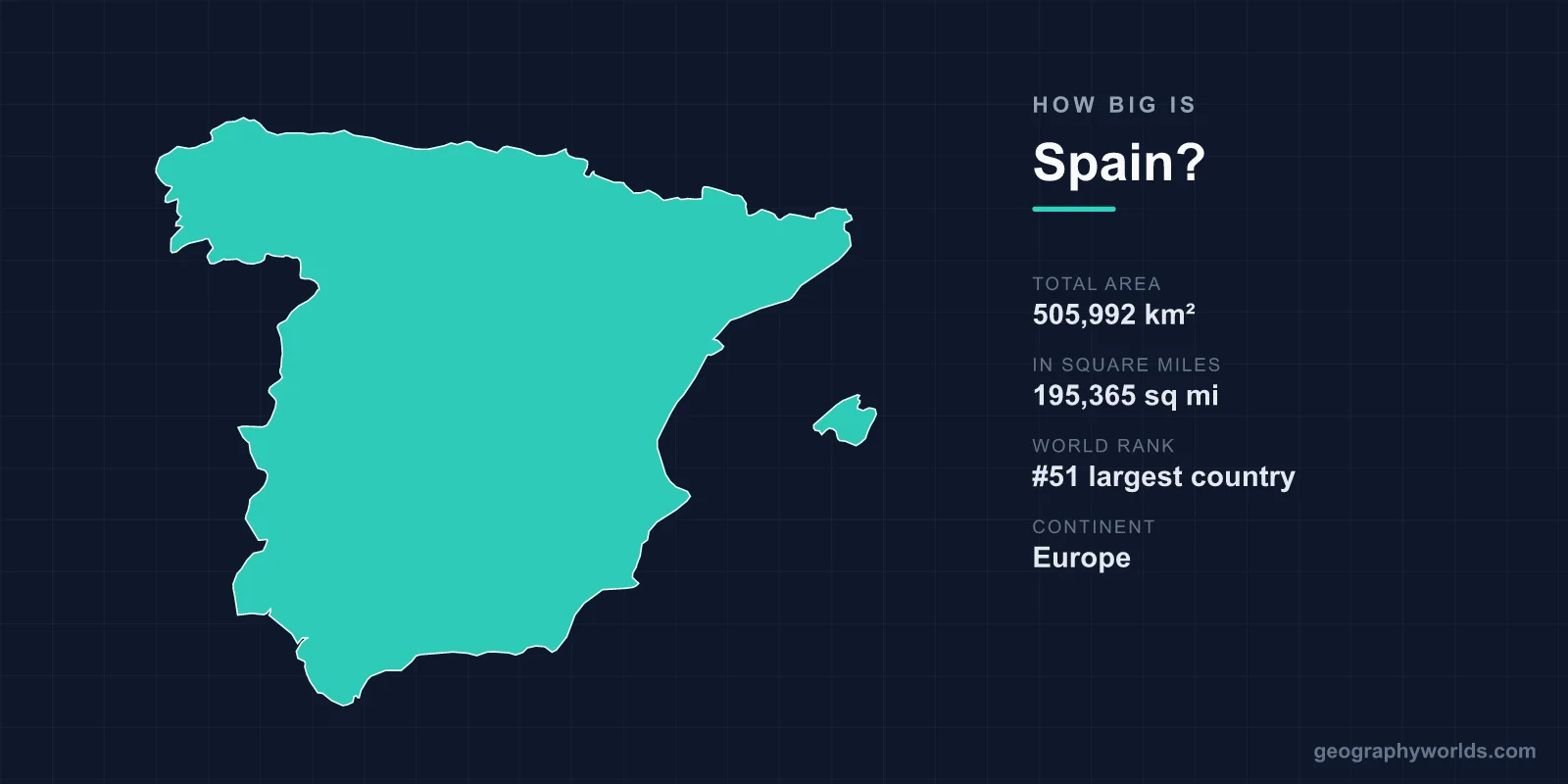
Spain covers a total area of 505,992 km² (195,365 sq mi), making it the 51st largest country in the world and the second-largest in the European Union after France. Stretching across most of the Iberian Peninsula plus two island archipelagos, Spain is roughly twice the size of the United Kingdom and accounts for about 0.34% of the planet's total land area.
Spain's Size in Numbers
Spain's 505,992 km² puts it just behind Thailand and ahead of Turkmenistan in the global rankings. Within Europe it is one of the larger nations, occupying around 85% of the Iberian Peninsula, which it shares with Portugal, Andorra, and the British territory of Gibraltar.
- Total area: 505,992 km² (195,365 sq mi)
- World rank: 51st largest country
- EU rank: 2nd largest, after France
- Share of global land area: roughly 0.34%
- Capital: Madrid, located almost exactly at the geographic centre of the country
The territory is not all contiguous mainland. It includes the Balearic Islands in the Mediterranean, the Canary Islands off the northwest coast of Africa, and two autonomous cities, Ceuta and Melilla, on the North African coast.
How Far Does Spain Stretch?
From its northern edge near the Bay of Biscay to its southern tip at the Strait of Gibraltar, mainland Spain measures roughly 880 km. East to west, from the Mediterranean coast to the Portuguese border, it spans about 1,000 km. That broad footprint gives the country a coastline of approximately 4,964 km, taking in the Atlantic Ocean, the Mediterranean Sea, and the Bay of Biscay, plus all the island shorelines.
This generous width is part of why Spain feels so geographically varied. A traveller can move from green, rain-soaked Atlantic valleys in the northwest to sun-baked Mediterranean beaches and semi-desert in the southeast within a single day's drive.
A Landscape Built Around a High Plateau
What makes Spain unusual among large European nations is its altitude. After Switzerland, Spain is the most mountainous country in Europe by average elevation. The heart of the country is the Meseta Central, a vast tableland sitting at 600–700 metres above sea level that covers much of the interior.
Ringing and crossing this plateau are several major mountain systems:
- The Pyrenees, forming a natural 430 km wall along the French border.
- The Cantabrian Mountains, shadowing the northern Atlantic coast.
- The Sierra Nevada in the south, home to mainland Spain's highest peak, Mulhacén (3,479 m).
The single highest point in all of Spanish territory, however, is not on the mainland at all. Mount Teide, a volcano on the Canary Island of Tenerife, rises to 3,718 m (12,198 ft), making it the tallest peak in Spain and across the Atlantic islands.
How Spain Compares to Other Countries
Comparisons make Spain's scale easier to picture. It is about twice the size of the United Kingdom (243,610 km²) and slightly larger than California. Set against its European neighbours and other well-known nations:
- Compared with France (640,679 km²), Spain is about 79% as large.
- Compared with Germany (357,022 km²), Spain is roughly 40% bigger.
- Compared with Japan (377,975 km²), Spain is about 134% the size.
- Compared with Italy (301,340 km²), Spain is around 68% larger.
For a deeper look at the country's regions, history, and culture, see our full spain country guide.
Climate and Geographic Diversity
Spain's size and varied terrain support an unusual range of climates. The Mediterranean coast in the south and east enjoys hot, dry summers and mild, wet winters. The northwest, particularly Galicia, is oceanic and famously green and rainy. The interior Meseta has a continental climate with hot summers and cold winters, while the southeast around Almería is genuinely semi-arid.
That dry corner contains the Tabernas Desert, often described as the only true desert in continental Europe and famous for standing in as the American Wild West in countless spaghetti western films. Spain's geographic richness also helps explain its enormous cultural heritage: it holds more UNESCO World Heritage Sites than any nation except Italy and China.
Frequently Asked Questions
Is Spain bigger than the UK?
Yes. At 505,992 km², Spain is roughly twice the size of the United Kingdom, which covers about 243,610 km². Despite being far larger in area, Spain has a smaller population.
What is the largest country in the European Union?
France is the largest EU member by area, followed by Spain in second place. Spain's 505,992 km² makes it comfortably the second-largest country in the bloc.
What is the highest point in Spain?
Mount Teide on the Canary Island of Tenerife is the highest point at 3,718 m (12,198 ft). On the Spanish mainland, the tallest peak is Mulhacén in the Sierra Nevada at 3,479 m.
How long is Spain's coastline?
Spain has approximately 4,964 km of coastline, touching the Atlantic Ocean, the Mediterranean Sea, and the Bay of Biscay, and including its Balearic and Canary island territories.