
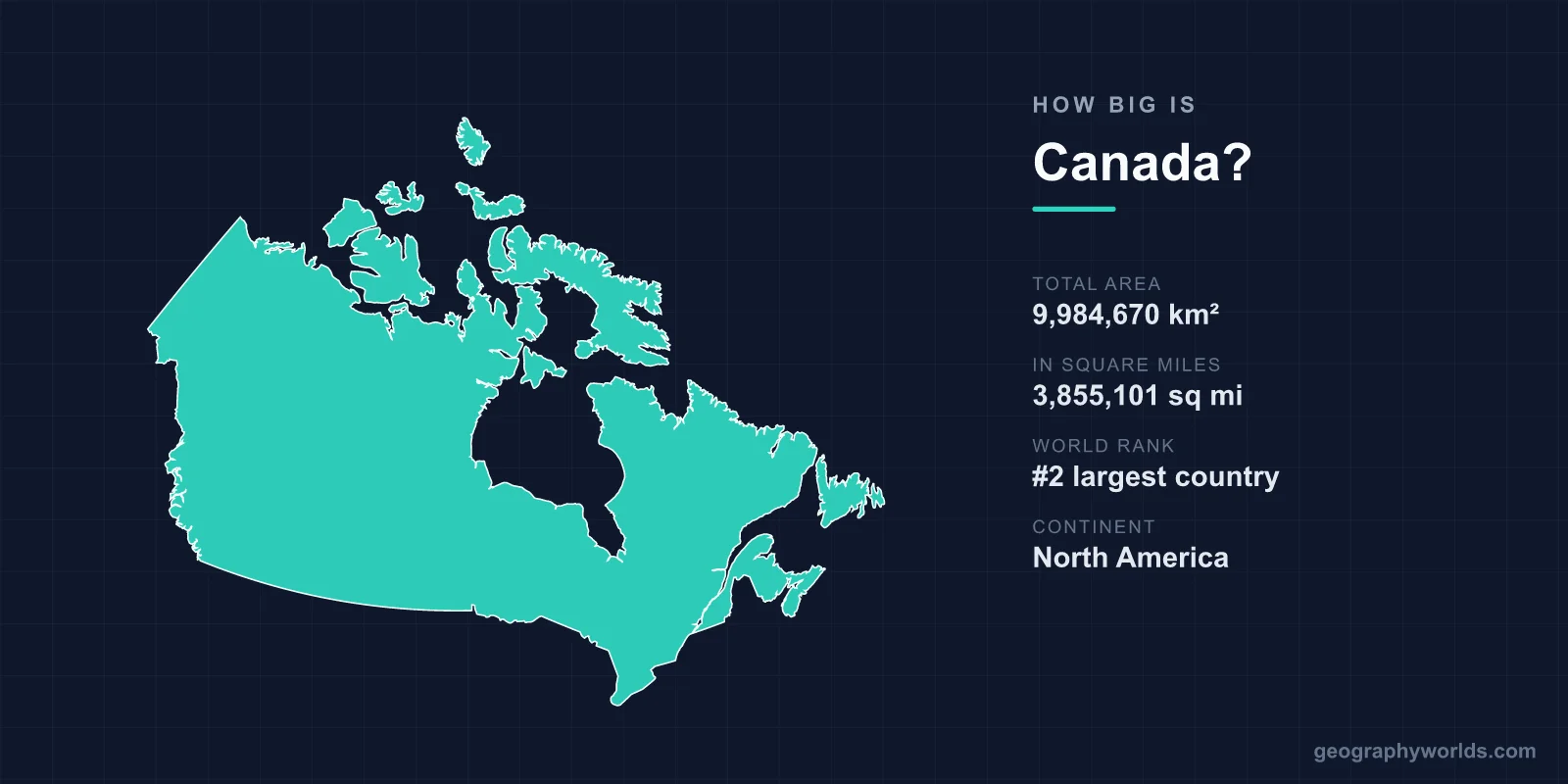
Canada covers a total area of 9,984,670 km² (3,855,101 sq mi), making it the second largest country in the world after Russia. It is so vast that it accounts for roughly 6.7% of all the land on Earth, spanning a continent-sized stretch of North America from the Atlantic to the Pacific to the Arctic Ocean.
Just How Big Is 9.98 Million Square Kilometres?
Canada's nearly 10 million km² makes it larger than the entire continent of Europe and slightly bigger than the United States (which covers about 9.83 million km² by most counts). Only Russia, at roughly 17.1 million km², is larger. To picture the scale another way, you could fit the United Kingdom inside Canada around 40 times, France about 18 times, or Japan more than 26 times.
Despite its enormous footprint, Canada is home to only about 40 million people. That gives it one of the lowest population densities of any nation on Earth — fewer than four people per square kilometre — with the vast majority living within roughly 160 km of the southern border with the United States. The far north remains some of the emptiest inhabited land on the planet.
Coast to Coast to Coast
Canada measures approximately 5,514 km from east to west, stretching across six time zones — when it is early morning in St. John's, Newfoundland, it is still the middle of the night in Vancouver. From north to south the country runs about 4,634 km, reaching from the temperate farmland near the U.S. border all the way to the high Arctic islands.
The country also holds a record that no other nation comes close to matching: the longest coastline in the world, at about 202,080 km. Bordered by three oceans — the Atlantic, Pacific, and Arctic — Canada's shoreline is so long it could wrap around the equator roughly five times. Much of this length comes from the deeply indented coasts of its thousands of northern islands.
A Land of Lakes, Shield, and Mountains
Canada's terrain is as varied as it is large. The ancient Canadian Shield — among the oldest exposed rock on Earth — covers much of the central and eastern interior, leaving behind a landscape pocked with countless lakes and rivers. In fact, Canada contains an estimated 60% of the world's lakes and more freshwater lake area than any other country, with over 31,700 lakes larger than 3 km².
To the west, the Rocky Mountains and the Coast Mountains rise dramatically, while the interior plains spread out as the broad prairies of Alberta, Saskatchewan, and Manitoba. The highest point in the country is Mount Logan in the Yukon, soaring to 5,959 m (19,551 ft) — the tallest peak in Canada and the second tallest in North America. You can explore more of the country's regions and landmarks in our canada country guide.
Provinces and Territories That Dwarf Whole Nations
Canada is divided into ten provinces and three territories, several of which are larger than most countries. Quebec, the biggest province, covers about 1.5 million km² — roughly three times the size of France. Nunavut, the largest territory, spans more than 2 million km², making it bigger than all of Western Europe, yet its population is under 40,000 people.
This combination of immense scale and sparse settlement defines Canada. Alert, Nunavut, is the northernmost continuously inhabited place on Earth, sitting just 817 km from the North Pole. Meanwhile, the Canada–United States border is the longest international boundary in the world, running 8,891 km including the Alaska stretch.
Standout Size Facts
- Canada is the world's second largest country and the largest in the Western Hemisphere.
- Its 202,080 km coastline is the longest of any nation by a wide margin.
- The Bay of Fundy, on the Atlantic coast, has the highest tides on Earth, rising over 16 metres.
- The country contains more lake area than the rest of the world combined.
- Canada's land mass is split among six time zones, from Newfoundland to the Pacific.
Frequently Asked Questions
Is Canada bigger than the United States?
Yes, slightly. Canada's total area of about 9,984,670 km² edges out the United States at roughly 9,833,000 km², largely because of Canada's vast water surface and northern islands. The difference is small, but it makes Canada the second largest country and the U.S. the third or fourth, depending on how areas are measured.
Which country is bigger, Canada or Russia?
Russia is much larger. At about 17.1 million km², Russia is nearly 1.7 times the size of Canada and remains the largest country in the world by total area. Canada is firmly in second place.
How does Canada's size compare to Europe?
Canada is bigger than the entire continent of Europe, which covers roughly 10.18 million km² in total land but is divided among nearly 50 countries. A single Canadian province like Quebec is larger than France, Spain, or Germany on its own.
Why does Canada have so few people for its size?
Much of Canada lies in cold, remote Arctic and sub-Arctic regions that are difficult to settle. As a result, about 90% of Canadians live within 160 km of the southern border, leaving the enormous northern interior nearly empty and giving the country a very low overall population density.