
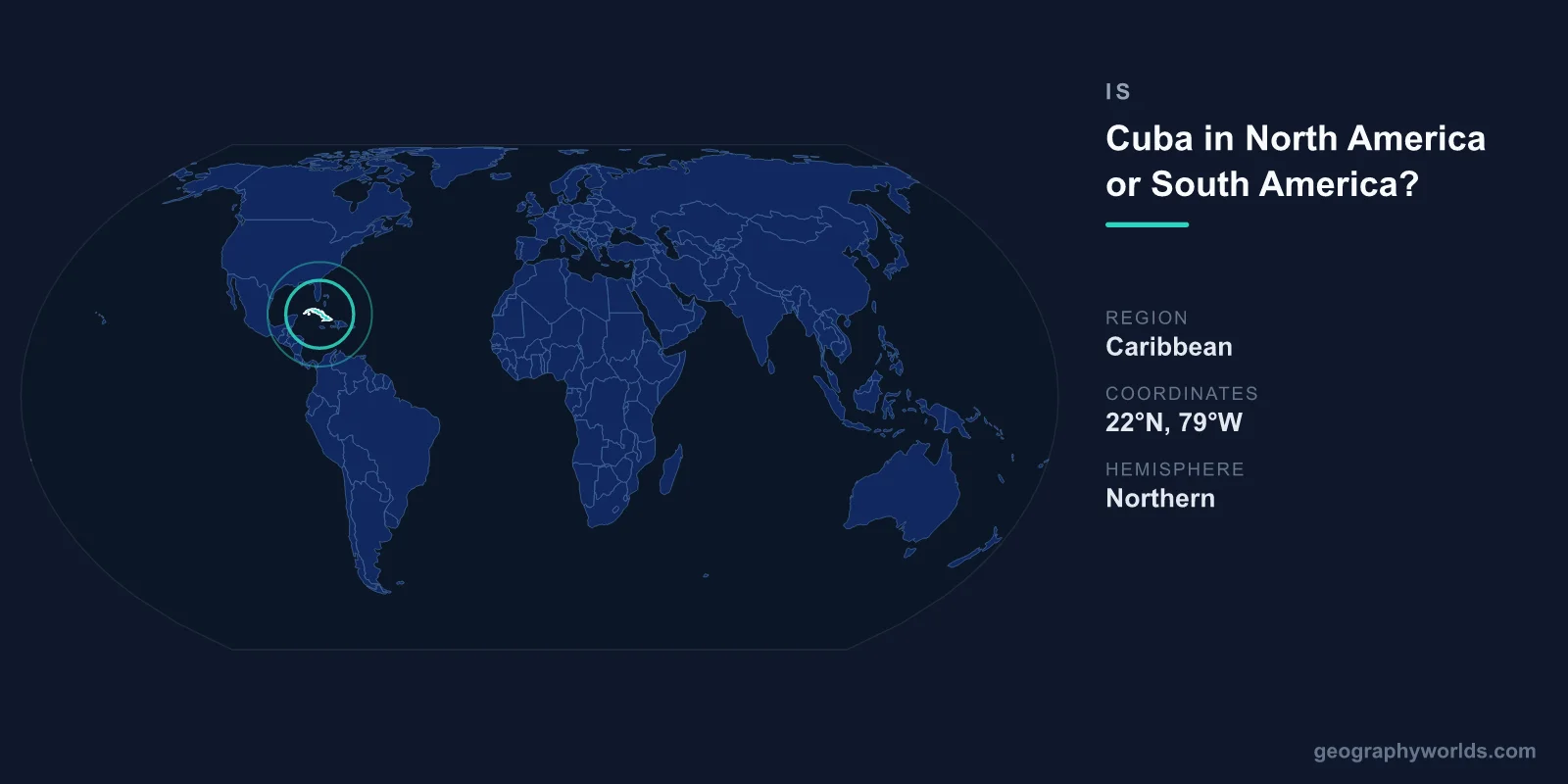
Cuba is in North America, not South America. Although Cuba is an island nation in the Caribbean Sea, geographers place the Caribbean islands within the North American continent. Cuba sits at the mouth of the Gulf of Mexico, just south of Florida, and shares the continental framework, tectonic setting, and geographic neighborhood of North America rather than the South American mainland far to the south.
The Short Answer: North America
By the standard geographic convention used in atlases, the United Nations, and most school curricula, Cuba belongs to North America. The continent of North America is not limited to the mainland of Canada, the United States, and Mexico — it also includes Central America and all of the Caribbean islands, a region collectively known as the West Indies. As the largest island in the Caribbean, Cuba is firmly within that grouping.
The South American mainland begins much farther away. The northern coast of South America, around Venezuela and Colombia, lies more than 1,000 kilometres south of Cuba across the Caribbean Sea. There is no plausible reading of physical geography that places Cuba on the South American continent.
Where Exactly Cuba Sits
Cuba is an archipelago positioned at the junction of three major bodies of water: the Gulf of Mexico to the northwest, the Atlantic Ocean to the north and east, and the Caribbean Sea to the south. This location at the entrance to the Gulf of Mexico has made the island strategically important for centuries, controlling shipping lanes between the Americas and the wider Atlantic world.
The island's nearest neighbours underline its North American setting:
- United States (Florida): roughly 150 km to the north across the Straits of Florida
- The Bahamas: to the northeast
- Mexico: to the west, across the Yucatán Channel
- Jamaica: to the south
- Haiti (and the rest of Hispaniola): to the east across the Windward Passage
Every one of these neighbours is also classified as part of North America, reinforcing Cuba's place in the continent.
Why People Get Confused
The confusion is understandable. The Caribbean is often treated as a region in its own right, mentally separate from the snowy image many people hold of North America. Cuba's Spanish language, its colonial history, and its long political alignment with countries such as Venezuela can make it feel "Latin American," which some people loosely associate with South America.
But "Latin America" is a cultural and linguistic label, not a continent. It spans parts of North America (Mexico, Central America, much of the Caribbean) and most of South America. A country can be culturally Latin American while being geographically North American — and Cuba is exactly that case. Cultural ties to the south do not move an island northward of the Tropic of Cancer onto a different landmass.
The Geological Picture
Tectonics tells the same story. Cuba lies near the boundary between the North American Plate and the smaller Caribbean Plate, with most of the island associated with the North American side. Its mountain ranges, including the Sierra Maestra in the southeast that rises to nearly 1,974 metres at Pico Turquino, formed through processes tied to this Caribbean–North American interaction rather than to the Andean systems of South America. The surrounding shallow shelves, coral reefs, and the Gulf basin all belong to the North American geological neighbourhood.
Key Facts About Cuba
- Continent: North America
- Region: Caribbean (West Indies)
- Total area: approximately 109,884 km², making it the largest country in the Caribbean
- Capital: Havana, whose old town is a UNESCO World Heritage Site
- Population: roughly 11 million
- Official language: Spanish
- Distinction: the largest island in the Caribbean and the 15th-largest island on Earth
For a fuller overview of the island's history, economy, and travel highlights, see our cuba country guide.
Frequently Asked Questions
Is Cuba part of North America or Central America?
Cuba is part of North America. Central America is the narrow land bridge connecting Mexico to Colombia (countries like Guatemala, Costa Rica, and Panama). Cuba is a Caribbean island, and the Caribbean is counted as a subregion of North America, separate from Central America.
Is Cuba in the Caribbean or North America?
Both descriptions are correct and do not conflict. "Caribbean" names the regional sea and the chain of islands around it, while "North America" names the continent that includes those islands. Cuba is a Caribbean island within the North American continent.
How far is Cuba from the United States?
Cuba lies about 150 km south of Key West, Florida, across the Straits of Florida. This short distance is one reason the two countries have such an intertwined geography and history.
Is Cuba near South America?
Not especially. The northern edge of South America is well over 1,000 km south of Cuba across the Caribbean Sea. Cuba is far closer to the United States and Mexico than to any South American country.