
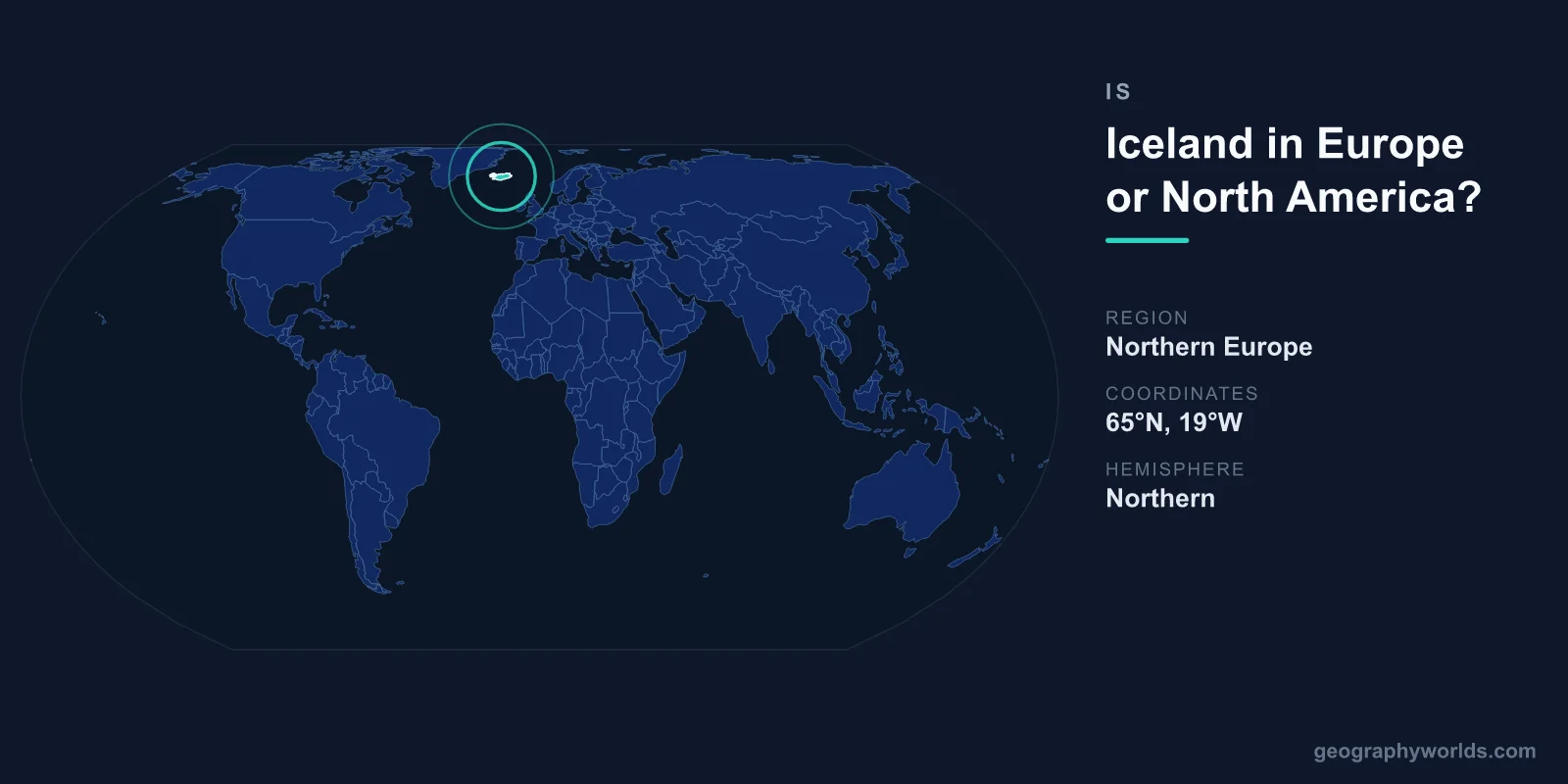
Iceland is in Europe. It is a Nordic island nation in the North Atlantic Ocean, and it is counted among the countries of Europe culturally, politically, and historically. The reason the question comes up at all is geological: Iceland sits directly on the boundary between the North American and Eurasian tectonic plates, so a small part of the island physically rests on the North American plate. For every practical purpose, however, Iceland is European.
Why Iceland Is Classified as European
Continents are defined by more than just bedrock. They reflect a shared history, culture, language, and political identity, and on every one of those measures Iceland belongs to Europe. The island was settled around 874 AD by Norse explorers from Norway and the British Isles, and Icelandic remains the modern language closest to the Old Norse once spoken across Scandinavia. From its first centuries, Iceland looked east toward the Nordic world, not west toward Greenland or the Americas.
That orientation is reflected in Iceland's modern alliances. The country is a founding member of NATO, a member of the European Economic Area (EEA), and part of the Schengen Area, which means travelers can move between Iceland and most of mainland Europe without border checks. Iceland also belongs to the Nordic Council alongside Denmark, Norway, Sweden, and Finland, and it competes in European sporting and cultural events such as the UEFA football tournaments and the Eurovision Song Contest. Standard geographic references, the United Nations, and atlases worldwide all list Iceland under Europe.
The Tectonic Twist That Causes Confusion
Iceland is one of the only places on Earth where the Mid-Atlantic Ridge rises above sea level. This ridge marks the seam where the North American and Eurasian plates are slowly pulling apart, spreading by roughly two centimetres a year. The western portion of the island, including parts of the Reykjavik area, technically sits on the North American plate, while the eastern portion sits on the Eurasian plate.
You can actually see and walk between the two plates at Þingvellir National Park, where the rift valley is visible as a dramatic series of cliffs and fissures. This geological split is why some people wonder whether Iceland might "really" be North American. But tectonic plates do not determine continental membership. By the same logic, parts of eastern Russia would be North American too. Geography classifies Iceland by its human and historical ties, and those are firmly European.
Where Iceland Sits in the Atlantic
Iceland lies in the far North Atlantic, just south of the Arctic Circle, which actually clips the small island of Grímsey off the north coast. It is roughly 300 kilometres east of Greenland and about 1,000 kilometres west of Norway, placing it nearer to North America by raw distance but far closer to Europe in every other sense. The mainland of continental Europe, via the United Kingdom and Scandinavia, is the island's natural reference point.
The country covers about 103,000 square kilometres, making it the second-largest island in Europe after Great Britain. Its volcanic origins shape everything: glaciers cover roughly 11% of the land, including Vatnajökull, the largest glacier in Europe by volume. Black sand beaches, fjords, lava fields, geysers, and hot springs define a landscape that is still being actively built by eruptions along the ridge.
Key Facts About Iceland
- Continent: Europe
- Capital: Reykjavik, the world's northernmost national capital
- Area: approximately 103,000 km²
- Population: around 370,000
- Official language: Icelandic
- Currency: Icelandic króna
- Region: Nordic countries, Northern Europe
For a fuller picture of the country's history, geography, and travel highlights, see our iceland country guide.
A Long European History
Iceland's European identity is not a modern invention. In 930 AD the settlers established the Althing, a national assembly that is widely regarded as one of the oldest functioning parliaments in the world. The country later came under Norwegian and then Danish rule, fully gaining independence as the Republic of Iceland only in 1944. Centuries of governance, trade, religion, and literature, including the medieval Icelandic sagas, tie the nation directly to the European tradition. Today Iceland is also a model of sustainability, generating nearly all of its electricity from renewable geothermal and hydroelectric sources thanks to the very volcanic activity that sits beneath its feet.
Frequently Asked Questions
Is Iceland part of North America?
No. Although the western part of the island physically rests on the North American tectonic plate, Iceland is classified as a European country by history, culture, language, and political membership. It is universally listed under Europe.
Is Iceland in the European Union?
Iceland is not a member of the European Union, but it is part of the European Economic Area and the Schengen Area, so it participates in Europe's single market and shares open borders with most EU countries.
Why does Iceland sit on two tectonic plates?
Iceland straddles the Mid-Atlantic Ridge, the boundary where the North American and Eurasian plates spread apart. This is what gives the island its volcanoes, geysers, and geothermal energy, and you can walk between the plates at Þingvellir National Park.
Is Iceland considered a Nordic country?
Yes. Iceland is one of the five Nordic nations, alongside Denmark, Norway, Sweden, and Finland, and is a member of the Nordic Council. This reinforces its place within Northern Europe.