
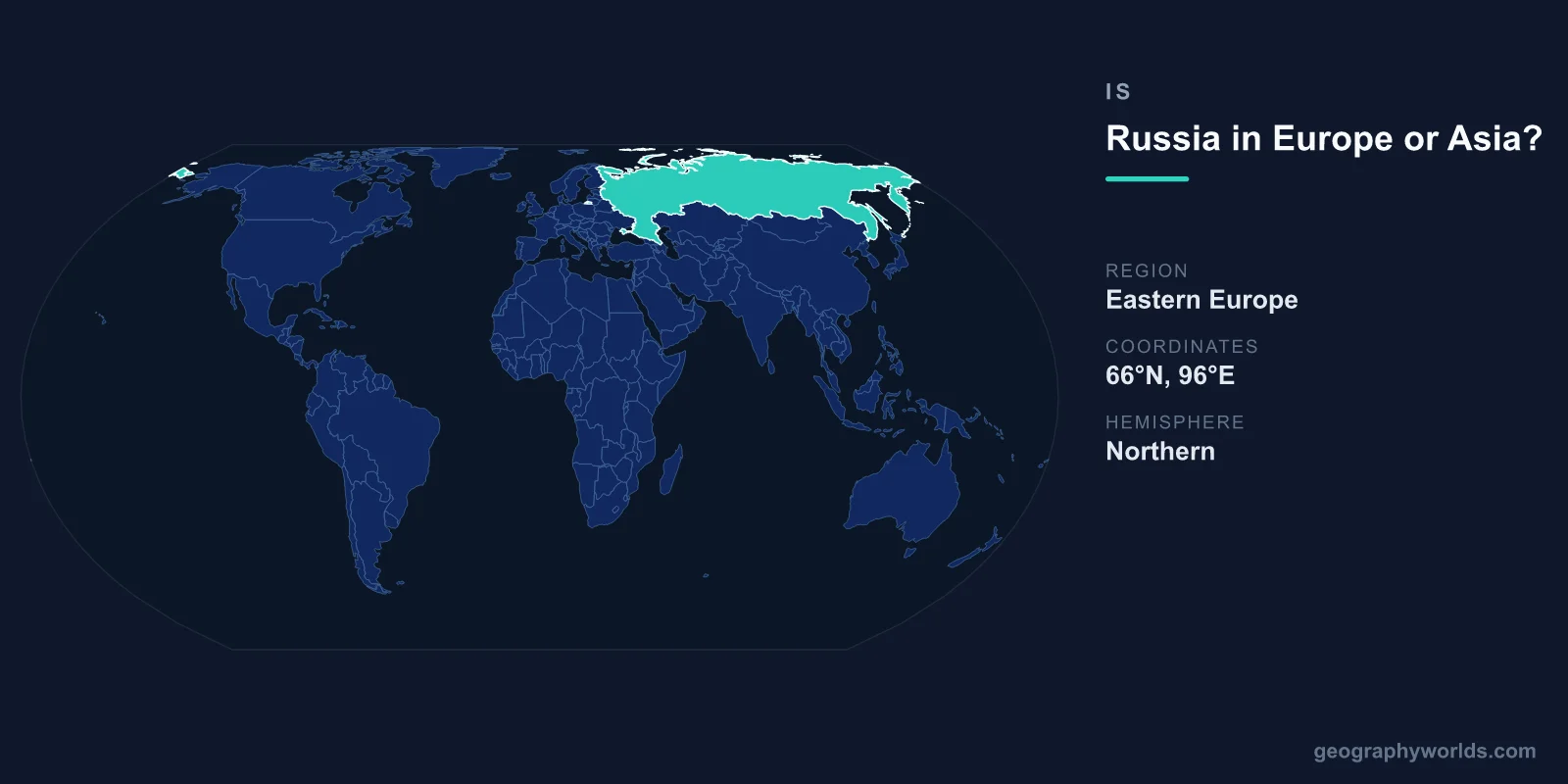
Russia is in both Europe and Asia — it is a transcontinental country whose territory stretches from the eastern edge of Europe across the entire width of northern Asia. No single continent can claim Russia, because the world's largest nation straddles the traditional dividing line between the two, with its western quarter in Europe and the vast remainder, known as Siberia, in Asia.
Where Europe Ends and Asia Begins in Russia
The boundary between European Russia and Asian Russia is not a coastline or a national border but a chain of natural landmarks running roughly north to south. Geographers traditionally draw the line along the Ural Mountains, then down the Ural River to the Caspian Sea, and through the Caucasus region toward the Black Sea. Everything west of this line — including Moscow, St. Petersburg, and the Volga basin — sits in Europe. Everything east of the Urals belongs to Asia.
The Urals themselves are an ancient, worn-down range, rarely rising above 1,900 metres, which is part of why the European-Asian divide here feels more conceptual than dramatic. Cities such as Yekaterinburg lie almost exactly on the boundary, and monuments mark the precise spot where a visitor can stand with one foot in each continent.
Why So Many People Think of Russia as European
Although about 77 percent of Russia's land area lies in Asia, roughly three-quarters of its 144 million people live in the European portion west of the Urals. The country's political capital, Moscow, and its former imperial capital, St. Petersburg, are both firmly European cities. Russia's recorded history, its Orthodox Christian heritage, its literature, ballet, and classical music, and its long entanglement in European diplomacy and warfare all anchor it culturally to Europe.
This concentration of population, power, and cultural identity in the west explains why Russia is so often classed as a European nation, even though the bulk of its territory is unmistakably Asian. In effect, Russia is European where most Russians live and Asian where most of its land lies.
The Asian Half: Siberia and the Far East
The Asian side of Russia is enormous and sparsely populated. It includes the Siberian taiga — the largest forest on Earth — the frozen tundra of the Arctic north, and the volcanic Kamchatka Peninsula on the Pacific rim. Here you also find Lake Baikal, the deepest lake in the world, which holds roughly 20 percent of the planet's unfrozen fresh surface water.
Russia's Asian regions border countries such as Kazakhstan, Mongolia, China, and North Korea, and the far eastern port of Vladivostok sits closer to Tokyo and Beijing than to Moscow. These regions carry their own distinct Turkic, Mongol, and indigenous Siberian cultural influences, giving Asian Russia a character quite different from the European heartland.
A Country Built Across Two Continents
Few statistics capture Russia's transcontinental scale better than its time zones: the country spans 11 of them, more than any other nation on the planet. When the working day is beginning in Kaliningrad on the Baltic, it is already evening in Kamchatka on the Pacific. Russia shares land borders with 14 countries and reaches from the Baltic Sea in the west to the Bering Strait in the east, where it lies just a few kilometres from Alaska.
The physical link between its two halves is famously embodied by the Trans-Siberian Railway, which runs about 9,289 km from Moscow to Vladivostok. The journey takes roughly a week and physically carries passengers from Europe deep into Asia, crossing the Urals on the way. To explore more places that sit on continental crossroads, you can sharpen your geography with our interactive map and quiz games, or read the full russia country guide for a deeper look at the nation.
Key Facts About Russia
- Continent: Both Europe and Asia (transcontinental)
- Area: 17,098,242 km² — the largest country on Earth
- Capital: Moscow (in European Russia)
- Population: approximately 144 million
- Dividing line: Ural Mountains, Ural River, and the Caspian Sea
- Time zones: 11
Frequently Asked Questions
Is Moscow in Europe or Asia?
Moscow is in Europe. The Russian capital lies well to the west of the Ural Mountains, within the European part of the country, which is also where the majority of Russia's population is concentrated.
What separates European Russia from Asian Russia?
The conventional boundary follows the Ural Mountains in the north, then the Ural River down to the Caspian Sea, and continues through the Caucasus toward the Black Sea. Land west of this line is considered European; land to the east is Asian.
What percentage of Russia is in Asia?
About 77 percent of Russia's land area lies in Asia, mostly in the region known as Siberia. Yet only around a quarter of the population lives there, because Asian Russia is vast and thinly settled.
Is Russia considered a European or Asian country?
Politically and culturally Russia is most often grouped with Europe, since its capital, history, and most of its people are European. Geographically, however, it is transcontinental, and the larger share of its territory is in Asia.