
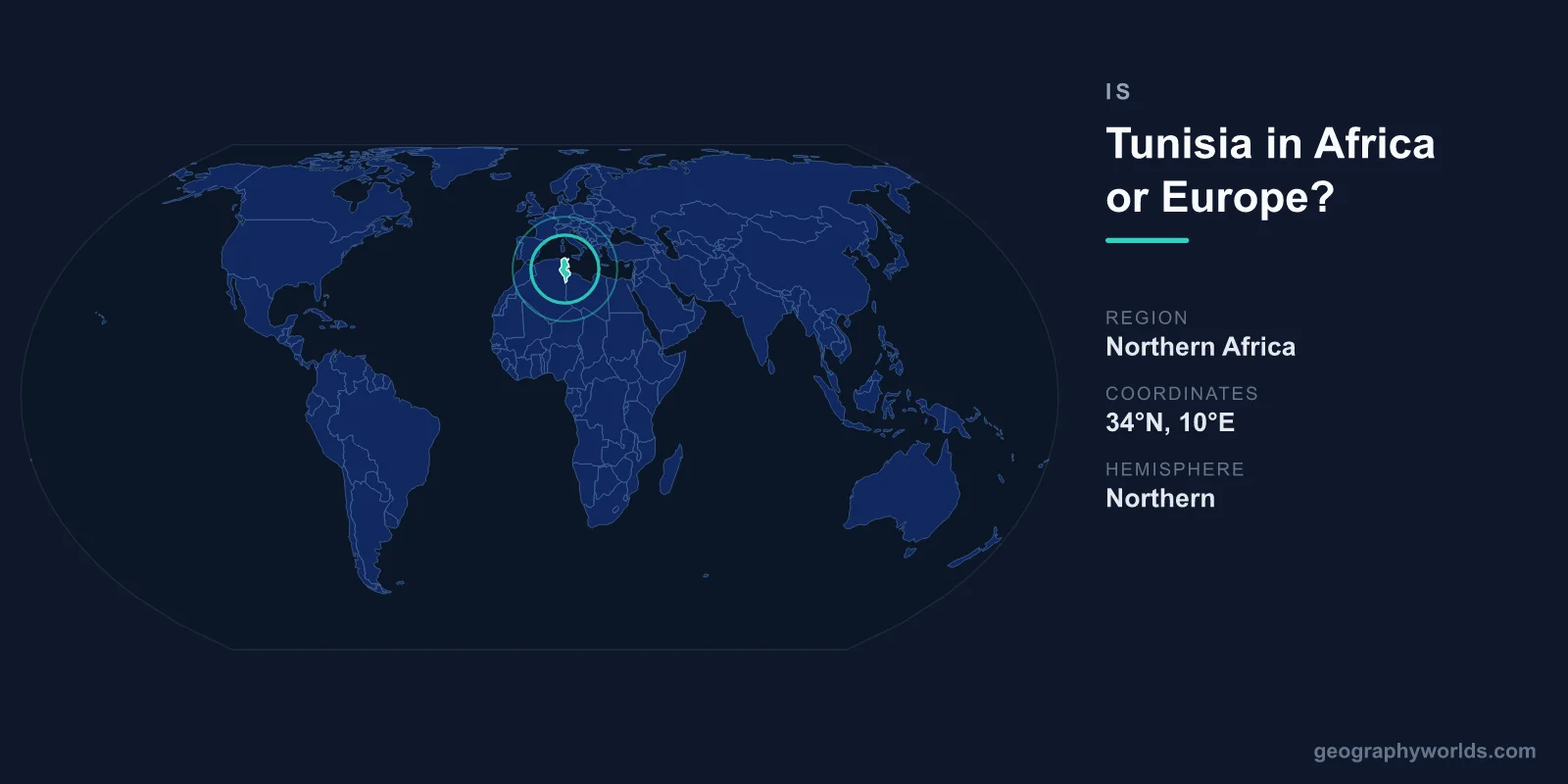
Tunisia is in Africa, not Europe. It is the northernmost country on the African continent, sitting on the Mediterranean coast of North Africa between Algeria and Libya. While Tunisia lies remarkably close to Europe and shares deep cultural and historical ties with the Mediterranean world, it is geographically, politically, and continentally part of Africa.
Tunisia Is Firmly in Africa
Tunisia occupies the far north of the African continent, with a Mediterranean coastline stretching roughly 1,300 km. To its west lies Algeria, and to its southeast lies Libya, both fellow African nations. The capital, Tunis, sits on the northern coast near the site of ancient Carthage. With a land area of about 163,610 km² and a population of around 12 million people, Tunisia is one of the smaller countries in North Africa by land, but it punches well above its weight in historical and cultural significance.
Tunisia is a member of the African Union, the Arab League, and the Arab Maghreb Union, all of which underscore its identity as a North African and Arab nation. There is no serious geographic, political, or institutional basis for placing Tunisia in Europe.
Why People Confuse Tunisia With Europe
The confusion is understandable. Tunisia's northern tip, Cap Angela, is the closest point on mainland Africa to Europe. The Italian island of Sicily lies just around 140 km away across the narrow Strait of Sicily, and the small Italian island of Pantelleria is even closer. On a clear day, the two continents almost feel like neighbors looking at each other across the water.
Beyond geography, Tunisia's atmosphere can feel distinctly Mediterranean and even southern European. Its coastal cafe culture, olive groves, vineyards, seafood cuisine, and whitewashed blue-shuttered towns like Sidi Bou Said evoke the look and rhythm of Greece, southern Italy, or Spain. Decades of French colonial rule (1881 to 1956) left a strong French linguistic and architectural imprint, and French is still widely spoken alongside Arabic. All of this can give travelers the impression of a European setting, but Tunisia remains an African country.
A Crossroads Between Continents
Tunisia's position at the meeting point of Africa, the Mediterranean, and the gateway to Europe has shaped its entire history. The Phoenicians founded Carthage near modern Tunis, and it grew into a maritime superpower that rivaled Rome before its destruction in 146 BC. The Romans, Vandals, Byzantines, Arabs, Ottomans, and French all left their mark here, drawn by the same strategic location.
This crossroads role explains why Tunisia blends so many influences. It is unmistakably African in its geography and Arab-Berber in its core identity, yet it has absorbed European, Middle Eastern, and Mediterranean elements over thousands of years. The result is a country that bridges worlds without belonging to Europe.
The Geography Behind the Answer
Continents are defined by large, recognized landmasses, and Tunisia sits squarely on the African mainland. There is no land border or continental shelf connecting it to Europe; the two are separated by open Mediterranean sea. Tunisia's terrain itself reflects its African placement and is far more varied than a coastal first impression suggests:
- The north: mountainous and green, forming the eastern end of the Atlas Mountain range, with fertile valleys and a wetter climate.
- The center: rolling plains and the semi-arid Sahel region, historically a major olive-growing zone.
- The south: the vast Sahara Desert, including salt flats like Chott el Jerid and dramatic oasis towns.
This progression from Mediterranean coast to Saharan dunes is a classic North African landscape, reinforcing that Tunisia is geographically rooted in Africa.
Key Facts About Tunisia
- Continent: Africa (North Africa)
- Capital: Tunis
- Area: approximately 163,610 km²
- Population: roughly 12 million
- Official language: Arabic (French widely used)
- Closest point to Europe: Cap Angela, about 140 km from Sicily
For a deeper look at the country's regions, history, and travel highlights, see our tunisia country guide.
Frequently Asked Questions
Is Tunisia part of Africa or the Middle East?
Geographically, Tunisia is part of Africa, specifically the North African region known as the Maghreb. Culturally and politically, it is also considered part of the wider Arab world and is a member of the Arab League, which is why it sometimes appears in discussions of the Middle East and North Africa (MENA) region. But its continent is unambiguously Africa.
How close is Tunisia to Europe?
Very close. The northernmost point of Tunisia, Cap Angela, lies only about 140 km from the Italian island of Sicily across the Strait of Sicily. This narrow gap makes Tunisia the African country closest to mainland Europe at this point.
Is Tunisia the northernmost country in Africa?
Yes. Cap Angela in Tunisia is the northernmost point of the entire African continent, which makes Tunisia the northernmost country in Africa, slightly edging out neighboring Algeria and Morocco.
Why does Tunisia feel European to visitors?
Tunisia's Mediterranean climate, coastal cafe culture, French colonial heritage, and architecture can give it a southern European feel. Widespread use of French and its proximity to Italy and France reinforce the impression. Despite this atmosphere, Tunisia is fully an African nation.