
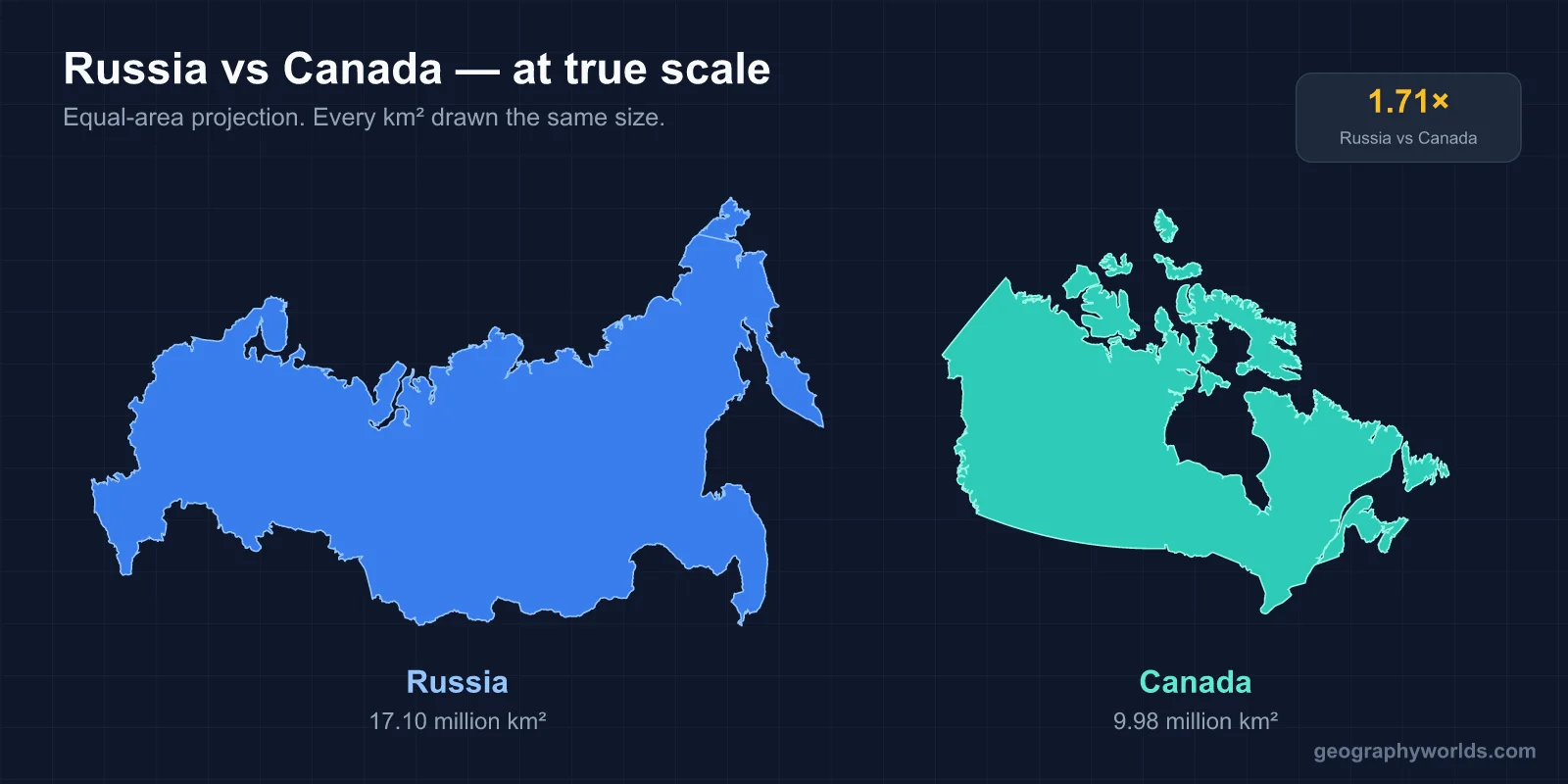
Russia and Canada are the two largest countries on Earth by land area, but they are far from equals. Russia covers 17,098,242 km² — roughly 1.7 times the size of Canada's 9,984,670 km² — and is home to about 143.4 million people, some 3.5 times Canada's population of 40.5 million. Russia spans 11 time zones across Europe and Asia, while Canada stretches across six in North America. Below we compare them in detail across size, population, capitals, language, climate, and the natural features that define each nation.
Whether you are studying for a geography test, planning travel, or simply curious about how the world's two largest countries differ, this side-by-side comparison gives you the essential facts and the context that makes them meaningful.
Size and Geography
| Feature | Russia 🇷🇺 | Canada 🇨🇦 |
|---|---|---|
| Area | 17,098,242 km² | 9,984,670 km² |
| Continent | Europe | North America |
| Region | Eastern Europe | North America |
| Land Borders | Norway, Finland, Estonia, Latvia, Lithuania, Poland, Belarus, Ukraine, Georgia, Azerbaijan, Kazakhstan, China, Mongolia, North Korea | United States |
| Landscape | vast flat plains to mountains; largest country on Earth | vast land with Arctic tundra, prairies, forests, and mountains |
Russia is roughly 1.7 times larger than Canada, and the gap in physical scale shapes almost everything else about the two nations. Russia is the only country that spans two continents on this scale, reaching from the Baltic shores of Europe across the Ural Mountains and the immense expanse of Siberia to the Pacific coast facing Japan and Alaska. Canada, by contrast, occupies the northern half of North America in a single broad band, framed by three oceans — the Atlantic, the Pacific, and the Arctic.
Their land borders tell two very different stories. Russia touches 14 countries, more than almost any nation on Earth, giving it complex relationships across Northern Europe, the Caucasus, and Central and East Asia. Canada has just one neighbour — the United States — but it shares the longest international land border in the world, stretching about 8,891 km including the Alaska boundary.
Population and Demographics
| Metric | Russia 🇷🇺 | Canada 🇨🇦 |
|---|---|---|
| Population | 143.4 million | 40.5 million |
| Population Density | 8.4 per km² | 4.1 per km² |
Russia's population of about 143.4 million is roughly 3.5 times larger than Canada's 40.5 million, and at 8.4 people per km² it is also about twice as densely settled. Yet both countries are sparsely populated by global standards because so much of their territory is inhospitable. In Russia, the great majority of people live west of the Ural Mountains in the European heartland, while vast stretches of Siberia and the Far East remain nearly empty. In Canada, roughly 90 percent of the population lives within about 160 km of the U.S. border, leaving the northern territories among the least densely inhabited inhabited places on the planet.
This concentration reflects climate as much as history. Both nations possess enormous reserves of land that are simply too cold, too remote, or too mountainous to support large communities, which is why their density figures are far lower than countries a fraction of their size.
Capital Cities
Moscow is the capital of Russia, and Ottawa is the capital of Canada. Moscow sits in European Russia and is the country's largest city, with a metropolitan population well over 12 million — a sprawling political, financial, and cultural centre home to the Kremlin and Red Square. Ottawa, located in the province of Ontario near the border with Quebec, is far smaller, with around one million residents. It was deliberately chosen in the 19th century as a compromise capital between English- and French-speaking regions, which is why Canada's largest cities, Toronto and Montreal, are not its seat of government.
Language, Currency and Culture
| Aspect | Russia 🇷🇺 | Canada 🇨🇦 |
|---|---|---|
| Languages | Russian (official), plus over 100 minority languages | English and French (both official) |
| Currency | Russian Ruble (RUB) | Canadian Dollar (CAD) |
Russian is the single official language of Russia, but the country recognises more than 100 minority languages spoken by its many ethnic groups, from Tatar and Chechen to the indigenous languages of Siberia. Canada is officially bilingual at the federal level: both English and French carry equal status, a legacy of British and French colonisation. French is dominant in Quebec, while English prevails across most of the rest of the country, and dozens of Indigenous languages are also spoken. These linguistic differences reflect each country's distinct colonial history, indigenous heritage, and cultural evolution over centuries. The Russian ruble (RUB) and the Canadian dollar (CAD) likewise reflect very different economies and financial systems.
Climate and Natural Features
| Aspect | Russia 🇷🇺 | Canada 🇨🇦 |
|---|---|---|
| Climate | ranges from steppes to subarctic; extremely diverse | varies from temperate in south to arctic in north |
| Key Features | Siberia, Lake Baikal, Ural Mountains, Volga River, Kamchatka | Rocky Mountains, Niagara Falls, Arctic Archipelago, Great Lakes |
| Economy | oil and gas, mining, agriculture, aerospace | oil and gas, mining, lumber, agriculture, technology |
Russia's climate ranges from southern steppes to the subarctic and is extraordinarily diverse, including some of the coldest permanently inhabited places on Earth in eastern Siberia. Its landscape is anchored by Lake Baikal, the deepest and oldest freshwater lake in the world; the Ural Mountains, which divide Europe from Asia; the Volga, Europe's longest river; and the volcanoes of the Kamchatka Peninsula.
Canada's climate shifts from temperate in the populated south to true Arctic in the far north. Its defining natural features include the Rocky Mountains along the western frontier, the thundering Niagara Falls, the icy expanse of the Arctic Archipelago, and the freshwater Great Lakes shared with the United States. Economically the two countries overlap more than their geography suggests: both are major producers of oil, gas, and minerals, though Canada also leans on lumber, agriculture, and a growing technology sector, while Russia adds aerospace to its resource-heavy mix.
What Makes Each Country Unique
Russia is internationally renowned for spanning 11 time zones, the Trans-Siberian Railway — the longest railway line in the world — the Kremlin, its world-famous ballet tradition, and its pioneering role in space exploration, having launched both the first satellite and the first human into orbit. Russia's sheer breadth means that when the sun is rising over its Pacific coast, it is still the previous evening in its western cities.
Canada is best known for maple syrup, Niagara Falls, the Rocky Mountains, ice hockey, and its multicultural cities. It boasts the longest coastline of any country in the world at over 202,000 km, and it contains more lakes than all other countries on Earth combined — an astonishing concentration of freshwater carved by retreating glaciers.
Key Facts
- Area: Russia 17,098,242 km² vs Canada 9,984,670 km² — Russia is about 1.7x larger
- Population: Russia 143.4 million vs Canada 40.5 million — Russia is about 3.5x more populous
- Capitals: Moscow (Russia) vs Ottawa (Canada)
- Currency: Russian Ruble (RUB) vs Canadian Dollar (CAD)
- Continents: Europe and Asia (Russia) vs North America (Canada)
- Population density: Russia 8.4 per km² vs Canada 4.1 per km²
- Official languages: Russian vs English and French
Key Differences at a Glance
- Land borders: Russia touches 14 countries; Canada borders only the United States.
- Coastline: Canada has the world's longest coastline; Russia has the longest of any single country across the Arctic and Pacific.
- Time zones: Russia spans 11; Canada spans six.
- Settlement: Russians cluster in the European west; Canadians cluster near the U.S. border.
Verdict
Russia and Canada — the two largest countries by area — each offer unique geographic characteristics that make them fascinating to compare. Russia claims the larger land area and the larger population, showing how the title of "biggest country" can mean very different things depending on whether you count square kilometres or people. Russia stands out for its vast, climate-diverse Eurasian expanse and landmarks like Lake Baikal and Siberia, whereas Canada is defined by its Arctic-to-temperate sweep and features such as the Rocky Mountains, the Great Lakes, and its countless lakes and rivers.
Both nations are resource-rich, sparsely populated relative to their size, and shaped profoundly by cold northern climates. Understanding how they differ — and where they are surprisingly alike — builds a richer picture of our diverse planet. To dig deeper into the borders mentioned here, explore the flag of Kazakhstan or the flag of the United States.
Frequently Asked Questions
Is Russia bigger than Canada?
Yes. Russia is the largest country in the world at 17,098,242 km², while Canada is the second largest at 9,984,670 km². Russia is roughly 1.7 times larger than Canada.
Which country has more people, Russia or Canada?
Russia has far more people, with about 143.4 million residents compared with Canada's roughly 40.5 million — making Russia about 3.5 times more populous despite both countries being thinly settled relative to their enormous size.
What are the capitals of Russia and Canada?
Moscow is the capital of Russia and its largest city, while Ottawa is the capital of Canada. Notably, Ottawa is not Canada's largest city; Toronto and Montreal are both bigger.
How many countries does each one border?
Russia shares land borders with 14 countries, among the most of any nation. Canada borders just one country, the United States, but their shared boundary is the longest international land border in the world.
Test Your Knowledge!
Think you know your countries? Try our interactive geography quiz!
Play Geography Games →