

Suva is the capital and largest city of Fiji, built on a hilly peninsula on the south-east coast of Viti Levu, between Suva Harbour and Laucala Bay. The 2017 census counted 93,874 people in the city itself and 268,423 in the metropolitan area that takes in Lami, Nasinu and Nausori. Besides being Fiji's political and commercial centre and main port, Suva hosts more regional organisations than any other Pacific Island capital, including the Pacific Islands Forum Secretariat, the Pacific Community and the main campus of the University of the South Pacific.
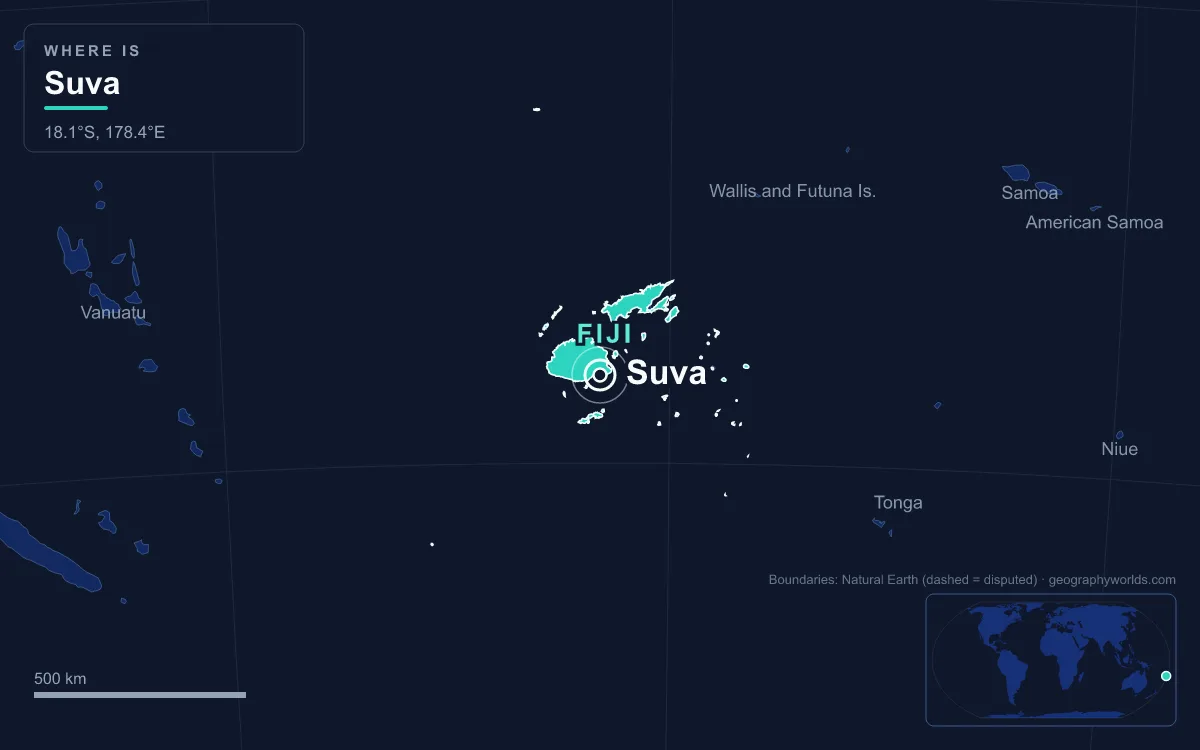
The city is a colonial creation. In 1868 the Bauan chief Seru Epenisa Cakobau granted land around Suva to the Australian-based Polynesia Company, which hoped to grow cotton and failed. After Fiji was ceded to Britain in 1874, officials looked for a new capital to replace Levuka on Ovalau, hemmed in between a steep mountain and the sea. Suva was chosen in 1877, laid out by Colonel F. E. Pratt of the Royal Engineers, and the administration moved in 1882. It became a municipality in 1910 but covered only one square mile until 1952, when it annexed the Muanikau and Samabula wards, grew to 13 km² and was declared Fiji's first city; Tamavua and the Cunningham area were added later. The old capital kept a few firsts of its own: Levuka switched on Fiji's first public electricity supply in 1927, three days before Suva. Suva's elected council has had a rougher time. Until 2009 a lord mayor and a 20-member council ran the city, but that year the military-backed interim government dismissed municipal officials and appointed special administrators instead. Its buildings tell that story street by street, and seven of them carry most of it.
Government Buildings on Victoria Parade
The seat of Fiji's government stands on ground that was once a creek. In 1935 the creek was drained, and the foundations were made by driving more than five kilometres of reinforced concrete piles into its bed. The foundation stone was laid in 1937 and the Art Deco complex, designed by the Chief Colonial Architect Walter Frederick Hedges, was formally opened by Governor Sir Harry Luke in May 1939. Its clock tower on Gladstone Road, built by the Cumbria Clock Company the same year, was restored in renovations commissioned in 2013.
The building has followed Fiji's political fortunes closely. It housed the colonial Legislative Council, then the Parliament created at independence on 10 October 1970. After the two coups of 1987 Parliament left, and from 1992 it sat in a new complex on Ratu Sukuna Road. Following the 2006 coup it was suspended altogether, and when it returned after the September 2014 election it came back to its historic chamber here. Today the complex also holds the Prime Minister's offices, the High Court and several ministries, with statues of Ratu Seru Cakobau and Ratu Sir Lala Sukuna out front. A new wing was added in 1967.
Albert Park, Where Kingsford Smith Landed in 1928
Across the road lies Albert Park, named for Prince Albert, consort of Queen Victoria, to whom the islands were ceded. It is large enough to hold two rugby matches at once and has a hockey pitch and grandstand, but its place in Fijian memory comes from two events. In 1928 the Australian aviator Sir Charles Kingsford Smith brought his plane down on the park during the first flight across the Pacific from the United States to Australia, having flown from California. And on 9 October 1970, the eve of independence, the new national flag of Fiji was raised there for the first time.
The park remains the city's parade ground. It hosts the annual Hibiscus Festival, and in 2018 it was chosen as a venue for a regional qualifying tournament for cricket's World Twenty20. Nearby Sukuna Park, in the business district, is where many smaller weekly performances happen.
The Grand Pacific Hotel, Built to Feel Like a Liner
Across Victoria Parade from Albert Park, facing the harbour, is the Grand Pacific Hotel, opened on 23 May 1914 by the Union Steamship Company of New Zealand. It was built on reclaimed land at the landing place of the original Suva village, called Vu-ni-vesi, and the Dunedin architects Salmond & Vanes designed it so that transpacific passengers would feel they had never left their ship. Rooms were laid out like first-class staterooms with saltwater bathrooms, all on the upper floor, opening onto a 4.6-metre-wide veranda that ran around the building like a deck.

It quickly became the centre of colonial society. Somerset Maugham stayed in 1916, a ball was held for Kingsford Smith's crew on 6 June 1928, and visiting royalty addressed crowds in Albert Park from the portico over the entrance, starting with the Prince of Wales in April 1920. Queen Elizabeth II stayed several times from 1953. Decline followed: the hotel was painted pink for a time, sold in 1988 to the Nauru Phosphate Royalties Trust and closed in 1992. The government took it over in 2000, and a joint venture of Papua New Guinea's NASFUND, the Fiji National Provident Fund and Lamana Developments restored it, reopening it on 24 May 2014, a century after it first opened.
Sacred Heart Cathedral on Pratt Street
On Pratt Street, which shares its name with the Royal Engineer who planned the city, stands the seat of Fiji's Roman Catholic archbishop. Sacred Heart Cathedral was built in 1902 from sandstone quarried near Sydney, in a style modelled on the churches of Rome, with twin square towers, stained glass and a crypt beneath. It became the cathedral of the Metropolitan Archdiocese of Suva when Pope Paul VI created the archdiocese in 1966.

The cathedral stands among a small cluster of early 20th-century public buildings in the centre, including the Suva City Carnegie Library, built in 1909. Around them the city's mix shows clearly. Indigenous Fijians and Indo-Fijians make up most of Suva's population, alongside Rotumans, Lauans, Rambians, Chinese, Europeans and part-Europeans, and English, Fijian and Fiji Hindi are all heard on the same streets. Cumming Street, a shopping street since colonial times, still has its narrow roads and original colonial buildings.
Thurston Gardens and the Fiji Museum
Thurston Gardens opened in 1913 as the city's botanical garden, named after Governor John Bates Thurston and planted with flora from across the South Pacific. Since the mid-1950s it has also held the Fiji Museum, founded in 1904 by a voluntary association and first housed in the old Town Hall. Its collection of Fijian artefacts is the most important in the world. The centrepiece is the Ratu Finau, a 13-metre double-hulled canoe, and the museum also holds the rudder of HMS Bounty and displays on Indo-Fijian communities, alongside archaeological material reaching back about 3,700 years.
Another colonial survivor stands south of the Government Buildings on the same street, Victoria Parade: Government House, once home to the governors and now the President's official residence. The first house on that site was built in 1882, the year the administration arrived; lightning set it on fire in 1921, and the present building dates from 1928.
Kings Wharf and Walu Bay
Suva is a port before it is anything else. A large part of Fiji's international shipping, along with visiting cruise ships, docks at Kings Wharf on the harbour front. Walu Bay is the largest of the city's industrial districts, with shipyards, container yards, warehouses, a brewery and printing works, while Vatuwaqa, Raiwaqa and Laucala Beach are the other main industrial areas.
That commercial base explains why the regional offices of ANZ and Westpac, the Asian Development Bank and the World Bank are here, and why Air Pacific, now Fiji Airways, kept its headquarters in the city until it moved to Nadi in the 1990s. The weather is part of the harbour's backdrop too: mountains to the north and west catch the south-east trade winds, giving Suva about 3,000 mm of rain a year, far more than Nadi on the dry western side of Viti Levu. Although the city is almost surrounded by sea, mangroves line its coast, and the nearest beach is about 40 km away at Pacific Harbour.
The Laucala Bay Campus of the University of the South Pacific
The last landmark explains Suva's regional reach. The University of the South Pacific opened on 5 February 1968 on the site of a former Royal New Zealand Air Force station at Laucala Bay, once home to No. 5 Squadron RNZAF. It is owned by the governments of 12 Pacific Island countries, from the Cook Islands to Vanuatu, and had almost 30,000 students in 2017, with Laucala as its largest campus. The university and the regional agencies have drawn students and workers from across the Pacific, and Suva, home to people from all the major island groups, is sometimes called the "New York of the Pacific".
Suva hosted the first Pacific Games in 1963 and returned as host in 2003, when a Chinese aid package of about $16 million funded new venues. For the islands beyond the capital, our guide to Fiji's islands covers Viti Levu, Vanua Levu and the outer groups, the Fiji country guide sets Suva in national context, and our advice on the best time to visit Fiji covers the islands' wetter and drier seasons.
Quick Facts About Suva
- Country: Fiji
- Continent: Oceania
- Country population: approximately 937 thousand
- Capital city status: Suva is the capital of Fiji, the seat of national government, and the location of foreign embassies, parliament, and the head of state's official residence.
Frequently Asked Questions
What is the capital of Fiji?
The capital of Fiji is Suva. Suva is the seat of national government, hosts most foreign embassies and consulates, and is typically where the head of state and parliament are located.
What continent is Suva in?
Suva, the capital of Fiji, is located in Oceania. As Fiji's capital, Suva serves as the country's primary connection to the broader Oceanian political, economic, and cultural sphere.
Why is Suva the capital of Fiji?
Suva was chosen as the capital of Fiji for reasons that typically combine geography, history, and politics. Capital city selections often reflect a desire for centrality (being accessible from across the country), historical importance (being a longstanding seat of government or culture), or neutrality (being acceptable to multiple regions or ethnic groups within the country). The specific reasons for Suva's designation are detailed in the city's history above.
What is Suva known for?
As the capital of Fiji, Suva is best known for housing the country's central government institutions — parliament, presidential or royal residences, supreme court, and key ministries. It is also typically a major cultural and economic center within Fiji, hosting national museums, embassies, and signature monuments. The introduction and history sections above provide detailed coverage of the city's specific notable institutions and landmarks.
Related Pages
- Fiji Country Guide — full geography, climate, economy, and culture overview
- Flag of Fiji — meaning, history, and design of Fiji's national flag